


Argentina's New regulations prompt Vietnam Trade Office recommendations for Vietnamese businesses
Wednesday, June 24,2026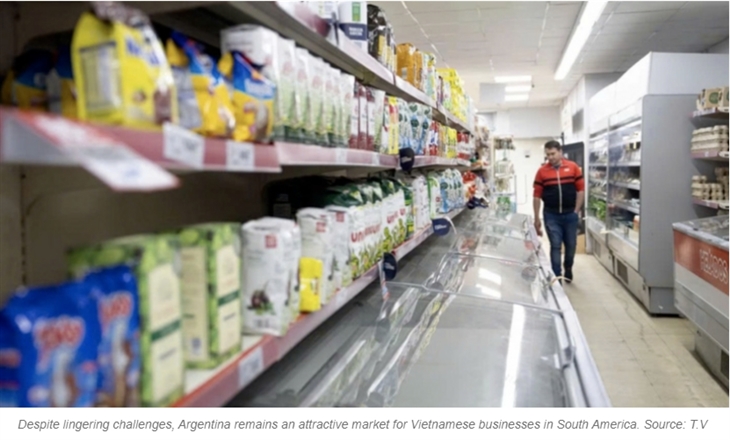
AsemconnectVietnam - Argentina is accelerating customs digitalization and easing foreign exchange controls, creating new trade opportunities while also introducing fresh compliance requirements for Vietnamese enterprises.
In the trade landscape connecting Vietnam and South America, Argentina has long represented an attractive yet complex market filled with both promise and uncertainty.
A notable paradox has emerged in recent years. While Vietnamese exporters have been actively seeking market opportunities for products ranging from high-tech goods and supporting industries to consumer products and handicrafts, Argentine businesses have remained cautious about large-scale agricultural transactions due to concerns over port procedures and international payment flows. This divergence in perspective stems not from a lack of market potential, but rather from the difficulty both sides face in navigating Argentina's rapidly evolving regulatory framework.
Entering 2026, Argentina's foreign trade environment is undergoing significant transformation as the country moves toward the complete elimination of foreign exchange controls (known as CEPO) and the full-scale operation of the ARCA super-agency. The country's trade regime is increasingly characterized by digitalization and trade liberalization. For businesses seeking to optimize cash flow and maintain control over long-distance logistics operations, a thorough understanding of the latest regulations has become essential to securing commercial advantages and ensuring the safe movement of goods across oceans.
Argentina's foreign trade policies are currently shifting dramatically toward digitalization and the removal of administrative barriers. Without a clear understanding of the differing expectations between buyers and sellers, as well as the latest legal requirements, businesses risk finding themselves at a disadvantage.
For Vietnamese companies, the greatest risk remains long-distance logistics. Maritime shipping between South America and Vietnam typically takes between 30 and 45 days. Exporters are particularly concerned about the possibility of sudden customs policy changes while cargo is already in transit, or goods being held for extended periods at Buenos Aires port for origin verification, resulting in additional costs and frozen working capital.
Argentine businesses, meanwhile, are primarily focused on foreign currency turnover. Since the Central Bank of Argentina (BCRA) abolished the mixed exchange-rate mechanism that required 100% of export proceeds to be settled at the official exchange rate, companies have been under pressure to optimize cash flow for tax obligations and production activities. Consequently, they strongly favor financially capable partners willing to commit to long-term contracts that ensure a steady inflow of U.S. dollars.
Vietnamese businesses need to stay informed
Rather than relying on assumptions during negotiations, Vietnamese companies should base their decisions on two key regulatory changes recently introduced by Argentine authorities.
First, the Customs Management and Control Agency (ARCA), in coordination with Argentina's National Single Window for Foreign Trade (VUCEA), has made the Advance Ruling on Origin mechanism mandatory.
ARCA's General Resolution No. 5859/2026 states: "The Advance Ruling mechanism aims to simplify administrative procedures, provide legal certainty to foreign trade operators before goods arrive at port, and minimize customs clearance time at national entry points."
Under this framework, importers may request Argentine customs authorities to issue a formal determination regarding tariff classification and the legality of a product's origin before shipment. Vietnamese exporters are advised to include this requirement in contractual negotiations and encourage Argentine import partners to complete the Advance Ruling on Origin process through the VUCEA system before cargo is loaded at the port of departure.
This coordinated approach can significantly reduce customs clearance time while establishing a robust legal safeguard throughout the transaction process. The maximum review period is 30 days, and the resulting ruling remains legally binding for up to three years.
Second, the Central Bank of Argentina has relaxed access to the Foreign Exchange Market (MULC) while maintaining strict timelines based on product categories.
According to BCRA Communication "A" 8226: "Except for goods subject to special regulatory treatment, payment deferral periods for ordinary imported goods are reduced to zero days from the date of customs declaration registration."
In 2026, the policy was further strengthened as the Argentine government accelerated the dismantling of historical foreign exchange controls, commonly known as the CEPO system. The comprehensive easing measures have largely eliminated the bottlenecks associated with central bank approval for international payments, a major concern for businesses in previous years.
Greater access to foreign currency helps explain why Argentine corporations and importers are now actively seeking large-scale contracts for agricultural products, supporting industry goods, and consumer products from Asia, particularly Vietnam.
The current foreign exchange payment system operates under three primary mechanisms.
For deferred-payment transactions involving ordinary goods, Argentine companies can access U.S. dollars immediately after customs clearance and transfer funds to Vietnamese suppliers without the previous 30-to-60-day waiting period.
For immediate payment transactions, the banking system automatically approves foreign currency transfers only when shipping documentation is available and the importer qualifies as a certified small or medium-sized enterprise (SME). Large corporations must use their own foreign currency resources if they wish to make immediate payments.
For advance payments or deposits, BCRA maintains strict controls to protect foreign exchange reserves. Advance payments are generally limited to 30% for machinery, equipment, and production lines, and 10% for components and spare parts.
Vietnamese exporters of consumer goods should not accept contractual clauses requiring deposits above these thresholds, as Argentine commercial banks will be unable to approve such transfers. Conversely, Vietnamese importers purchasing agricultural commodities can leverage the promise of rapid payment to negotiate more favorable prices.
Recommendations from the Vietnam Trade Office in Argentina
Based on field research and market monitoring, the Vietnam Trade Office in Argentina believes that language barriers and geographical distance remain key factors slowing business connectivity between the two countries.
Recent trade experience indicates that both sides possess strong interest in cooperation but require reliable channels for information verification before proceeding with agreements.
A representative of a Vietnamese agricultural importing company explained: "We would like to sign directly with major farm operators in Rosario to secure the most competitive corn prices. However, when communicating via email, information barriers make it difficult to distinguish between genuine warehouse owners and commercial intermediaries."
Argentine agricultural exporters have expressed similar views regarding long-term cooperation: "We are prepared to open warehouse capacity and offer preferential floor prices for Asian markets. However, to ensure confidence on both sides, we need information support and guidance from your representative office in Buenos Aires."
In light of these realities, the Trade Office recommends that Vietnamese businesses verify the legal status, customs clearance history, and actual warehousing capacity of Argentine agricultural suppliers before making any deposits. This proactive approach helps safeguard capital while laying a solid foundation for long-term cooperation.
Companies should also carefully assess any requests for payment upon presentation of shipping documents and ensure compliance with current BCRA regulations.
Furthermore, Vietnamese enterprises are encouraged to request and verify SME certification through official Argentine channels. Such certification constitutes the only legal basis for automatic approval of immediate-payment transactions within Argentina's banking system, effectively eliminating the risk of payment delays for eligible companies.
Source: ven.congthuong.vn/argentina-s-new-regulations-prompt-vietnam-trade-office-recommendations-for-vietnamese-businesses-59407.html
ASEAN, Russia should create more stable, balanced, and sustainable environment: Prime Minister Le Minh Hung
Vietnam - Australia strengthen cooperation in electricity regulation
UAE: A strategic gateway for Vietnamese goods to Middle East and global markets
Vietnam and UK deepen economic and energy cooperation
Vietnam enhances export promotion efforts to meet double-digit growth goal
Vietnam participates in WTO review of Uruguay's trade policy
Singaporean businesses explore investment opportunities at VSIP Can Tho
Vietnamese food products gain prominence at RoK's leading food fair
Green transition creates fresh opportunities for Vietnam–Canada partnership
Can Tho invites Singaporean firms to invest in industry, energy, logistics
Deputy PM calls for integrated ASEAN fintech ecosystem
Phu Tho expands cooperation with Chinese localities
Deputy PM receives IMF Asia-Pacific Director
Digital economy fuels new growth momentum in Vietnam: French daily

Place preserving memories of President Ho Chi Minh in ...
Although there is little publicly available documentation confirming exactly when Place Ho Chi Minh was established, French urban ...Vietnamese leaders pay tribute to President Ho Chi Minh on ...
16th NA reviews amendments to four tax-related laws on ...
General Secretary, State President praises ethnic minority ...
National conference disseminates resolution of 14th Party ...
General plan task of Can Tho City until 2050 with a vision ...
General plan of Can Tho city is based on viewpoint of inheritance and development, in accordance with the Party's Resolutions on ...International market expansion program in a period of ...
Public debt borrowing and repayment plan for 2026

Tourism destinations refresh offerings to welcome New ...
Across the Mekong Delta, many tourist sites have been busy upgrading their offerings. At the Con Son tourism site in Can Tho city, members ...Annual New Year festival shines in Da Nang
Phu Quoc emerging as a favourite global destination
Vietnam Airlines adds 270 flights to during 2026 New Year ...
