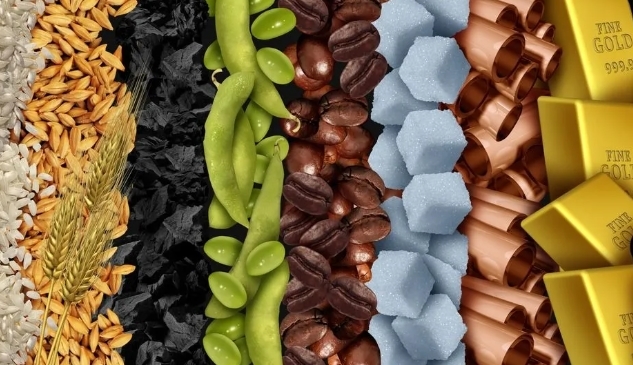
AsemconnectVietnam - Vietnam’s commodity markets on May 11, 2026, reflected diverging trends as domestic gold prices declined sharply, while agricultural commodities were supported by tightening supply conditions. Rice and rubber maintained stable trading momentum and export advantages, whereas coffee and durian experienced significant divergence due to mixed impacts from domestic supply and international quality barriers.
Domestic gold prices dropped sharply throughout the session
Domestic gold prices recorded a steep decline across all major brands and product categories during the trading session.
By the close, SJC gold bars were listed at 162.2–165.2 million dong per tael (buying – selling), down 2.3 million dong per tael on both sides compared to the previous weekend’s close.
SJC gold rings (1–5 chi) also fell by 2.3 million dong per tael, settling at 161.7–164.7 million dong per tael. Similarly, 9999 pressed gold rings from Bao Tin Manh Hai were quoted at 162.2–165.1 million dong per tael, marking the same level of decline.
Bao Tin Minh Chau’s plain gold rings dropped by 2.3 million dong per tael to 162.2–165.2 million dong per tael.
During intraday trading, prices continued to weaken. At 1:14 p.m., SJC gold bars declined by an additional 700,000 dong per tael, maintaining the range of 162.2–165.2 million dong per tael. Gold rings followed a similar trajectory.
Earlier in the session, by mid-morning, prices had already fallen by around 1.6 million dong per tael compared to the previous close. At the opening (8:38 a.m.), SJC initially reduced prices by 500,000 dong per tael to 164–167 million dong per tael, signaling sustained downward pressure throughout the day.
Domestic coffee prices moved sideways amid mixed global signals
Domestic coffee prices remained largely unchanged across the Central Highlands.
Dak Nong (Lam Dong area) continued to lead the market at 87,300 dong per kg, while Dak Lak and Gia Lai traded at around 87,100 dong per kg.
On international markets, coffee prices showed mixed movements. On the London exchange, robusta coffee futures for July 2026 increased by 1.5% to 3,414 USD per ton, while the September contract rose to 3,302 USD per ton.
In contrast, arabica prices on the New York exchange declined sharply under pressure from expectations of a large harvest in Brazil. The July 2026 contract fell by 4.3% to 274.15 US cents per pound, while the September contract dropped to 266.3 US cents per pound.
This divergence reflected contrasting supply outlooks between robusta and arabica segments.
Pepper prices held firm at high levels
Domestic pepper prices showed slight increases in some regions after a prolonged period of stability, trading within a range of 141,000 to 144,000 dong per kg.
Dak Lak and Dak Nong (Lam Dong area) maintained the highest levels at 144,000 dong per kg. Dong Nai recorded a modest increase of 500 dong per kg to 142,500 dong per kg, matching Ba Ria–Vung Tau (Ho Chi Minh City area).
Gia Lai posted the strongest gain, rising by 1,000 dong per kg to 141,000 dong per kg.
Globally, pepper prices remained largely stable, except for a slight decline in Indonesia, where black pepper fell by 11 USD per ton to 6,955 USD per ton. Brazil’s ASTA 570 remained unchanged at 6,100 USD per ton, while Malaysian pepper held steady at around 9,300 USD per ton.
Vietnam’s white pepper remained stable at 9,000 USD per ton, while Malaysia maintained 12,200 USD per ton. Indonesia’s Muntok white pepper edged down to 9,164 USD per ton.
Limited global supply continued to underpin high price levels.
Rice trading slowed while export prices remained elevated
Rice markets in the Mekong Delta experienced slower trading activity as fresh paddy supply became increasingly scarce. Transactions were subdued in provinces such as Ca Mau, An Giang, Can Tho, Dong Thap, and Vinh Long.
However, supply tightness helped sustain prices for high-quality varieties. OM 18 and Dai Thom 8 traded at 6,200–6,300 dong per kg. OM 5451 ranged between 5,600 and 5,700 dong per kg, while IR 50404 stood at 5,400–5,500 dong per kg.
On the export side, Vietnamese rice continued to command premium pricing due to stable international demand. Fragrant rice (5% broken) was quoted at 510–520 USD per ton, significantly higher than Thailand’s 396–400 USD per ton and India’s 345–349 USD per ton.
Jasmine rice exports ranged between 513 and 517 USD per ton, while 100% broken rice stood at 331–335 USD per ton.
Durian prices showed strong divergence
Durian prices displayed significant variation across segments.
Ri6 durian recorded slight increases at warehouse levels, while Thai durian maintained high prices but experienced slower transactions due to stricter quality inspections following early seasonal rains.
In the Mekong Delta, Thai durian VIP grade A was priced at 85,000 dong per kg, while grade B stood at 65,000 dong per kg. Standard Thai grade A traded at 80,000 dong per kg and grade B at 60,000 dong per kg.
Musang King grade A remained stable at around 88,000 dong per kg in both the Mekong Delta and Binh Phuoc.
Notably, Black Thorn durian grade A reached as high as 120,000 dong per kg in the Mekong Delta, with grade B at 95,000 dong per kg.
For Ri6, grade A ranged from 41,000 to 46,000 dong per kg in the Mekong Delta, while grade B stood at 26,000–29,000 dong per kg. In Tay Ninh and Dong Nai, Ri6 grade A was traded at 43,000–46,000 dong per kg.
The divergence reflected differences in quality standards, export requirements, and supply conditions across segments.
Rubber prices remained stable domestically amid global fluctuations
Global rubber markets recorded mixed movements. On the Tokyo exchange, RSS3 rubber futures for May 2026 declined slightly by 0.10 yen per kg to 396 yen per kg.
Meanwhile, the Shanghai exchange extended gains, with May 2026 contracts reaching 17,880 yuan per ton and June contracts rising to 17,965 yuan per ton. In Singapore, TSR20 rubber increased to around 220–221 US cents per kg.
Market forecasts indicated that global rubber production would reach approximately 15.3 million tons this year, while consumption could rise to 15.6 million tons, suggesting a potential supply deficit for the sixth consecutive year.
Domestically, procurement prices remained stable. Ba Ria Rubber Company purchased latex at 420 dong per TSC per kg and raw latex at 18,100 dong per kg. Phu Rieng maintained prices at 390 dong per DRC and 420 dong per TSC.
Mang Yang purchased latex at 458–463 dong per TSC per kg and coagulated rubber at 404–459 dong per DRC, while Binh Long maintained latex prices at 432 dong per TSC per kg.
Live hog prices rose across regions
Live hog prices increased nationwide, ranging between 67,000 and 71,000 dong per kg.
In the south, prices remained stable but continued to lead the country. Dong Nai held the highest level at 71,000 dong per kg, followed by Ho Chi Minh City at 70,000 dong per kg. Tay Ninh, Dong Thap, and Vinh Long traded at 69,000 dong per kg, while An Giang, Ca Mau, and Can Tho stood at 68,000 dong per kg.
The strongest upward momentum was observed in the north, where multiple provinces recorded increases of 1,000 dong per kg. Bac Ninh, Hanoi, and Hung Yen reached 69,000 dong per kg, while Thai Nguyen, Quang Ninh, and Hai Phong rose to 68,000 dong per kg. Other provinces such as Tuyen Quang, Cao Bang, and Lang Son traded at 67,000 dong per kg.
Central and Central Highlands regions also saw gains. Nghe An and Ha Tinh increased to 67,000 dong per kg, while Lam Dong maintained the highest regional level at 69,000 dong per kg. Dak Lak remained stable at 68,000 dong per kg.
Overall market outlook
Vietnam’s commodity markets on May 11, 2026, reflected a clear divergence between precious metals and agricultural commodities. While gold prices came under heavy selling pressure, agricultural markets were largely supported by tightening supply conditions and stable export demand.
Rice and rubber continued to provide stability, while coffee and durian showed mixed performance depending on global signals and quality constraints. The steady rise in live hog prices further reinforced confidence among producers, suggesting continued resilience across Vietnam’s agricultural sector.
Source: Vitic