


Vietnam commodities market on April 28: Coffee faced macro pressure, durian prices diverged sharply, gold decreased
Tuesday, April 28,2026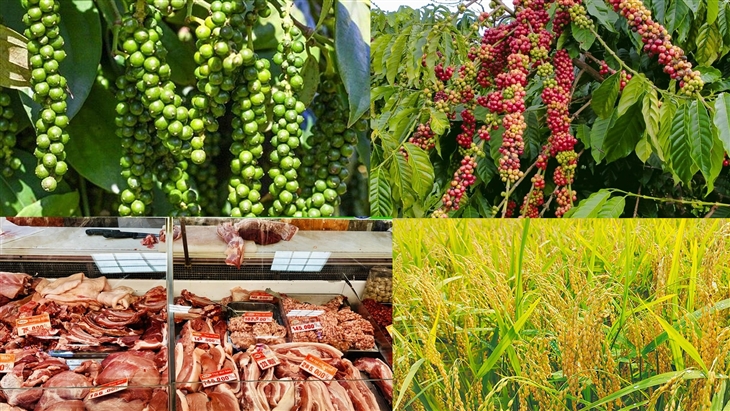
AsemconnectVietnam - Vietnam’s agricultural commodities market on April 28 showed a pause in domestic coffee prices amid growing concerns over global supply, while pepper consolidated at elevated levels and durian prices displayed a sharp divide between premium and lower-grade segments.
Coffee traders remained cautious after previous losses, as expectations of a larger Brazilian crop weighed on international futures markets. Pepper held firm despite slower transactions, rice trading softened during the holiday period, and live hog prices stayed strong nationwide.
Domestic gold prices
On April 28, 2025, international gold prices extended their decline, falling below the USD 3,300 per ounce threshold. In line with the global trend, Vietnam’s domestic gold market saw notable decreases, with SJC gold bars and plain gold rings dropping by VND1.5 million per tael, bringing the selling price to around VND119.5 million per tael.
By the close, SJC gold bars were quoted at VND117.5–119.5 million per tael (bid–ask), down VND1.5 million per tael on both buying and selling sides compared to the previous weekend’s close.
SJC gold rings (1–5 chi, equivalent to 3.75–18.75 grams) were listed at VND112.5–115 million per tael (bid–ask), also declining by VND1.5 million per tael on both sides versus the prior weekly close.
Similarly, DOJI’s 9999 gold rings closed at VND112.5–115 million per tael, down VND 1.5 million per tael on both buying and selling sides compared to the previous weekend.
During the midday session, SJC’s 9999 gold was further reduced by VND1 million per tael on both sides compared to the morning session, to VND117.5–119.5 million per tael (bid–ask).
Gold ring prices were also revised downward at midday. SJC and DOJI both cut prices by an additional VND 1 million per tael on both buying and selling sides versus the morning session, to VND112.5–115 million per tael.
Earlier in the morning, domestic gold ring prices had already been adjusted lower in line with global market movements. SJC initially quoted its 1–5 chi gold rings at VND113.5–116 million per tael (bid–ask), down VND500,000 per tael on both sides compared to the previous weekend’s close.
Coffee Traded Sideways as Global Supply Pressure Intensified
Vietnam’s domestic coffee market entered in a steady but cautious mood, reflecting hesitation from both sellers and buyers after the recent correction.Domestic gold prices
On April 28, 2025, international gold prices extended their decline, falling below the USD 3,300 per ounce threshold. In line with the global trend, Vietnam’s domestic gold market saw notable decreases, with SJC gold bars and plain gold rings dropping by VND1.5 million per tael, bringing the selling price to around VND119.5 million per tael.
By the close, SJC gold bars were quoted at VND117.5–119.5 million per tael (bid–ask), down VND1.5 million per tael on both buying and selling sides compared to the previous weekend’s close.
SJC gold rings (1–5 chi, equivalent to 3.75–18.75 grams) were listed at VND112.5–115 million per tael (bid–ask), also declining by VND1.5 million per tael on both sides versus the prior weekly close.
Similarly, DOJI’s 9999 gold rings closed at VND112.5–115 million per tael, down VND 1.5 million per tael on both buying and selling sides compared to the previous weekend.
During the midday session, SJC’s 9999 gold was further reduced by VND1 million per tael on both sides compared to the morning session, to VND117.5–119.5 million per tael (bid–ask).
Gold ring prices were also revised downward at midday. SJC and DOJI both cut prices by an additional VND 1 million per tael on both buying and selling sides versus the morning session, to VND112.5–115 million per tael.
Earlier in the morning, domestic gold ring prices had already been adjusted lower in line with global market movements. SJC initially quoted its 1–5 chi gold rings at VND113.5–116 million per tael (bid–ask), down VND500,000 per tael on both sides compared to the previous weekend’s close.
Coffee Traded Sideways as Global Supply Pressure Intensified
Across the Central Highlands, farmgate prices were largely unchanged at VND87,500 to VND88,000 per kg.
Dak Lak, Gia Lai and Dak Nong, now under Lam Dong administration, were all reported at VND88,000 per kg.
While the domestic market remained calm, overseas coffee futures came under notable pressure.
At the close of April 27 trading, coffee markets on both the London and New York exchanges posted sharp losses.
July 2026 robusta coffee futures in London fell 1.57%, equivalent to $55 per ton, to settle at $3,428 per ton.
September 2026 robusta contracts declined even more sharply, losing 1.73%, or $59 per ton, to $3,344 per ton.
Arabica coffee futures in New York also weakened, losing 6.4 U.S. cents per pound to close at 288.5 cents per pound.
The main factor overshadowing sentiment was a series of upward production forecasts for Brazil’s upcoming crop year.
Market estimates suggested Brazil’s new harvest could reach as much as 75 million bags, raising concerns that the global market may face an oversupply of around 10 million bags in 2026.
That prospect encouraged speculative selling and prompted traders to reduce long positions.
Despite weaker futures prices, Vietnamese exporters said domestic coffee supply remained relatively tight, limiting the pace of local declines.
Vietnam, the world’s largest robusta exporter, remained highly sensitive to moves in London futures, though farmer selling was still selective at current price levels.
Pepper Consolidated at High Levels
After an extended rally earlier in the season, Vietnam’s pepper market entered what traders described as a healthy consolidation phase.
No major price adjustments were reported across key producing regions, with domestic prices holding in a range of VND138,000 to VND142,000 per kg.
Dak Nong (Lam Dong) remained the country’s highest-priced buying zone at VND142,000 per kg.
Dak Lak followed closely at VND141,000 per kg, while Ho Chi Minh City and Dong Nai were steady at VND140,000 per kg.
Gia Lai posted the lowest level at VND138,000 per kg.
Trading activity was reported as subdued, with both buyers and sellers adopting a wait-and-see stance after the recent rise.
On global markets, pepper prices were broadly stable.
Indonesian black pepper held at $7,007 per ton.
Brazilian pepper was unchanged at $6,000 per ton, while Malaysian pepper stood at $9,300 per ton.
Vietnamese black pepper exports continued to command firm values at $6,100 to $6,200 per ton.
Exporters said the pricing suggested that global supply and demand remained broadly balanced, while Vietnam continued to benefit from reliable shipment volumes and established customer relationships.
Some traders added that limited carryover stocks in several producing countries could keep prices supported in the medium term.
Rice Trading Slowed During Holiday Period
The Mekong Delta rice market moved at a slower pace due to the extended holiday period, with transactions described as thin across several provinces.
In An Giang, Can Tho and Dong Thap, buying activity weakened as unharvested paddy supply diminished and farmers preferred to hold out for higher prices.
Fresh Dai Thom 8 and OM 18 paddy were quoted at VND6,000 to VND6,100 per kg.
OM 5451 remained at VND5,600 to VND5,700 per kg.
IR 50404 was traded at VND5,400 to VND5,500 per kg.
Although domestic trading slowed, Vietnam’s export rice sector remained competitive.
Vietnamese 5% broken rice was offered at $490 to $500 per ton.
That compared favorably with Thai rice at $388 to $392 per ton and Indian rice at $346 to $350 per ton.
Premium aromatic rice categories also held steady.
Jasmine rice and fully fragrant grades maintained stable quotations, helping reinforce Vietnam’s competitive position in higher-value rice segments.
Exporters said steady demand from traditional Asian and African buyers continued to underpin sentiment, while Vietnam’s reputation for quality fragrant rice supported price premiums.
Durian Showed a Clear Two-Tier Market
Durian prices at warehouse purchasing centers highlighted a pronounced divide based on variety and quality.
Premium Thai durian in the Mekong Delta continued to command strong prices.
VIP Thai Grade A fruit traded at VND118,000 to VND125,000 per kg.
However, lower-grade Thai Grade C fruit fell sharply to around VND60,000 to VND65,000 per kg.
Ri6 durian was significantly cheaper.
Grade A Ri6 was purchased at only VND55,000 to VND60,000 per kg.
Grade C Ri6 slipped further to VND28,000 to VND32,000 per kg.
The pricing gap illustrated how buyers increasingly prioritized appearance, uniformity, sweetness and export suitability.
In the premium imported-variety segment, Musang King Grade A was sought after at VND105,000 to VND110,000 per kg.
Black Thorn Grade A reached VND135,000 to VND145,000 per kg, confirming continued demand for niche high-end durian varieties.
Traders said the market had become more segmented than in previous years, with export-linked premium fruit retaining value while lower-grade domestic fruit faced oversupply pressure.
Durian has become one of Vietnam’s fastest-growing fruit exports, particularly to China, and market pricing is increasingly shaped by warehouse standards and cross-border demand.
Live Hog Prices Stayed Strong
Vietnam’s live hog market remained broadly stable, with only limited upward movement in central provinces.
Northern Vietnam held steady in a range of VND64,000 to VND66,000 per kg.
Hung Yen continued to lead the region.
In central Vietnam and the Central Highlands, Nghe An rose by VND1,000 per kg to VND65,000 per kg.
Lam Dong remained one of the strongest markets nationwide at VND69,000 per kg.
Southern Vietnam continued to outperform all other regions, with no province trading below VND68,000 per kg.
Dong Nai, Dong Thap, Vinh Long, Can Tho and Ho Chi Minh City all held at the ceiling level of VND69,000 per kg.
Producers said firm consumer demand and controlled supply were helping maintain favorable returns for livestock farmers.
Market Outlook
Vietnam’s agricultural commodities market on April 28 reflected diverging fundamentals across sectors.
Coffee remained under pressure from expectations of larger global supply, particularly from Brazil, although domestic prices stabilized after earlier declines.
Pepper held firm at elevated levels and continued to benefit from balanced global fundamentals.
Rice trading slowed due to the holiday period, but export quotations stayed highly competitive.
Durian prices became increasingly segmented, with premium fruit retaining strong value while lower-grade varieties weakened sharply.
Live hog prices remained resilient, especially in southern provinces.
Looking ahead, traders expected market direction to depend on export demand, currency movements, weather developments and post-holiday trading activity.
Source: Vitic
Vietnam’s cement and clinker exports totaled 9.99 million tonnes in first quarter of 2026
Consolidated document on conditions for assembling and importing automobiles issued
Exports of cassava and cassava products increased in first quarter of 2026
Vietnam’s petroleum imports increased by 76.74% in first quarter of 2026
CPI up 0.84% in April on rising energy, dining costs
Imports of computers, electronics, and components increased in first quarter of 2026
Hanoi's supporting industries face challenges to get double-digit growth
Technology bolsters growth confidence among Vietnam’s small businesses
Vietnam's industry spearheads transition to circular economy
Vietnam ranks 18th among world’s top exporters in 2025
Leading LNG import markets in first quarter of 2026
Vietnam-Singapore trade exchange increased strongly
Vietnam’s property market buoyed by domestic strength, infrastructure push
Vietnam’s Q1 e-commerce revenue jumps 47% to 5.7 billion USD on Shopee, TikTok Shop, Lazada
