


Agricultural commodities market on April 22: Coffee surged on global momentum
Wednesday, April 22,2026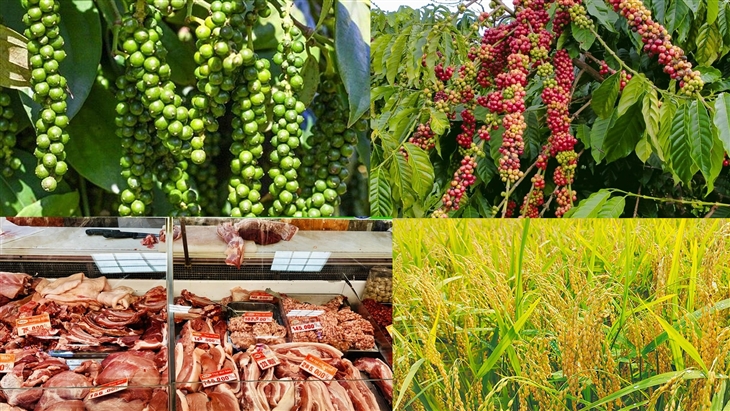
AsemconnectVietnam - Vietnam’s agricultural commodities market on April 22, 2026, presented a mixed landscape, with coffee prices rallying sharply in line with global trends, while durian continued to languish under mounting supply pressure. Meanwhile, rice, rubber, and pepper maintained relatively stable trading conditions, and live hog prices held firm at elevated levels nationwide.
Coffee prices accelerated on both domestic and international markets
Domestic coffee prices recorded a strong upward movement, supported by tightening supply sentiment and bullish expectations among farmers. Across the Central Highlands, farmgate prices rose by 2,000–2,100 dong per kilogram compared to the previous session, lifting the average trading range to between 86,800 and 87,600 dong per kilogram.
Dak Nong province (now administratively merged into Lam Dong) led the region, with prices reaching 87,600 dong per kilogram. Dak Lak and Gia Lai followed closely, both recording 87,300 dong per kilogram. Market participants reported that farmers had actively withheld supply, anticipating further upside in the current price cycle.
On the global stage, coffee markets moved higher across major exchanges. Robusta futures on the London exchange for May delivery climbed by $94 per metric ton to $3,482 per ton. The July contract posted an even stronger gain of $113 per ton, settling at $3,376 per ton. Arabica prices on the New York exchange also recovered, with the May contract rising 1% to 292.2 US cents per pound.
Analysts attributed the rally to escalating geopolitical tensions in the Middle East, particularly around the Strait of Hormuz, which had driven up shipping and insurance costs. These factors indirectly supported commodity prices, including coffee, by tightening global supply chains.
Durian prices remained under pressure amid weak demand
In contrast, Vietnam’s durian market continued to face downward pressure, as abundant supply and sluggish demand weighed heavily on prices.
Ri6 durian bore the brunt of the decline. Grade A fruit in the Mekong Delta region traded at just 56,000–60,000 dong per kilogram, while Grade B dropped further to 40,000–41,000 dong per kilogram.
Even premium Musang King durian failed to escape the broader downtrend, with Grade A prices ranging between 106,000 and 108,000 dong per kilogram due to slow consumption.
Thai durian varieties also weakened. Premium Grade A fruit was quoted at 120,000 dong per kilogram, while Grade B stood at around 100,000 dong per kilogram. Standard Grade A and B categories hovered at 100,000–105,000 dong per kilogram, and 80,000–85,000 dong per kilogram, respectively.
Lower-quality and off-grade fruit segments continued to deteriorate, falling to between 45,000 and 80,000 dong per kilogram depending on quality.
Among specialty varieties, Black Thorn durian maintained the highest price at approximately 145,000 dong per kilogram for Grade A, while Sau Huu and Chuong Bo varieties ranged from 75,000 to 95,000 dong per kilogram.
Rice market showed signs of improvement from domestic to export channels
Vietnam’s rice market displayed modest gains, supported by both domestic price adjustments and strong export competitiveness.
Data from the An Giang Department of Agriculture indicated that raw rice prices edged up slightly. IR50404 and CL555 varieties rose by 50–100 dong per kilogram to reach 8,100–8,200 and 8,150–8,250 dong per kilogram, respectively.
Processed IR50404 rice saw a more notable increase of 300 dong per kilogram, climbing to 10,750–10,900 dong per kilogram. Higher-grade varieties such as OM18, Dai Thom 8, and OM5451 remained stable.
Fresh paddy prices in the Mekong Delta held steady as the Winter-Spring harvest entered its peak phase. OM18 and Dai Thom 8 paddy traded between 6,000 and 6,200 dong per kilogram. However, trading activity was relatively subdued, with traders cautious in placing new orders.
On the export front, Vietnam continued to strengthen its position. Fragrant rice with 5% broken content was offered at USD490–500 per ton, significantly higher than comparable Thai rice at USD386–390 per ton and Indian rice at USD342–346 per ton.
Rubber benefited from higher oil prices and global demand
Global rubber markets extended their upward trend, supported by rising crude oil prices and improving demand fundamentals.
In Japan, rubber futures for May delivery increased by 0.6% to 380.3 yen per kilogram. Markets in Shanghai and Singapore also posted gains, with nearby contracts rising between 1.3% and 2%.
Reflecting international trends, major domestic rubber companies maintained stable procurement prices to support production chains. Phu Rieng Rubber Company set prices for mixed latex at 390 dong per DRC and fresh latex at 420 dong per TSC.
Other firms, including Mang Yang, Binh Long, and Ba Ria Rubber Companies, held steady purchasing ranges between 420 and 463 dong per TSC.
This pricing strategy was seen as a proactive measure to stabilize farmer sentiment ahead of the upcoming tapping season.
Pepper market remained in consolidation phase
Vietnam’s pepper sector entered a period of sideways movement, with domestic prices stabilizing between 139,500 and 141,000 dong per kilogram.
Dak Lak and Dak Nong (Lam Dong) continued to command the highest prices at 141,000 dong per kilogram. Ho Chi Minh City and Dong Nai recorded 140,000 dong per kilogram, while Gia Lai posted the lowest level at 139,500 dong per kilogram.
The steady pricing reflected a temporary equilibrium between supply and demand following the harvest season.
Globally, pepper prices also showed limited movement. Indonesian black pepper edged up to USD7,048 per ton, while Brazilian and Malaysian products remained unchanged at USD6,000 and USD9,300 per ton, respectively.
Vietnamese black pepper exports held competitive levels at USD6,100–6,200 per ton, reinforcing the country’s strong position despite narrow global trading ranges.
Live hog prices held firm at high levels nationwide
The live hog market remained stable across Vietnam, with prices maintaining a ceiling of 69,000 dong per kilogram.
In the northern region, prices showed no significant changes. Hung Yen led at 66,000 dong per kilogram, while Lai Chau recorded the lowest level at 63,000 dong per kilogram.
Central and Central Highlands regions also remained steady, with prices ranging from 63,000 to 69,000 dong per kilogram, with Lam Dong reaching the upper limit.
Strong consumption continued to support the southern market, which retained its leading position. Key livestock hubs such as Dong Nai, Tay Ninh, Dong Thap, Ho Chi Minh City, and Vinh Long all recorded prices at 69,000 dong per kilogram. Other provinces, including Ca Mau, An Giang, and Can Tho, traded slightly lower at 67,000–68,000 dong per kilogram.
Overall, the agricultural commodities market on April 22 reflected divergent trends, with coffee emerging as the standout performer amid global uncertainties, while durian remained under pressure. Other sectors demonstrated resilience, maintaining stability despite broader market fluctuations.
Source: Vitic
Iron and steel imports in first quarter of 2026
Wood and wood product export markets in first quarter of 2026
Agricultural market update – April 21, 2026
Vietnam's industry spearheads transition to circular economy
National branding seen as strategic lever to elevate Vietnam’s global value chain position
Vietnam’s footwear exports in first quarter of 2026
Textile and garment exports in first quarter of 2026
Deputy PM orders sweeping administrative reform, cutting red tape by half
De Heus–Hung Nhon alliance eyes high-tech agricultural chain in Can Tho
Reform of state-owned enterprises seen as key driver of economic growth
Reference exchange rate rises slightly at week’s beginning
Vietnam seeks stable jet fuel supplies from China amid Middle East disruptions
Agricultural Commodities Market Update – April 20
Nearly 100 tonnes of Vietnamese fruits, vegetables airlifted to UAE
