


Agricultural market update – April 21, 2026
Tuesday, April 21,2026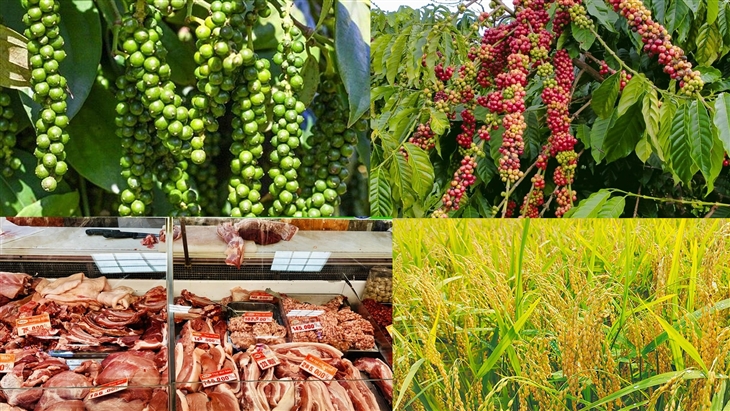
AsemconnectVietnam - Vietnam’s agricultural markets showed mixed movements on April 21, 2026, as domestic coffee prices edged up slightly in a technical rebound, while durian prices retreated from earlier peaks. Other key commodities, including rice, pepper, rubber and live hogs, remained largely stable, reflecting a consolidation phase across major sectors.
Coffee posts mild recovery amid lingering pressure
Vietnam’s domestic coffee market recorded a modest uptick following a period of subdued trading. In the Central Highlands, the country’s main coffee-growing region, farmgate prices rose by approximately 300 dong per kilogram compared with the previous day, bringing the average range to around 84,800–85,500 dong per kg.
Dak Nong province (now administratively merged into Lam Dong) led the market with prices reaching 85,500 dong per kg. Dak Lak and Gia Lai followed closely at 85,300 dong per kg. Market participants attributed the increase largely to a technical correction, as underlying demand remained relatively weak with no significant surge in buying activity.
On the global stage, divergent trends continued between the two major coffee varieties. Robusta futures on the London exchange extended gains, with the May 2026 contract settling at $3,388 per tonne, up 1.9% from the previous week. The July contract also edged higher to $3,263 per tonne.
In contrast, arabica prices on the New York exchange declined sharply. The May 2026 contract fell 3.6% to 289.3 U.S. cents per pound, while the July contract dropped 3.9% to 284.25 cents per pound.
According to Vietnam’s Ministry of Industry and Trade, the downward pressure in global markets had been driven by expectations of increased supply from major producers such as Brazil and Vietnam, while consumption demand had yet to recover as anticipated.
Pepper prices hold firm near peak levels
Vietnam’s domestic pepper market remained stable, with prices hovering between 139,000 and 141,000 dong per kg.
Key producing areas such as Dak Lak and Dak Nong continued to command the highest prices at around 141,000 dong per kg. Meanwhile, Dong Nai and Ho Chi Minh City recorded transactions at approximately 140,000 dong per kg, while Gia Lai posted slightly lower levels at 139,500 dong per kg.
The sideways movement reflected a temporary balance between supply and demand. Although supply had increased toward the end of the harvest season, with total output estimated at around 160,000 tonnes, export demand remained supportive.
Globally, pepper prices showed limited fluctuations. Data from the International Pepper Community indicated Indonesian black pepper at $7,043 per tonne, while Brazil’s ASTA 570 grade stood at around $6,000 per tonne. Malaysian black pepper was quoted higher at approximately $9,300 per tonne.
Vietnam’s black pepper export prices held steady in the range of $6,100–6,200 per tonne for 500 g/l and 550 g/l grades. In the white pepper segment, Indonesia’s Muntok variety was priced at around $9,279 per tonne, while Vietnamese and Malaysian white pepper remained at $9,000 and $12,200 per tonne, respectively.
Durian prices declined, Musang King retains premium
Durian prices across Vietnam fell broadly, particularly for Thai and Ri6 varieties, which had previously reached record highs earlier in the year.
In the Mekong Delta, Thai durian Grade A (VIP) dropped to between 125,000 and 140,000 dong per kg, while Grade B ranged from 110,000 to 125,000 dong per kg. Lower-quality grades saw sharper declines, with Grade C priced at 90,000–105,000 dong per kg.
Substandard and off-grade products fell significantly, with prices dropping to as low as 20,000–60,000 dong per kg depending on quality.
Ri6 durian followed a similar trend, with Grade A falling to 70,000–85,000 dong per kg and Grade B to 60,000–70,000 dong per kg.
Despite the overall downturn, premium varieties such as Musang King continued to command strong demand. Grade A Musang King was traded at 140,000–180,000 dong per kg, maintaining its position as the highest-priced segment in the market. Other premium cultivars, including Black Thorn, also held relatively high levels.
Rice market remains steady amid thin trading
Vietnam’s rice market remained subdued, with limited trading activity as supply tightened toward the end of the harvest season.
According to data from An Giang province, fresh paddy prices were largely unchanged. OM 18 traded at 6,000–6,200 dong per kg, while Dai Thom 8 ranged from 6,000 to 6,100 dong per kg. Lower-grade varieties such as IR 50404 were priced at 5,500–5,600 dong per kg.
Export-grade rice maintained firm levels. Dai Thom 8 was quoted at 9,150–9,450 dong per kg, while OM 18 ranged from 8,700 to 8,850 dong per kg.
In export markets, Vietnamese rice prices remained competitive. Five-percent broken fragrant rice was priced at $490–500 per tonne, while Jasmine rice stood at $465–469 per tonne.
Vietnam’s 5% broken white rice traded at $376–380 per tonne, slightly below Thailand’s $395–399 per tonne but significantly higher than Pakistan’s $356–360 and India’s $342–346 per tonne. India’s parboiled rice remained stable at $344–348 per tonne.
Rubber gains on global momentum
Global rubber markets posted gains across major exchanges in Tokyo, Shanghai and Singapore.
On the Tokyo Commodity Exchange (TOCOM), the April 2026 contract rose 0.88% to 378.30 yen per kg, while the July contract recorded the strongest increase, up 1.78% to 388.90 yen per kg.
The upward trend extended to Shanghai and Singapore markets, where contracts for delivery between May and September 2026 also moved higher.
The global rally was expected to lend support to domestic rubber prices as import demand from major consuming countries improved.
In Vietnam, domestic rubber prices remained stable. Mang Yang Rubber Company quoted latex at 463 dong per TSC/kg for Grade 1 and 458 dong per TSC/kg for Grade 2. Phu Rieng Rubber maintained purchasing prices at 420 dong per TSC/kg for latex and 390 dong per DRC/kg for processed rubber.
Live hog prices unchanged nationwide
Vietnam’s live hog market showed no new fluctuations, with prices holding steady across regions.
In the north, prices ranged between 63,000 and 66,000 dong per kg, with Hung Yen recording the highest level at 66,000 dong per kg. Hanoi, Bac Ninh and Hai Phong followed at 65,000 dong per kg.
Central and Central Highlands regions also remained stable, with prices fluctuating between 63,000 and 69,000 dong per kg. Lam Dong led the region at 69,000 dong per kg, while Ha Tinh posted the lowest level at 63,000 dong per kg.
The southern region continued to report the highest prices nationwide, ranging from 67,000 to 69,000 dong per kg. Key provinces including Dong Nai, Tay Ninh and Ho Chi Minh City maintained peak levels at 69,000 dong per kg.
Overall, the agricultural market on April 21 reflected a period of consolidation, with most commodities stabilizing after recent volatility, while selective sectors such as coffee and rubber showed early signs of recovery.
Source: Vitic
National branding seen as strategic lever to elevate Vietnam’s global value chain position
Vietnam’s footwear exports in first quarter of 2026
Textile and garment exports in first quarter of 2026
Deputy PM orders sweeping administrative reform, cutting red tape by half
De Heus–Hung Nhon alliance eyes high-tech agricultural chain in Can Tho
Reform of state-owned enterprises seen as key driver of economic growth
Reference exchange rate rises slightly at week’s beginning
Vietnam seeks stable jet fuel supplies from China amid Middle East disruptions
Agricultural Commodities Market Update – April 20
Nearly 100 tonnes of Vietnamese fruits, vegetables airlifted to UAE
Finance ministry eyes flexible tax thresholds
Imports of machinery and equipment in first quarter of 2026
Animal feed exports and imports in first quarter of 2026
Agricultural Commodities Market Update – April 19
