


Agricultural Commodities Market Update – April 20
Monday, April 20,2026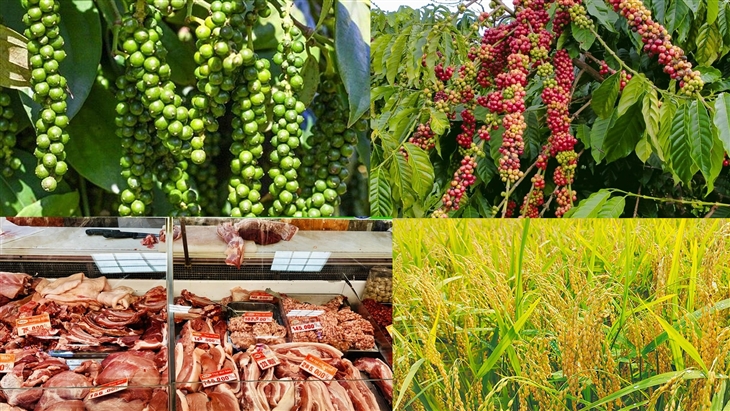
AsemconnectVietnam - On April 20, 2026, Vietnam’s agricultural commodities market exhibited strong divergence across key product groups, reflecting a complex interplay of supply dynamics and global influences. While coffee and durian prices continued to decline under the weight of fresh supply, pepper showed early signs of recovery. Meanwhile, rice exports and live hog prices maintained stable levels, reinforcing confidence among producers and traders.
Coffee prices extended their downward trend in the domestic market following a prolonged period of correction that had lasted nearly a month. At the start of the new trading week, cautious sentiment prevailed as buying interest remained weak, while farmers hesitated to sell at price levels below expectations. In the Central Highlands, farmgate prices fluctuated within the range of 84,500 to 85,200 dong per kg, declining by an additional 600 to 700 dong per kg compared to the previous week.
Dak Nong (now administratively part of Lam Dong) continued to record the highest purchasing price nationwide at 85,200 dong per kg, while Dak Lak and Gia Lai traded at approximately 85,000 dong per kg. Physical trading activity remained subdued, reflecting a tendency among farmers to hold back inventory in anticipation of a potential technical rebound.
Dak Nong (now administratively part of Lam Dong) continued to record the highest purchasing price nationwide at 85,200 dong per kg, while Dak Lak and Gia Lai traded at approximately 85,000 dong per kg. Physical trading activity remained subdued, reflecting a tendency among farmers to hold back inventory in anticipation of a potential technical rebound.
On the international front, price movements diverged. London robusta futures for May 2026 delivery edged up to 3,388 USD per ton, marking a gain of 1.9%. In contrast, arabica futures on the New York exchange declined sharply to 289.3 US cents per pound, down 3.6%. The sustained weakness in arabica prices was primarily driven by favorable crop prospects in Brazil. Production for the 2026–2027 season in Brazil was projected to reach 75.65 million bags, with arabica output surging by nearly 29%, creating substantial psychological pressure on global markets.
Durian prices continued to decline sharply, contrary to growers’ expectations. Thai durian, particularly Grade A, experienced the most significant drop, losing an additional 15,000 to 20,000 dong per kg in just one day and falling to 90,000–100,000 dong per kg. Premium Thai durian (VIP Grade A) was traded at 120,000–130,000 dong per kg, while lower-grade products dropped to 45,000–60,000 dong per kg.
Ri6 durian in the Mekong Delta also faced downward pressure. Grade A was purchased at only 61,000–62,000 dong per kg, while Grade B traded at 46,000–47,000 dong per kg. In the higher-end segment, Musang King durian (Grade A) was traded at 113,000–130,000 dong per kg, while Black Thorn reached 143,000 dong per kg. Other varieties such as Chuong Bo and Sau Huu were priced at approximately 67,000 dong per kg. The decline in prices reflected increased supply and weakening demand momentum.
Pepper emerged as a relative bright spot in the domestic market. Prices hovered between 139,000 and 141,000 dong per kg, and on a weekly basis, they had increased by 1,000 to 2,000 dong per kg despite minor fluctuations. Dak Lak and the Dak Nong (Lam Dong) region led the market with prices at 141,000 dong per kg, indicating a return of buying interest as post-harvest supply began to tighten.
In the southeastern region, including Ho Chi Minh City, transactions remained stable at around 140,000 dong per kg. Globally, however, pepper prices showed signs of weakness. Indonesian black pepper prices edged down to 7,043 USD per ton, while Brazilian pepper dropped sharply by 150 USD per ton to 6,000 USD per ton. Notably, Indonesia’s pepper exports in February 2026 declined by nearly 24%, suggesting potential long-term tightening in global supply.
Against this backdrop, Vietnam’s export pepper prices remained stable at 6,100–6,200 USD per ton for grades of 500 g/l and 550 g/l. This resilience highlighted the competitiveness of Vietnamese exporters and suggested potential for further upside if global demand were to recover.
Rice markets presented a contrast between slow domestic trading and strong export performance. In the Mekong Delta, fresh paddy prices remained unchanged, with subdued transaction volumes. According to data from the An Giang Department of Agriculture and Environment, OM 18 and Dai Thom 8 paddy were maintained at 6,000–6,200 dong per kg. Export-grade rice such as OM 18 remained at relatively high levels of 8,700–8,900 dong per kg.
In the global market, Vietnam’s rice exports continued to demonstrate strong performance. Fragrant rice with 5% broken grains was offered at 490–500 USD per ton, significantly higher than comparable products from Thailand, priced at 386–390 USD per ton, and India, at 342–346 USD per ton.
During the first three months of 2026, Vietnam exported approximately 2.3 million tons of rice, generating a total value of 1.11 billion USD. Although the average export price declined by 8% to 480.1 USD per ton, Vietnamese rice maintained its competitive position amid ongoing global uncertainties.
The rubber market reflected mixed developments internationally. On Japan’s TOCOM exchange, prices declined by nearly 1% to 378 yen per kg due to supply pressures. In contrast, the Shanghai Futures Exchange (SHFE) recorded a slight increase, with prices reaching 16,535 yuan per ton, supported by expectations of improved consumption.
Favorable weather conditions and increased rainfall in China supported latex tapping activities, adding downward pressure on global prices. In response to these fluctuations, major domestic rubber companies in Vietnam maintained stable procurement prices as a risk management strategy.
Phu Rieng Rubber Company continued to purchase mixed latex at 390 dong per DRC and liquid latex at 420 dong per TSC. Other major firms, including Mang Yang, Binh Long, and Ba Ria Rubber companies, also kept their purchasing prices unchanged, aiming to provide stability across the domestic supply chain.
The live hog market remained largely stable but showed early signs of upward momentum. In the northern region, Hung Yen recorded a peak price of 66,000 dong per kg, while Hanoi, Bac Ninh, and Hai Phong followed closely at 65,000 dong per kg.
Central and Central Highlands regions saw no significant changes, with prices ranging from 63,000 to 68,000 dong per kg. In the southern region, key provinces such as Dong Nai, Tay Ninh, Dong Thap, Ho Chi Minh City, and Vinh Long maintained the highest level at 69,000 dong per kg.
This stability suggested a well-balanced supply-demand dynamic. Strong consumption and controlled supply conditions supported the market, and there were expectations that prices could edge higher in regions with robust demand in the near term.
Overall, the agricultural commodities market on April 20, 2026 reflected a nuanced and evolving landscape. Declining prices in coffee and durian underscored the impact of increased supply and global production outlooks, while resilience in pepper and rice exports demonstrated Vietnam’s competitive strengths. Stability in rubber and live hog markets further contributed to a balanced outlook, although participants remained cautious amid ongoing global economic uncertainties.
Source: Vitic
Finance ministry eyes flexible tax thresholds
Imports of machinery and equipment in first quarter of 2026
Animal feed exports and imports in first quarter of 2026
Agricultural Commodities Market Update – April 19
Agricultural Commodities Market Update – April 18
Agricultural Commodities Market Wrap – April 17
Macroeconomy to play key role in stock market after upgrade
Low-emission zone roadmap drives electric two-wheeler boom in Hanoi
Vietnam's fertilizer exports and imports in first quarter of 2026
Supporting 100 Vietnamese businesses to invest abroad, 30% through M&A
Gia Lai wood industry: Overcoming challenges, achieving impressive growth
Vietnam Agricultural Markets on April 16: Musang king durian surged, while hogs and coffee higher
Vietnam’s long-term investment appeal remains intact: EuroCham
Commercial apartment supply shrinks, social housing gathers pace
