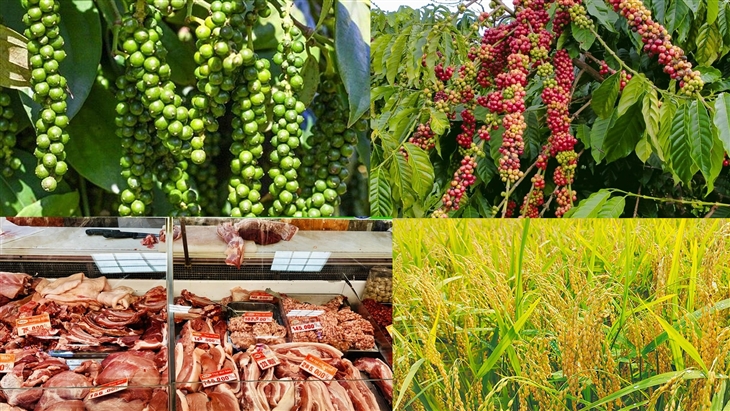
AsemconnectVietnam - On April 19, 2026, the agricultural commodities market experienced mixed movements, presenting both opportunities and challenges for investors and farmers. The reopening of the Strait of Hormuz eased global freight costs, yet it simultaneously exerted downward pressure on coffee prices. Meanwhile, domestic durian prices declined sharply, while Vietnam’s rice exports extended their upward momentum and established a new price range.
Coffee prices reversed course and fell significantly across both domestic and international markets. In Vietnam’s Central Highlands, farmgate prices dropped by approximately VND2,000 to VND2,100 per kilogram compared to the previous session, bringing the average range down to around VND84,500–85,200 per kilogram. Lam Dong recorded the lowest level in the key growing region, falling by VND2,100 to VND 84,500 per kilogram. However, areas formerly part of Dak Nong (now administratively merged into Lam Dong) maintained slightly higher levels at VND 85,200 per kilogram. Dak Lak and Gia Lai also saw declines of about VND2,000 per kilogram, settling near VND85,000 per kilogram.
On global exchanges, bearish sentiment dominated for a second consecutive session. London robusta futures for May 2026 delivery fell by USD 86 per ton to close at USD3,388 per ton. The July 2026 contract declined by 2.5% to USD3,263 per ton. Similarly, New York arabica futures for May delivery dropped by 7.15 US cents per pound to 289.3 cents per pound, marking the lowest level in about a week. The easing of logistical bottlenecks following the reopening of the Strait of Hormuz contributed to reduced transportation costs, thereby weakening price support for coffee.
The domestic durian market showed clear divergence. Prices for Thai durian and Ri6 varieties declined sharply, while Musang King surged. In the Mekong Delta, premium-grade Thai durian (Grade A) fell by as much as VND45,000–50,000 per kilogram, settling at VND120,000–130,000 per kilogram. Lower-grade Thai durian dropped to VND45,000–60,000 per kilogram. Ri6 durian (Grade A) also softened, trading at around VND 80,000–86,000 per kilogram. In contrast, Musang King durian recorded a strong rebound, rising by VND35,000–40,000 per kilogram. Robust demand pushed Grade A Musang King prices up to VND170,000–180,000 per kilogram depending on quality and warehouse conditions.
Rice markets displayed a notable contrast between domestic stagnation and export strength. In the Mekong Delta, paddy prices remained largely unchanged amid weak trading activity. The ongoing harvest of the Winter-Spring crop in provinces such as An Giang and Can Tho increased supply, leading to subdued buying interest. Fresh paddy varieties such as OM 18 and Dai Thom 8 were traded at approximately VND6,000–6,200 per kilogram.
In contrast, Vietnam’s rice export prices continued to rise. Fragrant rice with 5% broken grains increased by USD 15 per ton to reach USD490–500 per ton. Jasmine rice also edged up by USD9 per ton to USD465–469 per ton. This upward movement enhanced Vietnam’s competitive position in the global market, particularly as geopolitical tensions and elevated logistics costs continued to weigh on international trade flows, prompting cautious transactions.
The domestic pepper market remained stable despite global downward pressure. Prices held firm at around VND140,000–141,000 per kilogram. Dak Lak and the Dak Nong region (now part of Lam Dong) led the market at VND141,000 per kilogram. This stability indicated a temporary equilibrium, with both buyers and sellers adopting a cautious stance.
Globally, however, Indonesian black pepper prices declined for a fifth consecutive session, falling by USD19 per ton to USD7,043 per ton due to oversupply concerns. Despite this, Vietnam’s export pepper prices remained resilient at USD6,100–6,200 per ton for grades with densities of 500 g/l and 550 g/l, demonstrating the relative strength and adaptability of domestic exporters.
The live hog market showed localized improvement in the northern region. Prices in provinces such as Tuyen Quang, Lang Son, Hai Phong, and Hung Yen increased by about VND1,000 per kilogram. Hung Yen recorded the highest price in the north at VND66,000 per kilogram. Meanwhile, central and Central Highlands regions remained stable, with prices ranging between VND63,000 and VND68,000 per kilogram.
Southern provinces continued to lead the market, with Dong Nai, Tay Ninh, Dong Thap, Ho Chi Minh City, and Vinh Long maintaining peak levels of VND69,000 per kilogram. Strong consumption demand and relatively tight supply supported these elevated prices.
The rubber market experienced mixed developments globally. Japan’s TOCOM and China’s SHFE exchanges faced downward pressure toward the end of the trading week, while Singapore’s SGX showed relatively better resilience despite minor corrections. Escalating trade tensions between the United States and China weighed on the tire manufacturing sector, indirectly affecting demand for natural rubber.
In response to global uncertainties, Vietnam’s domestic rubber industry maintained a stable pricing strategy. Major companies kept procurement prices unchanged. For instance, Mang Yang Rubber Company purchased latex (Grade 1) at VND463 per TSC kilogram, while Phu Rieng Rubber Company maintained its buying price at VND420 per TSC kilogram. This price stabilization policy helped reassure farmers and mitigate risks arising from global economic volatility.
Overall, the agricultural commodities market on April 19, 2026 reflected a complex interplay of global and domestic factors. While improved logistics conditions reduced cost pressures, they also contributed to price declines in certain commodities such as coffee. At the same time, strong export performance in rice and resilience in pepper highlighted Vietnam’s competitive strengths. The divergent movements across sectors underscored the need for market participants to remain adaptive and closely monitor both geopolitical developments and supply-demand dynamics.
Source: Vitic