


Import and export 2026: expectation of accelerated growth from Q1 foundation
Wednesday, April 15,2026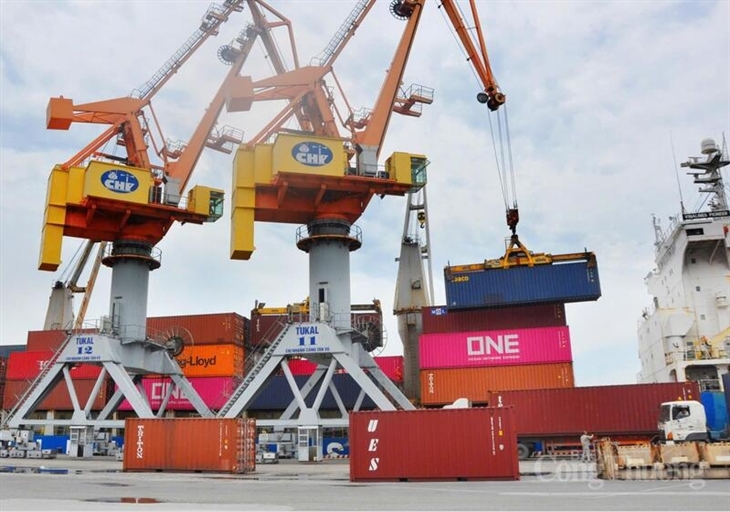
AsemconnectVietnam - Q1/2026 growth rate of 23.2% sets stage for import and export growth for the whole year. From an investment-driven trade deficit, Ministry of Industry and Trade aims for accelerated growth towards a sustainable trade surplus.
Improved import and export, trade deficit remains cyclical
According to Ministry of Industry and Trade, in Q1/2026, total value of goods import and export is estimated at US$249.5 billion, an increase of 23.2% compared to the same period last year. Of which, export reached US$122.9 billion, an increase of 19.1%, while import reached nearly US$126.6 billion, an increase of 27%.
Notably, processing industry continues to play a leading role with a turnover of US$87.8 billion, an increase of 20%. This shows that domestic production capacity is recovering positively, creating a foundation for export growth in the following quarters. In addition, agricultural, forestry and fisheries sector reached US$9.9 billion, an increase of 6.2%, reflecting stability of agricultural market amidst increasing technical barriers.
On market side, major partners all recorded impressive growth. Hong Kong (China) increased by 47.4%, China by 26.4% and the United States by 24.3%. These figures not only reflect recovery in demand but also demonstrate adaptability of Vietnamese businesses in face of global trade fluctuations.
However, along with growth came a trade deficit of approximately US$3.6 billion in the first quarter. This is a factor attracting attention, as target for the whole year is still a trade surplus.
According to Mr. Tran Thanh Hai, Deputy Director of Import-Export Department (Ministry of Industry and Trade), this development is not unusual when considered in context of previous years. The first quarter is usually period when businesses boost imports of raw materials and machinery to serve production.
Concurring with this view, Dr. Le Quoc Phuong, former Deputy Director of Center for Industrial and Trade Information, told reporters from Industry and Trade Newspaper that, looking at structure of imports in the first quarter, imports of electronic components increased by about 50%, and machinery, equipment and spare parts increased by about 22%. Energy items such as gasoline, petroleum and animal feed raw materials also increased sharply. These are all essential inputs for production, reflecting trend of importing for production, not for consumption.
From this perspective, trade deficit in the first quarter is more of an investment in production and exports in the following months than an imbalance. High rate of import growth is an inevitable consequence of preparing for larger production cycles in subsequent quarters.
Based on this foundation, import-export picture from now until the end of the year is expected to shift in a more positive direction, as input factors have been accumulated and are beginning to show their effectiveness.
Expanding markets and enhancing export quality for accelerated growth
Entering following quarters, potential for export growth remains significant as trade promotion activities are being intensified in a coordinated manner.
In the first quarter alone, Ministry of Industry and Trade organized a trade promotion meeting with system of Vietnamese trade offices abroad, aiming to boost export growth for the whole year to 15-16%, corresponding to a scale of 546-550 billion USD. Along with this, launch of Digital Platform for Developing Foreign Markets is expected to provide timely information and support businesses in accessing markets more effectively.
From a market perspective, opening of Australian market for Vietnamese pomelos is a concrete example of diversification efforts. After many years of negotiations, the first batches of pomelos have been processed at Toan Phat Irradiation Plant, meeting technical and biosafety requirements of Australian side.
This is not just the success of one product, but also a signal that Vietnamese agricultural products are gradually overcoming technical barriers to access more demanding markets.
Simultaneously, China remains the largest market for Vietnamese fruits and vegetables. In 2025, fruit and vegetable exports are expected to reach a record $8.6 billion, with China alone accounting for $5.5 billion, equivalent to 64%.
Notably, durian is emerging as a key product, contributing over 46% of fruit and vegetable export revenue, with over 90% of production going to China. This opens up opportunities for rapid growth while also highlighting urgent need to diversify markets to reduce the risk of dependence.
Beyond agricultural products, structure of Vietnam's export goods is expanding, with nearly 40 product groups having significant export value. In particular, technology and machinery groups continue to account for a high proportion of exports to China, with items such as computers, electronic products and components, machinery and equipment, cameras and video cameras…
This reflects trend of shifting the export structure towards increasing technological content and enhancing added value – a key factor in maintaining sustainable growth.
From now until the end of the year, to achieve set goals, Ministry of Industry and Trade will focus on three main pillars.
Firstly, diversifying markets, especially potential regions such as the Middle East and Latin America, in order to reduce dependence on a few traditional markets.
Secondly, promoting green exports and meeting new standards such as the Carbon Border Adjustment Mechanism (CBAM) will enhance competitiveness in face of increasing environmental barriers.
Thirdly, strengthening trade defense capabilities and proactively responding to investigations, especially those under Section 301 of the US, while effectively utilizing signed free trade agreements, is crucial.
Furthermore, restructuring export markets towards increasing value rather than just volume will be a long-term strategy. When businesses not only sell more but also sell better, achieving a trade surplus will become more sustainable.
Source: Vitic/ congthuong.vn
According to Ministry of Industry and Trade, in Q1/2026, total value of goods import and export is estimated at US$249.5 billion, an increase of 23.2% compared to the same period last year. Of which, export reached US$122.9 billion, an increase of 19.1%, while import reached nearly US$126.6 billion, an increase of 27%.
Notably, processing industry continues to play a leading role with a turnover of US$87.8 billion, an increase of 20%. This shows that domestic production capacity is recovering positively, creating a foundation for export growth in the following quarters. In addition, agricultural, forestry and fisheries sector reached US$9.9 billion, an increase of 6.2%, reflecting stability of agricultural market amidst increasing technical barriers.
On market side, major partners all recorded impressive growth. Hong Kong (China) increased by 47.4%, China by 26.4% and the United States by 24.3%. These figures not only reflect recovery in demand but also demonstrate adaptability of Vietnamese businesses in face of global trade fluctuations.
However, along with growth came a trade deficit of approximately US$3.6 billion in the first quarter. This is a factor attracting attention, as target for the whole year is still a trade surplus.
According to Mr. Tran Thanh Hai, Deputy Director of Import-Export Department (Ministry of Industry and Trade), this development is not unusual when considered in context of previous years. The first quarter is usually period when businesses boost imports of raw materials and machinery to serve production.
Concurring with this view, Dr. Le Quoc Phuong, former Deputy Director of Center for Industrial and Trade Information, told reporters from Industry and Trade Newspaper that, looking at structure of imports in the first quarter, imports of electronic components increased by about 50%, and machinery, equipment and spare parts increased by about 22%. Energy items such as gasoline, petroleum and animal feed raw materials also increased sharply. These are all essential inputs for production, reflecting trend of importing for production, not for consumption.
From this perspective, trade deficit in the first quarter is more of an investment in production and exports in the following months than an imbalance. High rate of import growth is an inevitable consequence of preparing for larger production cycles in subsequent quarters.
Based on this foundation, import-export picture from now until the end of the year is expected to shift in a more positive direction, as input factors have been accumulated and are beginning to show their effectiveness.
Expanding markets and enhancing export quality for accelerated growth
Entering following quarters, potential for export growth remains significant as trade promotion activities are being intensified in a coordinated manner.
In the first quarter alone, Ministry of Industry and Trade organized a trade promotion meeting with system of Vietnamese trade offices abroad, aiming to boost export growth for the whole year to 15-16%, corresponding to a scale of 546-550 billion USD. Along with this, launch of Digital Platform for Developing Foreign Markets is expected to provide timely information and support businesses in accessing markets more effectively.
From a market perspective, opening of Australian market for Vietnamese pomelos is a concrete example of diversification efforts. After many years of negotiations, the first batches of pomelos have been processed at Toan Phat Irradiation Plant, meeting technical and biosafety requirements of Australian side.
This is not just the success of one product, but also a signal that Vietnamese agricultural products are gradually overcoming technical barriers to access more demanding markets.
Simultaneously, China remains the largest market for Vietnamese fruits and vegetables. In 2025, fruit and vegetable exports are expected to reach a record $8.6 billion, with China alone accounting for $5.5 billion, equivalent to 64%.
Notably, durian is emerging as a key product, contributing over 46% of fruit and vegetable export revenue, with over 90% of production going to China. This opens up opportunities for rapid growth while also highlighting urgent need to diversify markets to reduce the risk of dependence.
Beyond agricultural products, structure of Vietnam's export goods is expanding, with nearly 40 product groups having significant export value. In particular, technology and machinery groups continue to account for a high proportion of exports to China, with items such as computers, electronic products and components, machinery and equipment, cameras and video cameras…
This reflects trend of shifting the export structure towards increasing technological content and enhancing added value – a key factor in maintaining sustainable growth.
From now until the end of the year, to achieve set goals, Ministry of Industry and Trade will focus on three main pillars.
Firstly, diversifying markets, especially potential regions such as the Middle East and Latin America, in order to reduce dependence on a few traditional markets.
Secondly, promoting green exports and meeting new standards such as the Carbon Border Adjustment Mechanism (CBAM) will enhance competitiveness in face of increasing environmental barriers.
Thirdly, strengthening trade defense capabilities and proactively responding to investigations, especially those under Section 301 of the US, while effectively utilizing signed free trade agreements, is crucial.
Furthermore, restructuring export markets towards increasing value rather than just volume will be a long-term strategy. When businesses not only sell more but also sell better, achieving a trade surplus will become more sustainable.
Source: Vitic/ congthuong.vn
E-commerce boom shadowed by surge in counterfeit goods
State Treasury raises 3 bln USD worth of Government bonds in Q1
Import and export procedures to be simplified
Highlights of imports and exports in first quarter of 2026
Standardizing production, Gia Lai aims for $3.05 billion in export
What policies are needed for footwear industry in face of pressure of 90% of its production for export?
AI technology and sustainable solutions for Vietnam's textile and garment industry
Vietnam agricultural markets in morning trade April 14: Coffee and durian edged higher
Japan - Vietnam's important shrimp market
Program for expanding into international markets in 2026–2030 period approved
Goods import and export in Q1 2026 increased by 23%, reaching $250 billion
Seafood export accelerate in Q1, businesses shift market focus
Rice export in Q1/2026 are expected to decrease in value, increasing pressure for restructuring
Coffee export expected to exceed US$8 billion


Public debt borrowing and repayment plan for 2026
Ensuring resources: Mobilizing sufficient and timely borrowed capital at reasonable costs and acceptable risks to meet expenditure needs ...Plan on implementation of high-tech law
Inter-sectoral legal support program for small and ...

Tourism destinations refresh offerings to welcome New ...
Across the Mekong Delta, many tourist sites have been busy upgrading their offerings. At the Con Son tourism site in Can Tho city, members ...Annual New Year festival shines in Da Nang
Phu Quoc emerging as a favourite global destination
Vietnam Airlines adds 270 flights to during 2026 New Year ...
