


What policies are needed for footwear industry in face of pressure of 90% of its production for export?
Tuesday, April 14,2026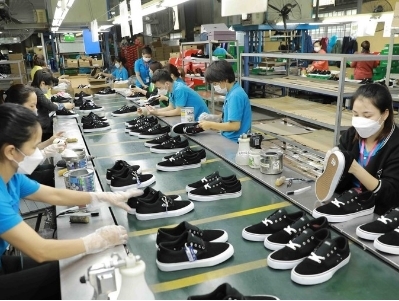
AsemconnectVietnam - Footwear industry, with 90% of its production exported, is facing significant risks from geopolitical fluctuations, creating an urgent need to improve policies to enhance resilience.
Retaining workforce means maintaining production capacity.
Speaking at recent seminar "Geopolitical Changes and Energy Security Strategies," Ms. Phan Thi Thanh Xuan, Vice President and General Secretary of Vietnam Leather and Footwear Association (Lefaso), stated that global footwear production currently reaches approximately 23 billion pairs per year. China accounts for about 60% and holds the leading position in production. India ranks second with about 2 billion pairs, followed by Vietnam with about 1-1.2 billion pairs. Notably, about 87% of global footwear production is in Asia, with an average growth rate of 5-6% per year.
Regarding export, China continues to be the world leader with approximately 9 billion pairs per year, while Vietnam ranks second with an export value of about 1.2 billion pairs per year to global market. It is evident that footwear industry has a very high degree of openness, with up to 90% of its production dedicated to export, a characteristic similar to textile and garment industry.
According to Ms. Phan Thi Thanh Xuan, textile and footwear industries cannot be evaluated solely based on profit indicators. These are industries that bring significant socio-economic value. Currently, these two industries provide jobs for approximately 5 million workers, contributing to structural shift from agriculture to industry. In context of land gradually being converted to industrial and urban development, absorbing and training a workforce to become professional workers is of particular importance.
Furthermore, 17 free trade agreements (FTAs) that Vietnam has signed are creating significant opportunities for footwear businesses to expand their markets, take advantage of tariff preferences, and participate more deeply in the global supply chain. With the continued expansion of FTAs, footwear industry has even more opportunities to enhance its competitiveness and increase export value.
After 30-40 years of development, Vietnam has risen to second place globally in exporting these goods with a firm foothold in major markets such as the US, Europe, Japan, and South Korea. This achievement not only brings economic value but also contributes to enhancing the country's standing.
“Contributions cannot be measured solely by economic figures; intangible values such as position and integration capacity are what create overall strength,” Ms. Xuan emphasized.
However, with its dependence on exports (up to 90%), footwear industry is highly vulnerable to external shocks. Following the Covid-19 pandemic and trade tensions, conflicts in the Middle East disrupted markets, especially the Middle East and transit routes to Africa.
Furthermore, fluctuations in input costs due to impact of conflict in the Middle East, while export prices have remained almost "frozen" for the past 20 years (only increasing by about 5%), have added significant pressure on businesses. "Currently, cost structure of a pair of shoes consists of 60-65% raw materials, 25% labor, 5% management costs and the rest is profit. Therefore, any fluctuations directly affect profits, even causing businesses to lose profit," Ms. Xuan shared.
In this context, many businesses accept breaking even, or even incurring losses, to retain their workforce. "Retaining employees means maintaining production capacity",Ms. Xuan emphasized.
Improving policies, increasing supply chain autonomy and adapting to "green" practices
According to data from General Statistics Office (Ministry of Finance), in the first quarter of 2026, 10 product categories achieved export turnover exceeding US$2 billion, accounting for 73.7% of total export turnover. Of that total, footwear exports reached US$5.42 billion, a 0.8% increase year-on-year and continued to be one of the key export sectors.
To cope, footwear businesses are implementing various solutions such as cost sharing in supply chain, reducing management costs, promoting automation and digital transformation, and restructuring the market towards areas closer to production to reduce logistics costs. “Vietnam can promote expansion of orders in the Asian region to reduce dependence on distant markets, thereby reducing logistics costs. However, this is only a short-term solution and cannot fundamentally address the challenges facing the industry”, Ms. Xuan commented.
Dr. Vo Tri Thanh - Director of Institute for Brand and Competition Strategy, Member of the Prime Minister's Policy Advisory Group, stated that labor-intensive export industries such as textiles and footwear, which already have low profit margins, are now facing even greater pressure, especially after recent trade fluctuations. Notably, these industries are currently facing two headwinds simultaneously. Firstly, geopolitical instability in the Middle East directly impacts the market and causes cost volatility. Secondly, there are risks from US tax policies.
In addition, according to Ms. Phan Thi Thanh Xuan, the industry also faces long-term challenges from the green transition requirements. Major markets, especially the EU, are tightening regulations on emission reduction, traceability and implementation of "digital product passports" (DPPs). This requires businesses to use clean energy and ensure supply chain transparency, while Vietnam remains heavily dependent on imported raw materials and components.
Based on that reality, Ms. Phan Thi Thanh Xuan proposed need to promote development of domestic raw material and auxiliary material industries, build a trading market and a raw material reserve system. This model is similar to the petroleum reserve system. This is considered a solution to help businesses proactively secure supply sources and minimize risks when market fluctuates.
"In reality, businesses with readily available raw material reserves have significantly reduced the impact of costs, while many other businesses have been forced to refuse or lose orders due to insufficient preparation," Ms. Xuan shared.
According to data from Vietnam Industry Research and Consulting Joint Stock Company (VIRAC), in 2025, Vietnam's footwear export turnover will reach approximately US$29 billion, an increase of nearly 10% compared to the previous year, further affirming its role as a key export industry. This industry aims to reach $100 billion by 2030. In context of many fluctuations, proactive risk management, improved adaptability, and increased self-reliance are considered key to the footwear industry maintaining growth and securing its position in the international market.
Source: Vitic/ congthuong.vn
Speaking at recent seminar "Geopolitical Changes and Energy Security Strategies," Ms. Phan Thi Thanh Xuan, Vice President and General Secretary of Vietnam Leather and Footwear Association (Lefaso), stated that global footwear production currently reaches approximately 23 billion pairs per year. China accounts for about 60% and holds the leading position in production. India ranks second with about 2 billion pairs, followed by Vietnam with about 1-1.2 billion pairs. Notably, about 87% of global footwear production is in Asia, with an average growth rate of 5-6% per year.
Regarding export, China continues to be the world leader with approximately 9 billion pairs per year, while Vietnam ranks second with an export value of about 1.2 billion pairs per year to global market. It is evident that footwear industry has a very high degree of openness, with up to 90% of its production dedicated to export, a characteristic similar to textile and garment industry.
According to Ms. Phan Thi Thanh Xuan, textile and footwear industries cannot be evaluated solely based on profit indicators. These are industries that bring significant socio-economic value. Currently, these two industries provide jobs for approximately 5 million workers, contributing to structural shift from agriculture to industry. In context of land gradually being converted to industrial and urban development, absorbing and training a workforce to become professional workers is of particular importance.
Furthermore, 17 free trade agreements (FTAs) that Vietnam has signed are creating significant opportunities for footwear businesses to expand their markets, take advantage of tariff preferences, and participate more deeply in the global supply chain. With the continued expansion of FTAs, footwear industry has even more opportunities to enhance its competitiveness and increase export value.
After 30-40 years of development, Vietnam has risen to second place globally in exporting these goods with a firm foothold in major markets such as the US, Europe, Japan, and South Korea. This achievement not only brings economic value but also contributes to enhancing the country's standing.
“Contributions cannot be measured solely by economic figures; intangible values such as position and integration capacity are what create overall strength,” Ms. Xuan emphasized.
However, with its dependence on exports (up to 90%), footwear industry is highly vulnerable to external shocks. Following the Covid-19 pandemic and trade tensions, conflicts in the Middle East disrupted markets, especially the Middle East and transit routes to Africa.
Furthermore, fluctuations in input costs due to impact of conflict in the Middle East, while export prices have remained almost "frozen" for the past 20 years (only increasing by about 5%), have added significant pressure on businesses. "Currently, cost structure of a pair of shoes consists of 60-65% raw materials, 25% labor, 5% management costs and the rest is profit. Therefore, any fluctuations directly affect profits, even causing businesses to lose profit," Ms. Xuan shared.
In this context, many businesses accept breaking even, or even incurring losses, to retain their workforce. "Retaining employees means maintaining production capacity",Ms. Xuan emphasized.
Improving policies, increasing supply chain autonomy and adapting to "green" practices
According to data from General Statistics Office (Ministry of Finance), in the first quarter of 2026, 10 product categories achieved export turnover exceeding US$2 billion, accounting for 73.7% of total export turnover. Of that total, footwear exports reached US$5.42 billion, a 0.8% increase year-on-year and continued to be one of the key export sectors.
To cope, footwear businesses are implementing various solutions such as cost sharing in supply chain, reducing management costs, promoting automation and digital transformation, and restructuring the market towards areas closer to production to reduce logistics costs. “Vietnam can promote expansion of orders in the Asian region to reduce dependence on distant markets, thereby reducing logistics costs. However, this is only a short-term solution and cannot fundamentally address the challenges facing the industry”, Ms. Xuan commented.
Dr. Vo Tri Thanh - Director of Institute for Brand and Competition Strategy, Member of the Prime Minister's Policy Advisory Group, stated that labor-intensive export industries such as textiles and footwear, which already have low profit margins, are now facing even greater pressure, especially after recent trade fluctuations. Notably, these industries are currently facing two headwinds simultaneously. Firstly, geopolitical instability in the Middle East directly impacts the market and causes cost volatility. Secondly, there are risks from US tax policies.
In addition, according to Ms. Phan Thi Thanh Xuan, the industry also faces long-term challenges from the green transition requirements. Major markets, especially the EU, are tightening regulations on emission reduction, traceability and implementation of "digital product passports" (DPPs). This requires businesses to use clean energy and ensure supply chain transparency, while Vietnam remains heavily dependent on imported raw materials and components.
Based on that reality, Ms. Phan Thi Thanh Xuan proposed need to promote development of domestic raw material and auxiliary material industries, build a trading market and a raw material reserve system. This model is similar to the petroleum reserve system. This is considered a solution to help businesses proactively secure supply sources and minimize risks when market fluctuates.
"In reality, businesses with readily available raw material reserves have significantly reduced the impact of costs, while many other businesses have been forced to refuse or lose orders due to insufficient preparation," Ms. Xuan shared.
According to data from Vietnam Industry Research and Consulting Joint Stock Company (VIRAC), in 2025, Vietnam's footwear export turnover will reach approximately US$29 billion, an increase of nearly 10% compared to the previous year, further affirming its role as a key export industry. This industry aims to reach $100 billion by 2030. In context of many fluctuations, proactive risk management, improved adaptability, and increased self-reliance are considered key to the footwear industry maintaining growth and securing its position in the international market.
Source: Vitic/ congthuong.vn
Vietnam agricultural markets in morning trade April 14: Coffee and durian edged higher
Japan - Vietnam's important shrimp market
Program for expanding into international markets in 2026–2030 period approved
Goods import and export in Q1 2026 increased by 23%, reaching $250 billion
Seafood export accelerate in Q1, businesses shift market focus
Rice export in Q1/2026 are expected to decrease in value, increasing pressure for restructuring
Coffee export expected to exceed US$8 billion
VinFast EV sales jump 127%, cementing market dominance
Vietnam’s key industries to be boosted
Vietnam's industrial sector and new opportunity
Maintaining export momentum towards double-digit growth
Fuel price surge puts mounting pressure on CPI: NSO
Dong Nai leads in banana exports with a production volume exceeding 700,000 tonnes per year
Vietnam's tilapia exports accelerated, requiring long-term strategy
