


Seafood export accelerate in Q1, businesses shift market focus
Monday, April 13,2026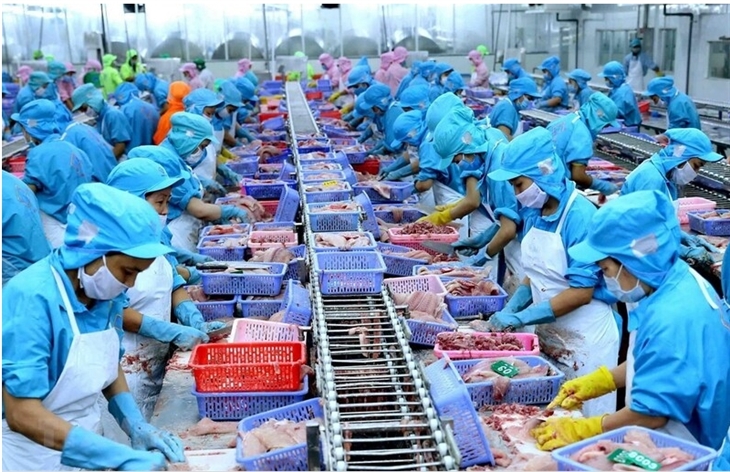
AsemconnectVietnam - Seafood exports in Q1/2026 showed positive growth but faced pressure from fluctuations and consumer trends, requiring the industry to diversify markets and products.
Aquaculture remains a pillar, export show positive growth
According to Ministry of Agriculture and Environment, in March 2026, fisheries sector continued to record a stable recovery, with aquaculture playing a key driving role. Total national seafood production is estimated at 780,700 tonnes, an increase of 2.8% compared to the same period last year; cumulative production in Q1 reached approximately 2.18 million tons, an increase of 3.2%.
Aquaculture continued to lead growth with production in March reaching 495,400 tonnes, an increase of 6.1%. Overall, in the first three months of the year, aquaculture production reached nearly 1.3 million tonnes, an increase of 5.4%. Notably, shrimp production increased by 7.3%, and fish production by 4.8%, reflecting the increasingly clear trend of expanding intensive farming and applying high technology.
Several key products recorded impressive growth. Pangasius reached 450,400 tonnes in the first quarter, up 5.9%, with strong growth in many localities such as An Giang and Can Tho. Whiteleg shrimp reached 128,900 tonnes, up 8.5%, continuing to be a key export item.
Conversely, fisheries were affected by rising fuel costs, causing production in March to decrease by 2.7%, to 285,300 tonnes.
Regarding export, fisheries sector achieved positive results with an estimated export value of US$900 million in March, bringing total export value for the first quarter to US$2.62 billion, a 13.3% increase compared to the same period in 2025. China, Japan and the United States continue to be the three largest markets, with export to China increasing sharply by 58.5%.
However, this growth momentum is facing many challenges from the international environment. In particular, the Middle East market – a potential region with an export value of over US$401 million in 2025 – is being affected by prolonged conflicts, directly impacting trade and logistics.
According to business feedback, orders are still being maintained, but shipping times are longer and shipping schedules are unstable. Some businesses have temporarily suspended exports to this region due to increased transportation risks. Along with that, cost pressures force businesses to both control input costs and maintain competitive selling prices, affecting business efficiency.
Adapting to consumer trends and expanding market space
In context of volatility, global consumer trends are shifting towards prioritizing reasonably priced products. Consumers tend to reduce their use of high-end items such as tiger prawns, instead switching to more common products such as pangasius, tilapia, surimi and processed seafood.
Vietnam Association of Seafood Processing and Export believes this is an opportunity for the industry to restructure its products, focusing on segments with stable demand and large scale. In fact, the global surimi market is projected to reach US$7.83 billion by 2034, while the tilapia market could exceed US$24 billion by 2035, showing enormous growth potential.
Demand for inexpensive, nutrient-rich protein sources continues to increase amidst global economic instability. This is an advantage for products such as pangasius and tilapia, which are competitively priced and suitable for various consumer segments. In an interview with Industry and Trade Newspaper, Associate Professor Dr. Nguyen Dinh Tho, Deputy Director of Institute for Agricultural Strategy, Policy and Environment (ISPAE), stated that in this context, businesses need to proactively diversify export markets and reduce dependence on traditional markets. Besides the US, China, Japan, and the EU, they should expand into potential regions such as South America, South Asia, or niche markets less affected by conflicts.
At the same time, flexibly adjusting trade flows and seeking alternative markets with similar demand will help businesses minimize risks, reduce inventory, and avoid supply chain disruptions. From perspective of regulatory agencies, it is necessary to strengthen market information provision, provide early warnings of risks, remove technical barriers and promote trade, supporting businesses in accessing new markets.
At Ministry of Agriculture and Environment's regular press conference, Deputy Minister Phung Duc Tien stated that tilapia is emerging as a strategic product with high demand from markets such as the US, Brazil, and China. It is projected that tilapia export revenue could reach over $2 billion in the near future, approaching the scale of the pangasius industry.
However, to realize this goal, fisheries sector needs to focus on improving product quality, standardizing products and building brands. Simultaneously, it needs to promote application of science and technology, invest in infrastructure and reorganize production along value chain.
Simultaneously, perfecting system of technical standards and regulations, especially in marine and reservoir aquaculture, is an urgent requirement to meet increasingly stringent standards of international market. This is also foundation for shifting from natural exploitation to sustainable aquaculture, increasing added value for the entire industry.
Source: Vitic/ congthuong.vn
According to Ministry of Agriculture and Environment, in March 2026, fisheries sector continued to record a stable recovery, with aquaculture playing a key driving role. Total national seafood production is estimated at 780,700 tonnes, an increase of 2.8% compared to the same period last year; cumulative production in Q1 reached approximately 2.18 million tons, an increase of 3.2%.
Aquaculture continued to lead growth with production in March reaching 495,400 tonnes, an increase of 6.1%. Overall, in the first three months of the year, aquaculture production reached nearly 1.3 million tonnes, an increase of 5.4%. Notably, shrimp production increased by 7.3%, and fish production by 4.8%, reflecting the increasingly clear trend of expanding intensive farming and applying high technology.
Several key products recorded impressive growth. Pangasius reached 450,400 tonnes in the first quarter, up 5.9%, with strong growth in many localities such as An Giang and Can Tho. Whiteleg shrimp reached 128,900 tonnes, up 8.5%, continuing to be a key export item.
Conversely, fisheries were affected by rising fuel costs, causing production in March to decrease by 2.7%, to 285,300 tonnes.
Regarding export, fisheries sector achieved positive results with an estimated export value of US$900 million in March, bringing total export value for the first quarter to US$2.62 billion, a 13.3% increase compared to the same period in 2025. China, Japan and the United States continue to be the three largest markets, with export to China increasing sharply by 58.5%.
However, this growth momentum is facing many challenges from the international environment. In particular, the Middle East market – a potential region with an export value of over US$401 million in 2025 – is being affected by prolonged conflicts, directly impacting trade and logistics.
According to business feedback, orders are still being maintained, but shipping times are longer and shipping schedules are unstable. Some businesses have temporarily suspended exports to this region due to increased transportation risks. Along with that, cost pressures force businesses to both control input costs and maintain competitive selling prices, affecting business efficiency.
Adapting to consumer trends and expanding market space
In context of volatility, global consumer trends are shifting towards prioritizing reasonably priced products. Consumers tend to reduce their use of high-end items such as tiger prawns, instead switching to more common products such as pangasius, tilapia, surimi and processed seafood.
Vietnam Association of Seafood Processing and Export believes this is an opportunity for the industry to restructure its products, focusing on segments with stable demand and large scale. In fact, the global surimi market is projected to reach US$7.83 billion by 2034, while the tilapia market could exceed US$24 billion by 2035, showing enormous growth potential.
Demand for inexpensive, nutrient-rich protein sources continues to increase amidst global economic instability. This is an advantage for products such as pangasius and tilapia, which are competitively priced and suitable for various consumer segments. In an interview with Industry and Trade Newspaper, Associate Professor Dr. Nguyen Dinh Tho, Deputy Director of Institute for Agricultural Strategy, Policy and Environment (ISPAE), stated that in this context, businesses need to proactively diversify export markets and reduce dependence on traditional markets. Besides the US, China, Japan, and the EU, they should expand into potential regions such as South America, South Asia, or niche markets less affected by conflicts.
At the same time, flexibly adjusting trade flows and seeking alternative markets with similar demand will help businesses minimize risks, reduce inventory, and avoid supply chain disruptions. From perspective of regulatory agencies, it is necessary to strengthen market information provision, provide early warnings of risks, remove technical barriers and promote trade, supporting businesses in accessing new markets.
At Ministry of Agriculture and Environment's regular press conference, Deputy Minister Phung Duc Tien stated that tilapia is emerging as a strategic product with high demand from markets such as the US, Brazil, and China. It is projected that tilapia export revenue could reach over $2 billion in the near future, approaching the scale of the pangasius industry.
However, to realize this goal, fisheries sector needs to focus on improving product quality, standardizing products and building brands. Simultaneously, it needs to promote application of science and technology, invest in infrastructure and reorganize production along value chain.
Simultaneously, perfecting system of technical standards and regulations, especially in marine and reservoir aquaculture, is an urgent requirement to meet increasingly stringent standards of international market. This is also foundation for shifting from natural exploitation to sustainable aquaculture, increasing added value for the entire industry.
Source: Vitic/ congthuong.vn
Coffee export expected to exceed US$8 billion
VinFast EV sales jump 127%, cementing market dominance
Vietnam’s key industries to be boosted
Vietnam's industrial sector and new opportunity
Maintaining export momentum towards double-digit growth
Fuel price surge puts mounting pressure on CPI: NSO
Dong Nai leads in banana exports with a production volume exceeding 700,000 tonnes per year
Vietnam's tilapia exports accelerated, requiring long-term strategy
Vietnam’s cassava exports saw positive growth in first quarter of 2026
Vietnam’s agricultural markets on April 9
QR, mobile payments on the rise, ATM usage declines
Vietnam sees ample opportunities in AI-powered economy
Vietnam’s seafood exports increased in first quarter of 2026
Vietnam advised to build sustainable linkages for bioethanol production


Public debt borrowing and repayment plan for 2026
Ensuring resources: Mobilizing sufficient and timely borrowed capital at reasonable costs and acceptable risks to meet expenditure needs ...Plan on implementation of high-tech law
Inter-sectoral legal support program for small and ...

Tourism destinations refresh offerings to welcome New ...
Across the Mekong Delta, many tourist sites have been busy upgrading their offerings. At the Con Son tourism site in Can Tho city, members ...Annual New Year festival shines in Da Nang
Phu Quoc emerging as a favourite global destination
Vietnam Airlines adds 270 flights to during 2026 New Year ...
