


Vietnam Commodities Market Update – April 2, 2026 (Thursday Morning)
Thursday, April 2,2026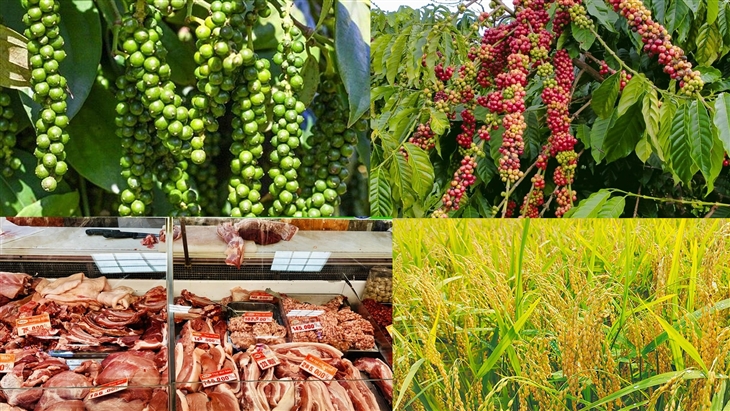
AsemconnectVietnam - Vietnam’s agricultural commodities markets showed mixed movements on Thursday morning, with coffee and durian prices rebounding, while pepper and live hog prices declined. Meanwhile, rice and rubber markets recorded mixed but generally positive trading signals.
Coffee rebounds strongly
Domestic coffee prices posted a notable recovery after a period of heavy selling pressure. In the Central Highlands, farmgate prices rose by 1,700–1,800 dong per kilogram, bringing the average range to 88,700–89,500 dong/kg.
Dak Nong recorded the strongest gain of 1,800 dong/kg to reach 89,500 dong/kg, the highest level in the region. Dak Lak and Gia Lai both increased by 1,700 dong/kg to 89,200 dong/kg.
On global markets, prices reversed course. London robusta futures for May 2026 rose 2.16% to $3,493 per metric ton, while the July contract reached $3,405 per ton.
New York arabica futures for May delivery gained 1.98% to 298.35 U.S. cents per pound, with the July contract at 290.8 cents per pound.
Vietnam’s coffee sector, the world’s largest producer of Robusta, needs to shift from volume-based exports toward a stronger focus on quality, standards, and brand value to reinforce its long-term position in the global market, according to a Mexican expert and other industry observers.
The call was made at a consultation workshop titled ‘Robusta Quality & Market Transformation,’ held on Monday in Buon Ma Thuot Ward, Dak Lak Province, located in Vietnam’s Central Highlands, by the Buon Ma Thuot Coffee Association.
The event, part of the Robusta XXI initiative led by the association and its partners, gathered more than 100 domestic and international coffee experts, businesses, and organizations.
Participants said it is time for Vietnam’s coffee sector to enter a new phase of development, where growth can no longer rely solely on output expansion but must shift toward higher quality and value addition.
Pepper prices decline domestically and in exports
In contrast, domestic pepper prices fell by 2,000 dong/kg across major producing regions, retreating to a range of 138,000–139,000 dong/kg.
Dak Lak and Dak Nong remained at the top of the market despite declining to 139,000 dong/kg. Ba Ria–Vung Tau traded at 138,500 dong/kg, while Gia Lai and Dong Nai recorded the lowest level at 138,000 dong/kg.
Internationally, the market was mixed. Indonesian black pepper rose by $117 per ton to $7,122 per ton, while white pepper increased by $108 to $9,382 per ton.
However, Vietnam’s export prices dropped sharply, with black pepper falling by $300 per ton to $6,000–6,100 per ton, and white pepper declining by $150 to $8,900 per ton.
Brazil’s ASTA 570 black pepper remained steady at $6,100 per ton, while Malaysia held prices at $9,300 per ton for black pepper and $12,200 per ton for white pepper.
Durian extends rally
Durian prices continued to surge at procurement warehouses. Ri6 Grade A durian in the Mekong Delta traded at 90,000–110,000 dong/kg, up 10,000–15,000 dong/kg from the previous day.
Other Ri6 grades remained firm, with Grade B at 75,000–95,000 dong/kg, Grade C at 60,000–65,000 dong/kg, and lower grades ranging from 40,000–55,000 dong/kg.
Thai durian varieties also maintained high levels. Premium Grade A fruit ranged from 160,000–165,000 dong/kg, while Grade B stood at 140,000–145,000 dong/kg.
Standard Thai durian Grade A averaged around 120,000 dong/kg, with Grade B at 88,000–100,000 dong/kg and Grade C at 70,000–85,000 dong/kg.
High-end varieties such as Musang King traded at 130,000–140,000 dong/kg, while Chuong Bo durian Grade A stood at 85,000–95,000 dong/kg.
Rice market improves, retail prices stable
Trading activity in the Mekong Delta improved. Fresh paddy prices for Dai Thom 8 rose by 50 dong/kg to 5,600–5,750 dong/kg. Other varieties remained stable, including OM 18 at 5,600–5,750 dong/kg, IR 50404 at 5,200–5,300 dong/kg, OM 5451 at 5,400–5,500 dong/kg, and OM 34 at 5,100–5,200 dong/kg.
Export rice prices fluctuated slightly. Dai Thom 8 stood at 9,200–9,400 dong/kg, OM 18 at 8,900–9,100 dong/kg, and OM 5451 at 8,350–8,450 dong/kg. Finished IR 504 rice was quoted at 9,500–9,700 dong/kg.
Globally, Vietnam’s 5% broken rice was offered at $400–415 per ton, closely competing with Thailand’s $381–385 per ton and India’s $351–355 per ton.
Vietnam’s 100% broken rice traded at $316–320 per ton, higher than India’s $304–308 per ton but below Thailand’s $363–367 per ton. Jasmine rice exports remained stable at $430–434 per ton.
Rubber steady domestically, mixed globally
Domestic rubber prices remained stable. Phu Rieng Rubber Company purchased latex at 440 dong/TSC/kg and cup lump at 400 dong/DRC/kg. Mang Yang Rubber Company bought Grade 1 latex at 463 dong/TSC/kg and Grade 2 at 458 dong/TSC/kg.
In Binh Long, factory purchase prices stood at 432 dong/TSC/kg. Ba Ria Rubber applied 452 dong/TSC/kg for latex with TSC above 30%, and 18,000 dong/kg for cup lump with DRC above 50%.
On international markets, prices increased in Japan and Singapore. The June contract on the TOCOM exchange rose to 375.50 yen/kg, while the May contract on SGX reached 200.10 U.S. cents/kg.
However, Shanghai futures were mixed, with the April contract rising to 16,635 yuan per ton, while contracts from May to August edged lower.
Live hog prices show mixed trends
The live hog market showed divergent trends across regions. In northern Vietnam, prices edged higher, with Bac Ninh, Hanoi, Hai Phong, Ninh Binh and Hung Yen all gaining 1,000 dong/kg. Hanoi remained at the peak level of 64,000 dong/kg, while other provinces traded at 62,000–63,000 dong/kg.
Central and Central Highlands regions were mixed. Thanh Hoa, Nghe An and Ha Tinh rose by 1,000 dong/kg but remained among the lowest levels, with Ha Tinh at 61,000 dong/kg.
Meanwhile, Quang Tri, Hue, Da Nang, Quang Ngai, Gia Lai, Dak Lak and Lam Dong all declined by 1,000 dong/kg. Lam Dong recorded the highest price in the region at 66,000 dong/kg.
In the south, prices declined broadly. Dong Thap, An Giang, Ca Mau, Ho Chi Minh City, Vinh Long and Can Tho all fell by 1,000 dong/kg, bringing the regional average down to 65,000–68,000 dong/kg.
An Giang, Ca Mau and Can Tho recorded the lowest level at 65,000 dong/kg, while Dong Nai and Tay Ninh remained the highest at 68,000 dong/kg.
Source: Vitic
Opportunities and challenges of Vietnamese tilapia in US market
Australia: potential market for Vietnamese shrimp amidst global trade fluctuations
Vietnam’s agricultural commodity markets – April 1, 2026
Seafood businesses seek oportunities in Brazil amid Middle East turmoil
Directive to promote rice exports issued
Cake digital bank launches GlobalX international remittance solution
Vietnam Elevator Expo 2026 to take place in Hanoi
Textile firms strengthen resilience amid rising global risks
A historic opportunity for Vietnam’s economy
Tay Ninh builds new edge through industrial park – logistics integration
Vietnam remains among fastest-growing economies in Southeast Asia-6
PM requests enhancing power saving, accelerating rooftop solar rollout
China spent nearly $900 million on Vietnamese lobsters
Vietnam’s exports in Q1: expectations for continued growth


Public debt borrowing and repayment plan for 2026
Ensuring resources: Mobilizing sufficient and timely borrowed capital at reasonable costs and acceptable risks to meet expenditure needs ...Plan on implementation of high-tech law
Inter-sectoral legal support program for small and ...

Tourism destinations refresh offerings to welcome New ...
Across the Mekong Delta, many tourist sites have been busy upgrading their offerings. At the Con Son tourism site in Can Tho city, members ...Annual New Year festival shines in Da Nang
Phu Quoc emerging as a favourite global destination
Vietnam Airlines adds 270 flights to during 2026 New Year ...
