


Vietnam, Russia expand room for, elevate trade cooperation
Monday, March 23,2026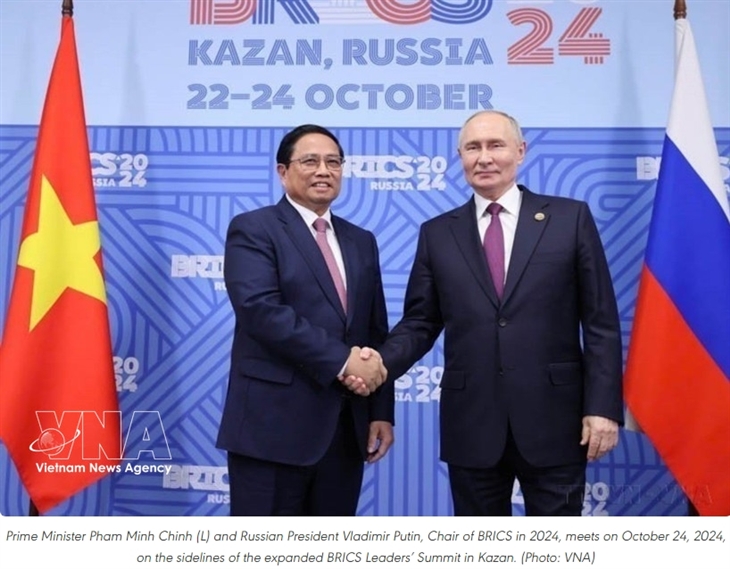
AsemconnectVietnam - According to the Department of Foreign Market Development under the Ministry of Industry and Trade (MoIT), Russia remains one of Vietnam’s key economic partners, particularly in industry and energy. Despite global economic and geopolitical uncertainties, bilateral trade has maintained a positive growth trend.
As Vietnam and Russia upgraded bilateral ties to a comprehensive strategic partnership in 2012 and are implementing the free trade agreement between Vietnam and the Eurasian Economic Union (EAEU), the forthcoming official visit to Russia by Prime Minister Pham Minh Chinh is expected to open new opportunities to advance bilateral trade relations to a higher level.
Positive growth
According to the Department of Foreign Market Development under the Ministry of Industry and Trade (MoIT), Russia remains one of Vietnam’s key economic partners, particularly in industry and energy. Despite global economic and geopolitical uncertainties, bilateral trade has maintained a positive growth trend.
Statistics from the Department of Customs show that two-way trade reached 4.77 billion USD in 2025, up 4% compared with 2024. Textiles and garments accounted for Vietnam’s largest export turnover to Russia, valued at 504 million USD, followed by coffee at 462.3 million USD, and seafood at 214.5 million USD.
Vietnam primarily imports production inputs from Russia. Also last year, coal accounted for the largest share of such imports at 875 million USD (35%), followed by fertilisers 315.2 million USD and plastic materials at 130 million USD.
In the first two months of 2026, bilateral trade reached 700 million USD, down 5.1% year-on-year. However, this decline is regarded as short-term, with the overall long-term trajectory remaining stable growth.
By the end of 2025, Russia had 213 investment projects in Vietnam with total registered capital of nearly 996 million USD, ranking 28th among 153 countries and territories investing in the Southeast Asian country. Major sectors include mining, accommodation and food services, and manufacturing.
Conversely, Vietnam currently has around 18 investment projects in Russia worth approximately 1.64 billion USD. Russia ranks fourth among the 85 countries and territories receiving Vietnamese outward investment, mainly in mining, industry and real estate.
At the 14th session of the industry cooperation subcommittee under the Vietnam–Russia intergovernmental committee on economic, trade, and sci-tech cooperation, the two sides reached important agreements in areas including transport manufacturing, railway industry, mechanical engineering, pharmaceuticals and medical equipment, mining, chemicals and metallurgy.
Seven priority cooperation areas were identified, notably the automotive industry, electrical engineering and renewable-energy equipment, chemicals, metallurgy, radio electronics and digital technology, and railway engineering.
Broadening cooperation space
The MoIT noted that bilateral energy and oil-and-gas cooperation has expanded beyond exploration and crude extraction into high-technology, high-value fields. These include gas-fired power plants in Vietnam, liquefied natural gas (LNG) supply, renewable-energy infrastructure development, fuel production and modernisation of existing energy facilities.
Speaking at a Vietnam–Russia scientific forum on industrial, technological and innovation promotion, Trinh Minh Anh of the Vietnam Institute of Strategy and Policy for Industry and Trade highlighted renewable energy, particularly offshore wind, as a clear indicator of evolving bilateral relations. This cooperation carries not only economic significance but also symbolic value, demonstrating continuity of traditional friendship while opening a new chapter focused on global frontier sectors, he said.
Experts noted that Vietnam is at a pivotal stage in its energy transition, where renewable energy is no longer optional but strategically essential. With abundant resources, favourable geography and an improving investment climate, Vietnam is becoming an attractive destination for large-scale energy projects. Russia, meanwhile, possesses strong technological capabilities in core industries such as oil and gas, engineering, energy and science. This complementarity provides an ideal basis for deeper cooperation.
As both countries seek to restructure growth models and transition towards green, sustainable industries, Vietnam–Russia energy cooperation faces a rare window of opportunity.
Vietnam’s institutional reforms, logistics development, digital transformation and commitment to net-zero emissions are improving the investment environment. Meanwhile, Russia’s technological strengths and industrial experience further enhance the potential for high-quality collaboration.
To further boost bilateral trade, the ministry plans to refine and expand cooperation mechanisms, fully utilise existing agreements, particularly the EAEU-Vietnam FTA, and balance trade structures in line with each side’s needs and potential.
Priority will be given to flexible joint-venture models that maximise economic complementarity, alongside intensified trade promotion and business connectivity. An annual Vietnam–Russia trade and investment forum will serve as a stable dialogue channel for enterprises, trade-promotion bodies, chambers of commerce and official representatives.
The ministry will also organise specialised trade and investment missions to Russia, support participation in fairs, exhibitions and seminars, and help Vietnamese firms connect with major distribution networks, especially supermarket chains and large e-commerce platforms. Major domestic promotion events such as Vietnam Expo and FoodExpo will continue to be widely publicised to attract Russian businesses seeking partnerships, investment opportunities and supply sources in Vietnam./.
Source: en.vietnamplus.vn/vietnam-russia-expand-room-for-elevate-trade-cooperation-post339677.vnp
Positive growth
According to the Department of Foreign Market Development under the Ministry of Industry and Trade (MoIT), Russia remains one of Vietnam’s key economic partners, particularly in industry and energy. Despite global economic and geopolitical uncertainties, bilateral trade has maintained a positive growth trend.
Statistics from the Department of Customs show that two-way trade reached 4.77 billion USD in 2025, up 4% compared with 2024. Textiles and garments accounted for Vietnam’s largest export turnover to Russia, valued at 504 million USD, followed by coffee at 462.3 million USD, and seafood at 214.5 million USD.
Vietnam primarily imports production inputs from Russia. Also last year, coal accounted for the largest share of such imports at 875 million USD (35%), followed by fertilisers 315.2 million USD and plastic materials at 130 million USD.
In the first two months of 2026, bilateral trade reached 700 million USD, down 5.1% year-on-year. However, this decline is regarded as short-term, with the overall long-term trajectory remaining stable growth.
By the end of 2025, Russia had 213 investment projects in Vietnam with total registered capital of nearly 996 million USD, ranking 28th among 153 countries and territories investing in the Southeast Asian country. Major sectors include mining, accommodation and food services, and manufacturing.
Conversely, Vietnam currently has around 18 investment projects in Russia worth approximately 1.64 billion USD. Russia ranks fourth among the 85 countries and territories receiving Vietnamese outward investment, mainly in mining, industry and real estate.
At the 14th session of the industry cooperation subcommittee under the Vietnam–Russia intergovernmental committee on economic, trade, and sci-tech cooperation, the two sides reached important agreements in areas including transport manufacturing, railway industry, mechanical engineering, pharmaceuticals and medical equipment, mining, chemicals and metallurgy.
Seven priority cooperation areas were identified, notably the automotive industry, electrical engineering and renewable-energy equipment, chemicals, metallurgy, radio electronics and digital technology, and railway engineering.
Broadening cooperation space
The MoIT noted that bilateral energy and oil-and-gas cooperation has expanded beyond exploration and crude extraction into high-technology, high-value fields. These include gas-fired power plants in Vietnam, liquefied natural gas (LNG) supply, renewable-energy infrastructure development, fuel production and modernisation of existing energy facilities.
Speaking at a Vietnam–Russia scientific forum on industrial, technological and innovation promotion, Trinh Minh Anh of the Vietnam Institute of Strategy and Policy for Industry and Trade highlighted renewable energy, particularly offshore wind, as a clear indicator of evolving bilateral relations. This cooperation carries not only economic significance but also symbolic value, demonstrating continuity of traditional friendship while opening a new chapter focused on global frontier sectors, he said.
Experts noted that Vietnam is at a pivotal stage in its energy transition, where renewable energy is no longer optional but strategically essential. With abundant resources, favourable geography and an improving investment climate, Vietnam is becoming an attractive destination for large-scale energy projects. Russia, meanwhile, possesses strong technological capabilities in core industries such as oil and gas, engineering, energy and science. This complementarity provides an ideal basis for deeper cooperation.
As both countries seek to restructure growth models and transition towards green, sustainable industries, Vietnam–Russia energy cooperation faces a rare window of opportunity.
Vietnam’s institutional reforms, logistics development, digital transformation and commitment to net-zero emissions are improving the investment environment. Meanwhile, Russia’s technological strengths and industrial experience further enhance the potential for high-quality collaboration.
To further boost bilateral trade, the ministry plans to refine and expand cooperation mechanisms, fully utilise existing agreements, particularly the EAEU-Vietnam FTA, and balance trade structures in line with each side’s needs and potential.
Priority will be given to flexible joint-venture models that maximise economic complementarity, alongside intensified trade promotion and business connectivity. An annual Vietnam–Russia trade and investment forum will serve as a stable dialogue channel for enterprises, trade-promotion bodies, chambers of commerce and official representatives.
The ministry will also organise specialised trade and investment missions to Russia, support participation in fairs, exhibitions and seminars, and help Vietnamese firms connect with major distribution networks, especially supermarket chains and large e-commerce platforms. Major domestic promotion events such as Vietnam Expo and FoodExpo will continue to be widely publicised to attract Russian businesses seeking partnerships, investment opportunities and supply sources in Vietnam./.
Source: en.vietnamplus.vn/vietnam-russia-expand-room-for-elevate-trade-cooperation-post339677.vnp
Vietnam, US forge new growth momentum in technology era
Phu Tho, Thailand boost investment cooperation, business connectivity
Vietnam, Switzerland push to accelerate Vietnam – EFTA FTA talks
Measures sought to help Vietnamese firms expand investment in Indonesia
Upcoming general election signals political stability, stronger parliamentary diplomacy: ambassador
Upcoming general election sparks expectations for new development phase
Vietnamese students in China anticipate election with great hope
Vietnam, Western Australia seek broader ties during business forum
Young voters demonstrate strong awareness of civic responsibility
Ho Chi Minh City: Nearly 9.7 million voters registered for NA, People’s Councils elections
Foreign media, scholars hail significance of Vietnam’s upcoming election
First senior officials’ meeting of CPTPP in 2026 opens in Hanoi
Border communities promote role of village elders in upcoming general election
Khanh Hoa gears up for elections, facilitates voting for tourists
Public debt borrowing and repayment plan for 2026
Ensuring resources: Mobilizing sufficient and timely borrowed capital at reasonable costs and acceptable risks to meet expenditure needs ...Plan on implementation of high-tech law
Inter-sectoral legal support program for small and ...
Tourism destinations refresh offerings to welcome New ...
Across the Mekong Delta, many tourist sites have been busy upgrading their offerings. At the Con Son tourism site in Can Tho city, members ...Annual New Year festival shines in Da Nang
Phu Quoc emerging as a favourite global destination
Vietnam Airlines adds 270 flights to during 2026 New Year ...
