


Cashew industry 2026: expanding markets, elevating deep processing
Monday, March 16,2026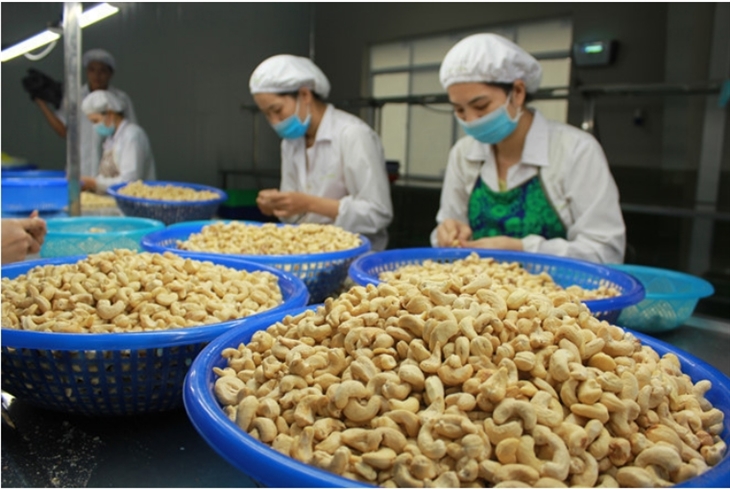
AsemconnectVietnam - Cashew industry starts 2026 with positive growth, aiming for deep processing, market diversification and consolidating its sustainable billion-dollar position.
Cashews thrive at the beginning of this year, consolidating its billion-dollar position
In early days of new year, while many businesses are still busy completing end-of-quarter orders, cashew industry has already made its mark with promising figures. According to data from Customs Department, in January 2026, Vietnam exported 50,600 tonnes of cashews, worth 34.7 million USD. Compared to previous month, both quantity and value decreased by over 25% due to seasonal factors and the Tet holiday, but compared to the same period in 2025, export increased sharply by 35% in quantity and 36.1% in value.
Average export price reached US$6,841/tonne, a slight increase compared to both December 2025 and January 2025. The United States and China continued to be the two largest markets, accounting for nearly 37.5% of total export. Notably, export to most key markets such as the United States, China, Germany, Canada, the United Kingdom, Thailand, and Japan all experienced double-digit growth compared to the same period last year.
In 2025, cashew industry concluded with a remarkable achievement: cashew export reached 766,585 tonnes, valued at US$5.22 billion, a 5.7% increase in volume compared to 2024 and setting a new record in value. After fruits and vegetables and coffee, cashews rose to become Vietnam's third largest agricultural export item, amidst a sharp decline in rice exports. 2025 also marks the year cashews officially join the "club" of agricultural products with export exceeding US$5 billion. A notable change is that for the first time, China has become the largest market for Vietnamese cashews, with a turnover of US$1.115 billion. The United States ranks second with US$975 million, followed by the Netherlands with US$495 million.
According to Vietnam Cashew Association (VINACAS), cashew export to China have increased sharply thanks to the country's economic recovery, increased demand for healthy food and Vietnamese businesses proactively meeting better quality and traceability requirement.
Meanwhile, the United States, the largest market for Vietnamese cashews for over a decade, remains crucial. While previous reciprocal tariffs created some pressure, positive signs have emerged in 2026 as processed cashew kernels are now exempt from reciprocal tariffs, meaning tariff to the US is 0%. This is seen as a "boost" for revenue from this market to return.
Notably, in the United States, consumer trends are shifting towards processed products. While cashew kernel import have slowed down at times, processed cashew nuts have seen an increase. Vietnam, India, Thailand and Canada are the main suppliers for this segment. This raises an important question: future of the cashew industry lies not only in production volume but also in ability to process and diversify products.
In current "nut basket," cashew nuts are priced about 5% lower than walnuts, almonds, or pistachios. This price advantage, in context of consumers tightening their spending, could help increase demand in the US and many other markets.
Towards building a product ecosystem
Besides export figures, issue of raw materials remains a long-standing concern for businesses. Currently, more than 50% of Vietnam's imported raw cashews come from Africa. Meanwhile, many major cashew-producing countries like Ivory Coast are adjusting their policies, restricting export of raw cashews to develop their domestic processing industries.
Challenge, therefore, is not only the risk of raw material shortages, but also direct competition. Processed goods from Africa exported to the US and Europe have advantages in terms of geographical distance and logistics costs.
However, according to VINACAS, global supply of raw cashews in 2025-2026 crop year is projected to reach over 5.5 million tonnes, an increase of about 3% compared to the previous crop year. Therefore, there is no shortage of raw materials; issue lies in approach and strategy of businesses.
One approach that some businesses have adopted is investing in factories directly in Africa to secure a reliable source of raw materials. Mr. Vu Thai Son, Chairman of Board of Directors of Long Son Joint Stock Company (Ho Chi Minh City), stated that when opening a factory in Ivory Coast, the company was able to purchase raw cashews at approximately US$900 per tonne, significantly lower than the US$1,400 per tonne required for direct import into Vietnam. This advantage in raw material prices enhances the competitiveness of exported cashew kernels.
Conversely, many businesses are also choosing to develop domestic raw material areas, signing contracts with cashew farming cooperatives to ensure supply and share benefits with farmers. In an interview with Industry and Trade Newspaper, Mr. Pham Ngoc Thanh, Deputy General Director of Ha My Joint Stock Company (Dong Nai province), said that the company proactively develops local raw material areas through product purchase agreements with cashew farming cooperatives in the area.
This approach not only helps businesses stabilize their supply but also demonstrates their responsibility to support sustainable development of the locality. Furthermore, the company is developing a closed-loop value chain, investing in technology, and aiming for deep processing instead of focusing solely on traditional roasted cashew nuts.
According to Mr. Thanh, if focus is only on roasted cashew nuts, regardless of whether the saltiness, sweetness or crispiness is adjusted, differences between producers are not significant. Meanwhile, cashew nuts can be used as raw materials for many high-value products such as cashew milk, cashew butter, nutritional foods for vegetarians and dieters, or combined products.
Previously, many batches of Vietnamese cashew kernels were exported to the US to be processed into cashew milk and other high-end products in that market. This shows that potential is real; what is lacking is commensurate investment in deep processing domestically.
By mastering technology and building a diverse product ecosystem, cashew industry will reduce its dependence on a few single product lines, mitigating risk of "bumper harvest - falling prices." More importantly, production mindset needs to shift from "selling what we have" to "selling what the market needs."
"This requires clearly defining target customer segment and corresponding product standards. If targeting the high-end segment, products must meet stringent requirements regarding quality, food safety, packaging, traceability and brand story. When standards are clear, the target market will also be clearer," Mr. Thanh shared.
2026 is projected to continue to be favorable as global demand for cashews increases, especially in China, Japan, South Korea, Russia, the Nordic countries and ASEAN. Younger consumers are driving trend of using plant-based products, opening up new opportunities for cashew milk and butter.
VINACAS also identifies the development of domestic raw materials and deep processing as a long-term strategic priority. Goal is not only to maintain its leading global position in cashew kernel exports, but also to improve efficiency, profitability and sustainability.
As the new year arrives, story of Vietnam's cashew industry is not just about billion-dollar figures, but about transformation of an industry that has gone through many changes. As each enterprise proactively innovates, each raw material area is strengthened and each product is elevated in value, Vietnamese cashews will not only maintain their export position, but also enter a longer spring, a spring of quality and innovation.
Source: Vitic/ congthuong.vn
In early days of new year, while many businesses are still busy completing end-of-quarter orders, cashew industry has already made its mark with promising figures. According to data from Customs Department, in January 2026, Vietnam exported 50,600 tonnes of cashews, worth 34.7 million USD. Compared to previous month, both quantity and value decreased by over 25% due to seasonal factors and the Tet holiday, but compared to the same period in 2025, export increased sharply by 35% in quantity and 36.1% in value.
Average export price reached US$6,841/tonne, a slight increase compared to both December 2025 and January 2025. The United States and China continued to be the two largest markets, accounting for nearly 37.5% of total export. Notably, export to most key markets such as the United States, China, Germany, Canada, the United Kingdom, Thailand, and Japan all experienced double-digit growth compared to the same period last year.
In 2025, cashew industry concluded with a remarkable achievement: cashew export reached 766,585 tonnes, valued at US$5.22 billion, a 5.7% increase in volume compared to 2024 and setting a new record in value. After fruits and vegetables and coffee, cashews rose to become Vietnam's third largest agricultural export item, amidst a sharp decline in rice exports. 2025 also marks the year cashews officially join the "club" of agricultural products with export exceeding US$5 billion. A notable change is that for the first time, China has become the largest market for Vietnamese cashews, with a turnover of US$1.115 billion. The United States ranks second with US$975 million, followed by the Netherlands with US$495 million.
According to Vietnam Cashew Association (VINACAS), cashew export to China have increased sharply thanks to the country's economic recovery, increased demand for healthy food and Vietnamese businesses proactively meeting better quality and traceability requirement.
Meanwhile, the United States, the largest market for Vietnamese cashews for over a decade, remains crucial. While previous reciprocal tariffs created some pressure, positive signs have emerged in 2026 as processed cashew kernels are now exempt from reciprocal tariffs, meaning tariff to the US is 0%. This is seen as a "boost" for revenue from this market to return.
Notably, in the United States, consumer trends are shifting towards processed products. While cashew kernel import have slowed down at times, processed cashew nuts have seen an increase. Vietnam, India, Thailand and Canada are the main suppliers for this segment. This raises an important question: future of the cashew industry lies not only in production volume but also in ability to process and diversify products.
In current "nut basket," cashew nuts are priced about 5% lower than walnuts, almonds, or pistachios. This price advantage, in context of consumers tightening their spending, could help increase demand in the US and many other markets.
Towards building a product ecosystem
Besides export figures, issue of raw materials remains a long-standing concern for businesses. Currently, more than 50% of Vietnam's imported raw cashews come from Africa. Meanwhile, many major cashew-producing countries like Ivory Coast are adjusting their policies, restricting export of raw cashews to develop their domestic processing industries.
Challenge, therefore, is not only the risk of raw material shortages, but also direct competition. Processed goods from Africa exported to the US and Europe have advantages in terms of geographical distance and logistics costs.
However, according to VINACAS, global supply of raw cashews in 2025-2026 crop year is projected to reach over 5.5 million tonnes, an increase of about 3% compared to the previous crop year. Therefore, there is no shortage of raw materials; issue lies in approach and strategy of businesses.
One approach that some businesses have adopted is investing in factories directly in Africa to secure a reliable source of raw materials. Mr. Vu Thai Son, Chairman of Board of Directors of Long Son Joint Stock Company (Ho Chi Minh City), stated that when opening a factory in Ivory Coast, the company was able to purchase raw cashews at approximately US$900 per tonne, significantly lower than the US$1,400 per tonne required for direct import into Vietnam. This advantage in raw material prices enhances the competitiveness of exported cashew kernels.
Conversely, many businesses are also choosing to develop domestic raw material areas, signing contracts with cashew farming cooperatives to ensure supply and share benefits with farmers. In an interview with Industry and Trade Newspaper, Mr. Pham Ngoc Thanh, Deputy General Director of Ha My Joint Stock Company (Dong Nai province), said that the company proactively develops local raw material areas through product purchase agreements with cashew farming cooperatives in the area.
This approach not only helps businesses stabilize their supply but also demonstrates their responsibility to support sustainable development of the locality. Furthermore, the company is developing a closed-loop value chain, investing in technology, and aiming for deep processing instead of focusing solely on traditional roasted cashew nuts.
According to Mr. Thanh, if focus is only on roasted cashew nuts, regardless of whether the saltiness, sweetness or crispiness is adjusted, differences between producers are not significant. Meanwhile, cashew nuts can be used as raw materials for many high-value products such as cashew milk, cashew butter, nutritional foods for vegetarians and dieters, or combined products.
Previously, many batches of Vietnamese cashew kernels were exported to the US to be processed into cashew milk and other high-end products in that market. This shows that potential is real; what is lacking is commensurate investment in deep processing domestically.
By mastering technology and building a diverse product ecosystem, cashew industry will reduce its dependence on a few single product lines, mitigating risk of "bumper harvest - falling prices." More importantly, production mindset needs to shift from "selling what we have" to "selling what the market needs."
"This requires clearly defining target customer segment and corresponding product standards. If targeting the high-end segment, products must meet stringent requirements regarding quality, food safety, packaging, traceability and brand story. When standards are clear, the target market will also be clearer," Mr. Thanh shared.
2026 is projected to continue to be favorable as global demand for cashews increases, especially in China, Japan, South Korea, Russia, the Nordic countries and ASEAN. Younger consumers are driving trend of using plant-based products, opening up new opportunities for cashew milk and butter.
VINACAS also identifies the development of domestic raw materials and deep processing as a long-term strategic priority. Goal is not only to maintain its leading global position in cashew kernel exports, but also to improve efficiency, profitability and sustainability.
As the new year arrives, story of Vietnam's cashew industry is not just about billion-dollar figures, but about transformation of an industry that has gone through many changes. As each enterprise proactively innovates, each raw material area is strengthened and each product is elevated in value, Vietnamese cashews will not only maintain their export position, but also enter a longer spring, a spring of quality and innovation.
Source: Vitic/ congthuong.vn
Export in 2026: growth target of 15-16%
Bringing Vietnam-Japan fisheries cooperation to level of regional value chain linkage
Vietnam Agricultural Markets – March 16: Coffee fell to three-month low as farm supply surges
An Giang accelerates export shift to meet green consumption trends
World-standard workforce crucial to building int’l financial centre
Vietnamese businesses ride wave of investment in green manufacturing
Seafood exports slowed in February and expected to recover in March
Agricultural exports maintain growth momentum in 2 months
Vietnam Agricultural Markets – March 15: Pepper rose on harvest demand while coffee and durian plunged
Vietnam Agricultural Markets – March 14: Coffee rebounded, durian firm while pepper fell to multi-month low
Tea export increased by nearly 30%: An opportunity to reposition Vietnamese tea brands
Fruit and vegetable export to EU set a new record
Vietnam's canned tuna export in 2026 and market opening opportunities
E5 RON92 biofuel price falls in latest adjustment
