


Tuna export to Canada maintain growth
Monday, February 2,2026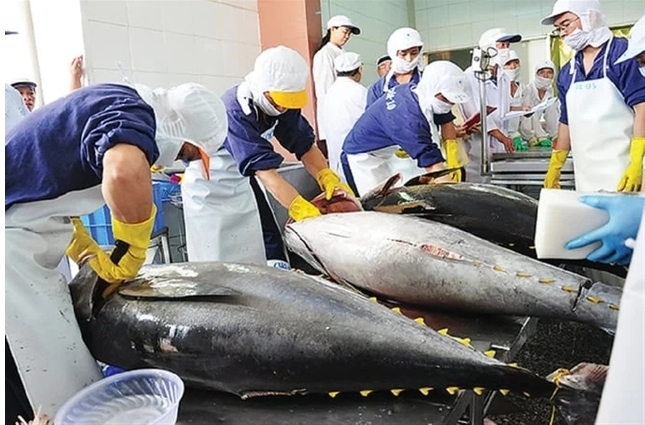
AsemconnectVietnam - Vietnam's tuna export to Canada in 2025 are expected to grow positively but remain subject to monthly fluctuations. Market demand and sustainable product trends continue to open opportunities for Vietnamese businesses.
Tuna export to Canada slightly increase
According to Vietnamese Customs statistics, tuna export to this market in the first 11 months of 2025 reached nearly US$38 million, an increase of about 10% compared to the same period in 2024. This figure shows that there is still room for growth but the market picture is not entirely "rosy" especially as year-end fluctuations indicate a slowdown in growth. Given that Canada is a developed market with high standards, traceability requirements and especially sustainability in fishing, Vietnamese businesses face both opportunities to expand market share and challenges to raise standards to meet new requirements.
According to Vietnam Association of Seafood Processing and Export (VASEP), frozen tuna meat/loin and canned tuna continue to be the two main product groups in Vietnam's tuna exports to Canada, accounting for approximately 70% and 26% respectively. Exports of these two product groups in the first 11 months of 2025 showed good growth compared to the same period last year, both increasing by about 15%. This is a positive foundation, reflecting competitiveness of Vietnamese tuna products in terms of variety and price.
However, cumulative growth does not fully reflect "market rhythm". Looking at monthly figures, tuna exports to Canada in 2025 continuously witnessed periods of rapid increases followed by sharp decreases, indicating instability of orders. In particular, the last months of the year saw a downward trend, suggesting pressure to adjust inventory and caution of importers in the face of economic fluctuations and consumer demand.
Competitively, Canada is an open market with diverse supply sources. Thailand, Italy and Vietnam are currently the three largest tuna suppliers. Canada's tuna imports have been steadily increasing in recent years, creating a large market share but also leading to more intense competition among suppliers. Vietnamese businesses compete not only on price but also on stability of their supply chains, their ability to deliver on time, their diverse product offerings and their capacity to meet technical standards.
According to data from International Trade Centre (ITC), Canada imports tuna from more than 43 countries with a total value of approximately US$214 million. A sufficiently large market with many alternatives gives buyers more bargaining power. Therefore, a fact that Vietnam's tuna exports to Canada are growing in value but fluctuating month by month can be seen as a manifestation of purchasing strategy: optimizing inventory seasonally, allocating orders in batches and changing suppliers when there are discrepancies in price, quality and service.
Sustainability as a purchasing standard, market standard as the "ticket to entry"
Trend of sustainable consumption is changing market structure in Canada. Sustainable tuna products are no longer a "niche market," but are gradually becoming the main purchasing standard.
According to a report by Marine Stewardship Council (MSC), 99.5% of MSC-labeled tuna in Canada is sold in canned form; in a period of 2023–2024 alone, Canadian seafood businesses sold nearly 94 million cans of MSC-certified/labeled tuna. Currently, market has approximately 81 MSC-labeled canned tuna products in major retail systems and this number is expected to continue increasing in a period of 2025-2026. This shows that sustainability criteria are becoming a "mass standard," no longer confined to a niche segment.
For Vietnamese businesses, pressure to shift from "meeting orders" to "meeting market standards" is increasingly evident. In Canada, compliance is not limited to border inspections but is a prerequisite for accessing large distribution systems. Canadian Food Inspection Agency (CFIA) applies strict regulations on food safety, traceability and labeling for fish and seafood products, including imported goods. These requirements are closely linked to consumer trends: transparency, social responsibility and protection of marine resources.
In this context, Vietnamese businesses wishing to increase their sustainable presence in Canada need to focus on three pillars.
Firstly, standardize raw material areas and harvesting-processing chain towards sustainability, increasing proportion of products with MSC certification or equivalent. Secondly, enhance traceability capabilities, apply digital technology in shipment management and meet requirements for transparency of information on labels and shipment records. Thirdly, diversify value-added products, especially convenient canned tuna products, a product group that currently dominates Canadian market.
Vietnam Association of Seafood Processing and Export (VASEP) recommends that, entering 2026, outlook for tuna exports to Canada is considered positive, but with a prerequisite: Vietnamese businesses must simultaneously meet two requirements – stabilizing supply chain and meeting market standards. As demand for sustainable products increases, businesses that are proactive in investing in certification, supply chain risk management and meeting quality control and labeling requirements will have a long-term competitive advantage. Conversely, relying only on short-term price advantages while being slow to raise standards risks shrinking market share.
Source: Vitic/ congthuong.vn
According to Vietnamese Customs statistics, tuna export to this market in the first 11 months of 2025 reached nearly US$38 million, an increase of about 10% compared to the same period in 2024. This figure shows that there is still room for growth but the market picture is not entirely "rosy" especially as year-end fluctuations indicate a slowdown in growth. Given that Canada is a developed market with high standards, traceability requirements and especially sustainability in fishing, Vietnamese businesses face both opportunities to expand market share and challenges to raise standards to meet new requirements.
According to Vietnam Association of Seafood Processing and Export (VASEP), frozen tuna meat/loin and canned tuna continue to be the two main product groups in Vietnam's tuna exports to Canada, accounting for approximately 70% and 26% respectively. Exports of these two product groups in the first 11 months of 2025 showed good growth compared to the same period last year, both increasing by about 15%. This is a positive foundation, reflecting competitiveness of Vietnamese tuna products in terms of variety and price.
However, cumulative growth does not fully reflect "market rhythm". Looking at monthly figures, tuna exports to Canada in 2025 continuously witnessed periods of rapid increases followed by sharp decreases, indicating instability of orders. In particular, the last months of the year saw a downward trend, suggesting pressure to adjust inventory and caution of importers in the face of economic fluctuations and consumer demand.
Competitively, Canada is an open market with diverse supply sources. Thailand, Italy and Vietnam are currently the three largest tuna suppliers. Canada's tuna imports have been steadily increasing in recent years, creating a large market share but also leading to more intense competition among suppliers. Vietnamese businesses compete not only on price but also on stability of their supply chains, their ability to deliver on time, their diverse product offerings and their capacity to meet technical standards.
According to data from International Trade Centre (ITC), Canada imports tuna from more than 43 countries with a total value of approximately US$214 million. A sufficiently large market with many alternatives gives buyers more bargaining power. Therefore, a fact that Vietnam's tuna exports to Canada are growing in value but fluctuating month by month can be seen as a manifestation of purchasing strategy: optimizing inventory seasonally, allocating orders in batches and changing suppliers when there are discrepancies in price, quality and service.
Sustainability as a purchasing standard, market standard as the "ticket to entry"
Trend of sustainable consumption is changing market structure in Canada. Sustainable tuna products are no longer a "niche market," but are gradually becoming the main purchasing standard.
According to a report by Marine Stewardship Council (MSC), 99.5% of MSC-labeled tuna in Canada is sold in canned form; in a period of 2023–2024 alone, Canadian seafood businesses sold nearly 94 million cans of MSC-certified/labeled tuna. Currently, market has approximately 81 MSC-labeled canned tuna products in major retail systems and this number is expected to continue increasing in a period of 2025-2026. This shows that sustainability criteria are becoming a "mass standard," no longer confined to a niche segment.
For Vietnamese businesses, pressure to shift from "meeting orders" to "meeting market standards" is increasingly evident. In Canada, compliance is not limited to border inspections but is a prerequisite for accessing large distribution systems. Canadian Food Inspection Agency (CFIA) applies strict regulations on food safety, traceability and labeling for fish and seafood products, including imported goods. These requirements are closely linked to consumer trends: transparency, social responsibility and protection of marine resources.
In this context, Vietnamese businesses wishing to increase their sustainable presence in Canada need to focus on three pillars.
Firstly, standardize raw material areas and harvesting-processing chain towards sustainability, increasing proportion of products with MSC certification or equivalent. Secondly, enhance traceability capabilities, apply digital technology in shipment management and meet requirements for transparency of information on labels and shipment records. Thirdly, diversify value-added products, especially convenient canned tuna products, a product group that currently dominates Canadian market.
Vietnam Association of Seafood Processing and Export (VASEP) recommends that, entering 2026, outlook for tuna exports to Canada is considered positive, but with a prerequisite: Vietnamese businesses must simultaneously meet two requirements – stabilizing supply chain and meeting market standards. As demand for sustainable products increases, businesses that are proactive in investing in certification, supply chain risk management and meeting quality control and labeling requirements will have a long-term competitive advantage. Conversely, relying only on short-term price advantages while being slow to raise standards risks shrinking market share.
Source: Vitic/ congthuong.vn
Vietnam rice market flat on the morning of Feb. 2 as Nang Nhen prices stayed high
Vietnam coffee prices held firm on morning of February 2, 2026 despite global pressure
Vietnam hog prices showed mixed movements on the morning of February 2, 2026
Vietnam pepper prices remained unchanged on the morning of February 2, 2026
Congestion at border gates largely resolved: Ministry
VinFast unveils plan to expand electric scooter business to five foreign markets
PM Pham Minh Chinh attends final rehearsal for opening ceremony of first Spring Fair 2026
Imports from China increased sharply
Opportunities for Vietnamese shrimp in Chinese market
Vietnam’s wood industry adapts to sustainable development requirements
Vietnam rice market in January 2026
Reference exchange rate continues to drop on January 30
Vietnam agricultural markets on the Morning of Jan 30, 2026
Vietnam's petroleum exports and imports in December and whole year 2025
