


Vietnam’s wood industry adapts to sustainable development requirements
Friday, January 30,2026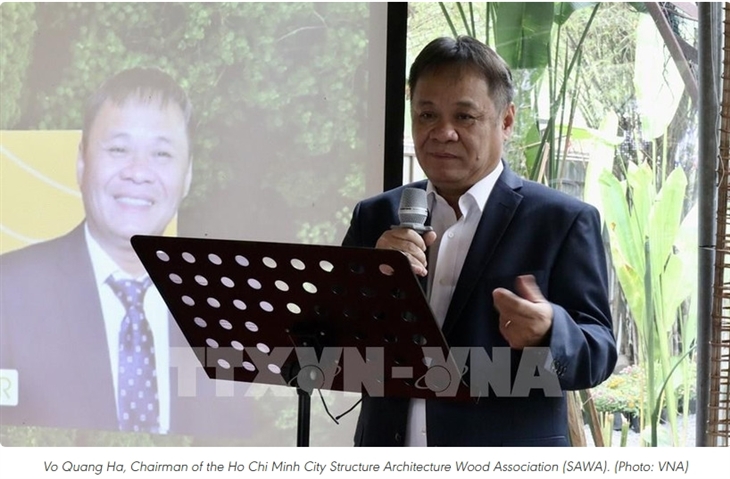
AsemconnectVietnam - Meeting sustainable development requirements is no longer optional but a mandatory condition for Vietnamese wooden furniture and wood products to retain their position in global supply chains.
Meeting sustainable development requirements is no longer optional but a mandatory condition for Vietnamese wooden furniture and wood products to retain their position in global supply chains, experts said at a seminar held in Ho Chi Minh City on January 29.
Vo Quang Ha, Chairman of the Ho Chi Minh City Structure Architecture Wood Association (SAWA), noted that, of more than 17 billion USD in Vietnam’s wood and wood product exports, raw materials and sawn timber account for only about 4–5 billion USD, while the rest comes from furniture and interior products. This highlights the significant potential for value-added growth in the sector.
However, Ha stressed that export expansion must be accompanied by responsible forest management and a long-term vision, supported by clear policy orientation and appropriate mechanisms to engage all stakeholders.
Developing large-timber plantations was identified as a key solution to increasing value added. Large timber generates higher economic returns for forest growers, provides greater economic value and enables longer carbon sequestration, contributing to climate change mitigation. Instead of early harvesting for low-value products such as wood chips, forest owners should be encouraged to extend rotation periods to support deep processing. Residual wood can be utilised for engineered wood products, while plantation timber in Vietnam has the potential to be processed into construction materials. Internationally, engineered wood has already been applied in high-rise buildings and large-scale, environmentally friendly projects.
To Xuan Phuc, Executive Director of Forest Trends’ Forest Products Trade Policy Programme, said global wood markets are rapidly shifting from voluntary to mandatory requirements on legality and sustainability. While voluntary certification schemes such as Forest Stewardship Council (FSC) and Programme for the Endorsement of Forest Certification (PEFC) were once the main tools to ensure sustainability, major consumer markets have since introduced binding regulations, including the EU’s Forest Law Enforcement, Governance and Trade (FLEGT) Voluntary Partnership Agreements (VPA), the US Lacey Act and Australia’s Illegal Logging Prohibition Act.
Since the 2010s, market demands have continued to rise, with legality seen as a necessary but insufficient condition. Consumers and importers increasingly require deforestation-free supply chains, respect for community rights, labour standards, and contributions to emission reduction and climate change response. Many large corporations have committed to sourcing only sustainable wood products with transparent supply chains.
Vietnam’s key export markets apply different levels of requirements, but the overall trend is tightening. The US, accounting for over half of Vietnam’s wooden furniture exports, focuses strongly on legal origin and high-risk timber imports. Although the EU represents a smaller market share, it leads regulatory innovation, notably with the EU Deforestation Regulation (EUDR), which requires traceability and proof of deforestation-free production. Compliance is considered feasible as most exports to the EU already hold FSC or PEFC certification.
Meanwhile, China remains a relatively stable market with lower requirements, mainly importing wood chips. Japan and the Republic of Korea continue to demand pellets, chips and plywood, though with stricter criteria on legality and climate impact. Overall, trade regulations are increasingly shaping forest governance and supply chains in producing countries like Vietnam.
Phuc noted that with over 1.1 million forest-growing households, fragmented landholdings and complex supply chains, Vietnam’s wood industry needs a more comprehensive approach. Key solutions include expanding certified forest areas, enhancing supply chain transparency, supporting smallholders’ livelihoods and reducing reliance on high-risk imported timber.
From a policy perspective, the State’s leading role was underscored through public procurement policies prioritising legal and sustainable wood products, helping reduce trade risks, stimulate the domestic market and improve forest growers’ livelihoods. The private sector is also expected to proactively implement sustainability commitments in response to evolving global consumption trends.
Addressing wood use in construction, Lu Thi Hong, Deputy Director of the Institute for Building Materials under the Ministry of Construction, said wood is increasingly recognised as a renewable, low-carbon material supporting green transition goals.
She recommended restructuring technical standards to integrate quality, origin, sustainability and carbon emissions, while incorporating life cycle assessment and environmental product declarations to align with green building standards and national emission reduction strategies./.
Source: en.vietnamplus.vn/vietnams-wood-industry-adapts-to-sustainable-development-requirements-post336960.vnp
Vo Quang Ha, Chairman of the Ho Chi Minh City Structure Architecture Wood Association (SAWA), noted that, of more than 17 billion USD in Vietnam’s wood and wood product exports, raw materials and sawn timber account for only about 4–5 billion USD, while the rest comes from furniture and interior products. This highlights the significant potential for value-added growth in the sector.
However, Ha stressed that export expansion must be accompanied by responsible forest management and a long-term vision, supported by clear policy orientation and appropriate mechanisms to engage all stakeholders.
Developing large-timber plantations was identified as a key solution to increasing value added. Large timber generates higher economic returns for forest growers, provides greater economic value and enables longer carbon sequestration, contributing to climate change mitigation. Instead of early harvesting for low-value products such as wood chips, forest owners should be encouraged to extend rotation periods to support deep processing. Residual wood can be utilised for engineered wood products, while plantation timber in Vietnam has the potential to be processed into construction materials. Internationally, engineered wood has already been applied in high-rise buildings and large-scale, environmentally friendly projects.
To Xuan Phuc, Executive Director of Forest Trends’ Forest Products Trade Policy Programme, said global wood markets are rapidly shifting from voluntary to mandatory requirements on legality and sustainability. While voluntary certification schemes such as Forest Stewardship Council (FSC) and Programme for the Endorsement of Forest Certification (PEFC) were once the main tools to ensure sustainability, major consumer markets have since introduced binding regulations, including the EU’s Forest Law Enforcement, Governance and Trade (FLEGT) Voluntary Partnership Agreements (VPA), the US Lacey Act and Australia’s Illegal Logging Prohibition Act.
Since the 2010s, market demands have continued to rise, with legality seen as a necessary but insufficient condition. Consumers and importers increasingly require deforestation-free supply chains, respect for community rights, labour standards, and contributions to emission reduction and climate change response. Many large corporations have committed to sourcing only sustainable wood products with transparent supply chains.
Vietnam’s key export markets apply different levels of requirements, but the overall trend is tightening. The US, accounting for over half of Vietnam’s wooden furniture exports, focuses strongly on legal origin and high-risk timber imports. Although the EU represents a smaller market share, it leads regulatory innovation, notably with the EU Deforestation Regulation (EUDR), which requires traceability and proof of deforestation-free production. Compliance is considered feasible as most exports to the EU already hold FSC or PEFC certification.
Meanwhile, China remains a relatively stable market with lower requirements, mainly importing wood chips. Japan and the Republic of Korea continue to demand pellets, chips and plywood, though with stricter criteria on legality and climate impact. Overall, trade regulations are increasingly shaping forest governance and supply chains in producing countries like Vietnam.
Phuc noted that with over 1.1 million forest-growing households, fragmented landholdings and complex supply chains, Vietnam’s wood industry needs a more comprehensive approach. Key solutions include expanding certified forest areas, enhancing supply chain transparency, supporting smallholders’ livelihoods and reducing reliance on high-risk imported timber.
From a policy perspective, the State’s leading role was underscored through public procurement policies prioritising legal and sustainable wood products, helping reduce trade risks, stimulate the domestic market and improve forest growers’ livelihoods. The private sector is also expected to proactively implement sustainability commitments in response to evolving global consumption trends.
Addressing wood use in construction, Lu Thi Hong, Deputy Director of the Institute for Building Materials under the Ministry of Construction, said wood is increasingly recognised as a renewable, low-carbon material supporting green transition goals.
She recommended restructuring technical standards to integrate quality, origin, sustainability and carbon emissions, while incorporating life cycle assessment and environmental product declarations to align with green building standards and national emission reduction strategies./.
Source: en.vietnamplus.vn/vietnams-wood-industry-adapts-to-sustainable-development-requirements-post336960.vnp
China’s Youyi Guan border gate accelerates customs clearance ahead of Lunar New Year
Deputy Minister hopeful for US tariff talks next week
New Zealand – Vietnam Business Council launched in Auckland
Vietnam’s tilapia exports to US accelerate
Spring Fair 2026: trade gathering to spur consumer spending
Vietnam ranks third globally in cassava exports, supply chain faces challenges
Vietnam to pilot smart border gate at Mong Cai-Dongxing international crossing
Vietnamese goods ready for peak Tet shopping season in France
PM urges swift, high-quality implementation of APEC 2027 projects in Phu Quoc
Vietnam targets new export growth milestone in 2026
Vietnam emerges as magnet for AI investment
Can Tho woos Sumitomo with industrial park, green energy pledges
Crypto exchange licensing poised to boost foreign capital attraction
Visa highlights Vietnamese payment trends for 2026

Plan of Hai Duong province for a period of 2021 - 2030, ...
Organize space reasonably and harmoniously, focusing on connecting Hai Duong in common development space, actively contributing to the ...Plan of Hau Giang province in a period of 2021 - 2030, ...
Sustainable forestry development program in a period of ...

Tourism destinations refresh offerings to welcome New ...
Across the Mekong Delta, many tourist sites have been busy upgrading their offerings. At the Con Son tourism site in Can Tho city, members ...Annual New Year festival shines in Da Nang
Phu Quoc emerging as a favourite global destination
Vietnam Airlines adds 270 flights to during 2026 New Year ...
