


Belgian expert optimistic about Vietnam’s economic outlook
Wednesday, January 21,2026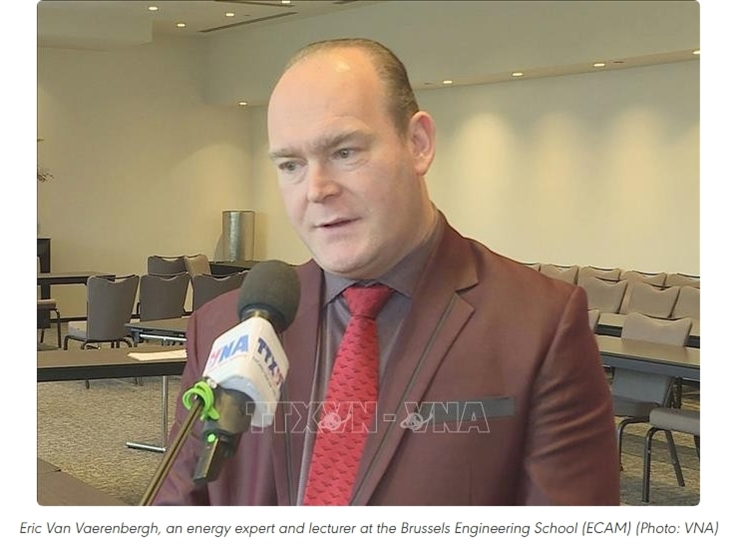
AsemconnectVietnam - Vietnam should move from a growth model based mainly on expanding capital and labour to one driven by productivity improvements. He said that this requires enhancing the quality of the workforce, particularly engineers, technicians, and managers in industrial sectors.
Vietnam’s ambition to maintain strong economic growth over the next decade and become a high-income nation by 2045 is supported by the country’s existing strengths, including deep international integration, a developing industrial base, and an increasingly robust capacity for policy implementation and governance, according to Eric Van Vaerenbergh, an energy expert and lecturer at the Brussels Engineering School (ECAM).
In an interview granted to Vietnam News Agency correspondents in Belgium on the occasion of the 14th National Congress of the Communist Party of Vietnam (CPV), Eric showed his belief in Vietnam’s economic prospects for 2026–2045, noting that the country’s development goals during this period are ambitious yet firmly grounded in practical realities.
However, Eric pointed out that the global development landscape has undergone fundamental changes, with increasing fragmentation in trade and technology; tighter requirements on climate, traceability, and compliance with international standards; and growing constraints on energy, water, and resources. In this context, Vietnam’s challenge is not only to sustain growth but also to ensure its quality and long-term sustainability.
According to the Belgian expert, in the next five years, Vietnam’s economy could grow 6.5–7.5% annually under a central scenario, 8–9% under a high-growth scenario, and approximate 10% under a very high-growth scenario, though this will require several conditions to be met simultaneously. To sustain high growth over the long term, Vietnam will need to implement measures in a coordinated and consistent manner.
Eric emphasised the necessity for Vietnam to accelerate and improve the efficiency of public investment in infrastructure, particularly in energy, seaports, roads, and railways, noting that energy plays a pivotal role in a modern economy.
He also stressed the need to boost productivity, noting that Vietnam should move from a growth model based mainly on expanding capital and labour to one driven by productivity improvements. He said that this requires enhancing the quality of the workforce, particularly engineers, technicians, and managers in industrial sectors.
The legal environment should be further simplified, stabilised, and made more predictable to support long-term production, business and investment, he added.
Regarding free trade agreements (FTAs) that Vietnam is joining, such as the EU-Vietnam Free Trade Agreement (EVFTA), the Comprehensive and Progressive Agreement for Trans-Pacific Partnership (CPTPP), and the Regional Comprehensive Economic Partnership (RCEP), as well as the trend of businesses diversifying their supply chains, Eric said these are important drivers for Vietnam’s economic growth.
To achieve its goal of becoming a high-income country, Vietnam needs to further advance institutional reforms to ensure legal certainty, streamline administrative procedures, and enhance the effectiveness of decision-making, he said.
Alongside institutional reforms, Vietnam should gradually strengthen its position in the global value chain, shifting from assembly to higher added-value activities such as design, component manufacturing, industrial software development, and high-quality services.
Attention should be also paid to substantive administrative reforms, strengthening the role of private economic sector, modernizing state-owned enterprises, improving resource allocation, and effectively implementing a circular economy in practice, he added.
In the context of a complex international geopolitical landscape, the Belgian expert said Vietnam needs to diversify partnerships and proactively comply with new international standards, noting that adhering to these standards will contribute to enhancing the economy’s competitiveness./.
Source: en.vietnamplus.vn/belgian-expert-optimistic-about-vietnams-economic-outlook-post336302.vnp
In an interview granted to Vietnam News Agency correspondents in Belgium on the occasion of the 14th National Congress of the Communist Party of Vietnam (CPV), Eric showed his belief in Vietnam’s economic prospects for 2026–2045, noting that the country’s development goals during this period are ambitious yet firmly grounded in practical realities.
However, Eric pointed out that the global development landscape has undergone fundamental changes, with increasing fragmentation in trade and technology; tighter requirements on climate, traceability, and compliance with international standards; and growing constraints on energy, water, and resources. In this context, Vietnam’s challenge is not only to sustain growth but also to ensure its quality and long-term sustainability.
According to the Belgian expert, in the next five years, Vietnam’s economy could grow 6.5–7.5% annually under a central scenario, 8–9% under a high-growth scenario, and approximate 10% under a very high-growth scenario, though this will require several conditions to be met simultaneously. To sustain high growth over the long term, Vietnam will need to implement measures in a coordinated and consistent manner.
Eric emphasised the necessity for Vietnam to accelerate and improve the efficiency of public investment in infrastructure, particularly in energy, seaports, roads, and railways, noting that energy plays a pivotal role in a modern economy.
He also stressed the need to boost productivity, noting that Vietnam should move from a growth model based mainly on expanding capital and labour to one driven by productivity improvements. He said that this requires enhancing the quality of the workforce, particularly engineers, technicians, and managers in industrial sectors.
The legal environment should be further simplified, stabilised, and made more predictable to support long-term production, business and investment, he added.
Regarding free trade agreements (FTAs) that Vietnam is joining, such as the EU-Vietnam Free Trade Agreement (EVFTA), the Comprehensive and Progressive Agreement for Trans-Pacific Partnership (CPTPP), and the Regional Comprehensive Economic Partnership (RCEP), as well as the trend of businesses diversifying their supply chains, Eric said these are important drivers for Vietnam’s economic growth.
To achieve its goal of becoming a high-income country, Vietnam needs to further advance institutional reforms to ensure legal certainty, streamline administrative procedures, and enhance the effectiveness of decision-making, he said.
Alongside institutional reforms, Vietnam should gradually strengthen its position in the global value chain, shifting from assembly to higher added-value activities such as design, component manufacturing, industrial software development, and high-quality services.
Attention should be also paid to substantive administrative reforms, strengthening the role of private economic sector, modernizing state-owned enterprises, improving resource allocation, and effectively implementing a circular economy in practice, he added.
In the context of a complex international geopolitical landscape, the Belgian expert said Vietnam needs to diversify partnerships and proactively comply with new international standards, noting that adhering to these standards will contribute to enhancing the economy’s competitiveness./.
Source: en.vietnamplus.vn/belgian-expert-optimistic-about-vietnams-economic-outlook-post336302.vnp
ESG standards offer opportunities to reposition Vietnam’s electronics firms
PM updates lead roles to drive UKVFTA forward
Phu Quoc accelerates infrastructure works serving APEC 2027
China-Vietnam economic, trade ties to become model for regional cooperation
Spring Fair 2026 strengthens Vietnam – India cooperation
Indonesian scholar praises Vietnam as model of sustainable, inclusive growth
Vietnam, US launch 15.2 million USD tilapia development project
Vietnam, Singapore enhance cooperation in IFC development
Vietnam eyes Israel as promising rice market under free trade deal
Vietnam records biggest trade surplus with Netherlands among European partners
Gia Lai province steps up IUU crackdown with smart warning system
VIFTA provides impetus for Vietnamese exports to Israel
Vietnam, ASEAN emerge as major export markets for RoK
Chinese scholar assesses Vietnam’s development prospect ahead of 14th National Party Congress
Plan of Hai Duong province for a period of 2021 - 2030, ...
Organize space reasonably and harmoniously, focusing on connecting Hai Duong in common development space, actively contributing to the ...Plan of Hau Giang province in a period of 2021 - 2030, ...
Sustainable forestry development program in a period of ...
Tourism destinations refresh offerings to welcome New ...
Across the Mekong Delta, many tourist sites have been busy upgrading their offerings. At the Con Son tourism site in Can Tho city, members ...Annual New Year festival shines in Da Nang
Phu Quoc emerging as a favourite global destination
Vietnam Airlines adds 270 flights to during 2026 New Year ...
