


HANOI CONVENTION – A MILESTONE IN GLOBAL FIGHT AGAINST CYBERCRIME, A LANDMARK OF VIETNAM’S MULTILATERAL DIPLOMACY
Monday, October 27,2025
AsemconnectVietnam - The signing ceremony of the UN Convention against Cybercrime (Hanoi Convention), to be held in Hanoi on October 25-26, marks a significant moment in international cooperation on cybersecurity, while carrying special significance for Vietnam’s multilateral diplomacy.
In the lead-up to this landmark occasion, State President Luong Cuong addressed leaders around the world with a message underscoring Vietnam’s spirit of “combating cybercrime – sharing responsibility – looking toward the future”, affirming the country’s strong commitment to solidarity, cooperation and upholding the rule of law in the protection of cyberspace – a shared asset of humanity.
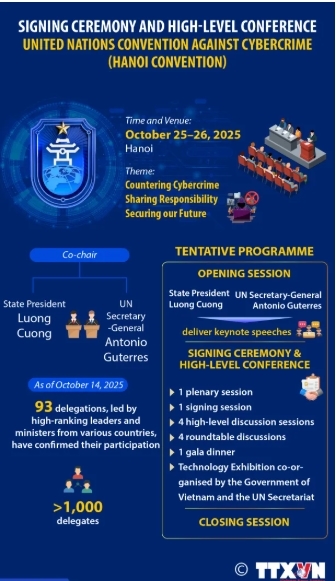
On December 24, 2024, the UN General Assembly officially adopted the convention and designated Hanoi as the venue for the opening of the signing process. This decision reflects the recognition by the world’s largest multilateral organisation of Vietnam’s active and responsible role in addressing cybercrime, a non-traditional security threat with profound implications on global peace, stability, and development.

The event comes at a time when the digital revolution is unleashing unprecedented innovation, while simultaneously escalating risks and vulnerabilities in cyberspace. Cybercrime has become increasingly sophisticated, borderless, and multi-sectoral – ranging from financial fraud and data breaches to attacks on critical infrastructure and government systems.
According to UN reports, the annual global economic damage caused by cybercrime exceeds 8 trillion USD, with millions of cyberattacks occurring every day.
In the US, the Federal Bureau of Investigation’s Internet Crime Complaint Centre (IC3)’s 2024 Internet Crime Report combined information from 859,532 complaints of suspected internet crime and details reported losses exceeding 16 billion USD, a 33% increase in losses from 2023.

In Europe, the “Threat Landscape 2024” report by the European Union Agency for Cybersecurity (ENISA) documented 11,000 cyber incidents, with ransomware and DDoS attacks among the most serious threats, disrupting operations in sectors such as healthcare, education, and public services.
In Vietnam, the cybercrime landscape has grown increasingly complex in scale, nature, and impact.

According to Major General Le Xuan Minh, Director of the Department of Cybersecurity and High-Tech Crime Prevention (A05 – Ministry of Public Security), more than 100,000 cyber-related incidents were recorded last year. Notably, cybercriminals are shifting from isolated, small-scale attacks to well-organised, transnational operations, targeting critical national systems and major economic enterprises.
In this context, the fight against cybercrimes requires multilateral cooperation, mutual legal assistance, the sharing of electronic evidence, and the coordinated enhancement of capabilities on a global scale. Therefore, the Hanoi Convention represents a necessary and significant step forward, enabling countries worldwide to transform goodwill commitments into concrete legal obligations.


State President Luong Cuong chairs the final rehearsal for the Hanoi Convention signing ceremony at the National Convention Centre in Hanoi on October 23, 2025. (Photo: VNA)
Major milestones in Hanoi Convention development
Initiated in 2019 through a UN General Assembly resolution, the convention is the first comprehensive international legal instrument on cybercrime under the UN framework, and the first new multilateral anti-crime treaty by the UN in nearly two decades since the UN Convention against Transnational Organised Crime (Palermo Convention – 2000).

Following eight formal negotiation rounds and five intersessional meetings held over 30 months (from February 2022 to August 2024), the convention was formally adopted on December 24, 2024.

It comprises nine chapters and 71 articles, with many important contents covering the definition of cyber offences, including illegal access, system interference, online child abuse, and laundering of criminal proceeds. Also, jurisdiction and investigative measures for evidence collection and prosecution, and procedural safeguards and law enforcement provisions are covered. The list also includes international cooperation mechanisms for joint investigation and prosecution, preventive measures, capacity-building, awareness-raising, and technical support.

“This landmark convention is a major victory for multilateralism, marking the first international anti-crime treaty in 20 years.”
Ghada Waly, Executive Director of the United Nations Office on Drugs and Crime (UNODC)
Ghada Waly, Executive Director of the United Nations Office on Drugs and Crime (UNODC), underlined that the adoption of this landmark convention is a major victory for multilateralism, marking the first international anti-crime treaty in 20 years. It is a crucial step forward in our efforts to address crimes like online child sexual abuse, sophisticated online scams and money laundering.” “In today’s digital age, cybercrime is becoming more pervasive and destructive, exploiting the vulnerable and draining trillions from our economies every year. UNODC stands ready to support member states in signing, ratifying and implementing this new treaty by providing countries with the tools, assistance and capacity-building support they need to protect their economies and safeguard the digital sphere from cybercrime.”

Deputy Minister of Foreign Affairs Dang Hoang Giang, former Permanent Representative of Vietnam to the UN from 2022-2025, highlighted that Vietnam strongly supported the convention from the outset. From 2022 to 2024, under the mandate of the State President, an inter-agency working group led by the Ministry of Public Security and the Ministry of Foreign Affairs actively and comprehensively participated in all eight negotiation rounds.

“Vietnam advocated for the inclusion of key principles in the convention, including upholding national sovereignty, independence, non-interference in internal affairs, and compliance with international law, ensuring the common interest of all nations in cooperation against cybercrime.”
Deputy Minister of Foreign Affairs Dang Hoang Giang, former Permanent Representative of Vietnam to the UN for 2022-2025


Deputy Prime Minister Bui Thanh Son presides over a meeting of the Steering Committee for the Hanoi Convention signing ceremony on October 13, 2025. (Photo: VNA)
“Guided by its policy of enhancing multilateral diplomacy, Vietnam has actively contributed to shaping international legal frameworks that protect national interests, he noted.
Vietnam advocated for the inclusion of key principles in the convention, including upholding national sovereignty, independence, non-interference in internal affairs, and compliance with international law, ensuring the common interest of all nations in cooperation against cybercrime, said Giang,” Giang said.

He stated that during the negotiation process, Vietnam also served as coordinator for several critical provisions, and its constructive contributions were widely recognised by international partners, helping to finalise a convention that balances national interests and legal frameworks of signature members.
This is the first time a global multilateral convention in such a high-stakes and dynamic area is associated with a Vietnamese city, Giang stated, adding that it reflects the international community’s appreciation of Vietnam’s substantive role in shaping this legal instrument.
Vietnam’s ongoing efforts to strengthen cybersecurity
Over the years, Vietnam has taken numerous concrete steps to counter cyber threats and ensure online security. The Law on Cybersecurity, which took effect in 2018, provides a legal framework to protect national security, public order, and legitimate rights of individuals and organisations in cyberspace. It requires digital platforms and tech firms to respect local laws and national digital sovereignty.


Prime Minister Pham Minh Chinh attends and addresses at a national conference on the implementation of Government Resolution No. 147, which sets the national strategy for the prevention and response to non-traditional security threats until 2030, with a vision to 2045, in Hanoi on September 18, 2025. (Photo: VNA)
Cybersecurity has been elevated to a key and regular task associated with national protection efforts in the new circumstance as stated in the 13th National Party Congress’ Resolution and recent Party resolutions, as well as earlier documents such as the 1998 Resolution 08-NQ/TW, which identified non-traditional security threats as national security challenges.

On this foundation, the country’s legal framework has been generally completed. Along with the 2004 National Security Law and the 2018 Cybersecurity Law, the 2020 national digital transformation programme affirms cybersecurity as a consistent and integral part of digital transformation.
Regulations on personal data protection have also established a clear legal framework for the processing, storage, and transmission of data, alongside technical standards and coordinated incident response procedures.


Dong Nai province receives 85 citizens involved in criminal activities, including online fraud, from Cambodia on July 30, 2025. (Photo: VNA)
Vietnam has also strengthened nationwide cyber monitoring, early warning, and incident response systems, while conducting regular cybersecurity drills and dismantling online scam and cybercrime networks. It has also promoted digital literacy and public awareness campaigns, enhanced public-private cooperation and demanded greater accountability from cross-border platforms providing services in Vietnam.

Vietnam is an active member of numerous regional and inter-regional cybersecurity mechanisms, maintains close collaboration with global law enforcement agencies, shares experience and best practices within ASEAN, and promotes mutual judicial support and extradition under international treaties.

The UN’s adoption of the convention and the decision to open it for signature in Hanoi underscore Vietnam’s readiness to contribute actively to the global fight against cybercrime.

On October 15, during a meeting on preparations for the signing ceremony, State President Luong Cuong affirmed that Vietnam’s role as host underscores its status as a responsible nation, a friend, a reliable partner, and an active and responsible member of the international community, committed to global peace, stability, and development, while upholding the UN Charter and international law.


The Ministry of Foreign Affairs holds a press conference for the United Nations Convention against Cybercrime signing ceremony in Hanoi on the afternoon of October 8, 2025. (Photo: VNA)
As of October 14, 93 delegations led by high-level officials and ministers have confirmed participation, along with over 1,000 delegates and media representatives. UN Secretary-General António Guterres is expected to attend the event in person.

In addition to the main signing ceremony, the event will feature eight high-level side events and dialogues, co-hosted by Vietnamese ministries and the UNODC; 38 expert workshops and panel discussions; and over 20 exhibition booths.
The Hanoi Convention marks a significant milestone in strengthening international cooperation to combat cybercrime. This historic initiative not only protects national security, economic stability, and public order across countries but also aims to create a safe and transparent cyberspace, thus promoting sustainable growth./.
Source: VNA
Source: VNA
Vietnamese, Indonesian businesses strengthen investment, trade ties
Vietnam joins WTO’s dispute settlement mechanism
An Giang to host Vietnam – Cambodia production connectivity conference
Vietnam–Francophonie Economic Forum promotes partnership for shared growth
Zurich discussion opens gateway for cooperation between Khanh Hoa, Swiss firms
Vietnam looks to global best practices to develop crypto-asset market
Vietnam to send delegation to US for reciprocal tariff negotiations
UK–Vietnam business summit to focus on financial hub, renewable energy development
Association pledges to strengthen Vietnam – Japan business connectivity
Vietnam – A magnet for German investment
Plan aims to facilitate Vietnam-Cambodia trade
Can Tho calls for Japan's investment in agriculture, food processing
Vietnam enhances dialogue on tax, customs policies with Korean businesses
FTA implementation: Adapting to defense, conquering new markets
