


Vietnam pepper exports surge in 10 months despite falling prices
Friday, November 20,2026
AsemconnectVietnam - Vietnam’s pepper exports posted strong growth in the first 10 months of this year, though falling prices, Brazilian competition, and stricter import standards continue to challenge the sector.
According to data from the Vietnam Customs, Vietnam exported 25,300 tons of pepper worth $167.1 million in October, up 29 percent in volume and 27.4 percent in value year on year.
For the 10-month period, pepper exports totaled 241,900 tons valued at $1.577 billion, rising 17.4 percent in volume and 12.9 percent in value compared with the same period in 2025. However, the average export price slipped 3.8 percent year on year to $6,521 per ton, dragging export revenue growth below volume expansion.
By market, export volumes rose sharply to Turkey (up 70 percent), Thailand (up 52.7 percent), the US (up 28.1 percent), Egypt (up 27.3 percent), the Philippines (up 19.8 percent), and the Netherlands (up 17.6 percent). Conversely, shipments fell to the UAE (down 25.8 percent), India (down 19 percent), Germany (down 13.3 percent), and the UK (down 10.3 percent).
A bright spot was the US market. Data compiled by the Agency of Foreign Trade under the Ministry of Industry and Trade showed that in the first nine months of 2026, the US imported 68,800 tons of pepper worth $513.64 million, up 6.7 percent in volume and 7.5 percent in value. Vietnam supplied 54,940 tons valued at $412.21 million, up 22.8 percent and 21.7 percent, respectively.
Consequently, Vietnam’s market share in the US expanded from 69.42 percent in 2025 to 79.86 percent in volume, and from 70.9 percent to 80.25 percent in value during the nine-month period, while imports from Indonesia, India, and China declined.
Competitive pricing bolstered this gain, as Vietnam’s average import price into the US dipped 0.9 percent to $7,503 per ton, contrasting with price hikes from Indonesia, China, and Brazil.
Despite these gains, sustaining market share requires meeting stringent food safety, pesticide residue, and traceability standards, including the EU Deforestation Regulation (EUDR) and the US Food Safety Modernization Act (FSMA). Because Vietnam’s pepper cultivation remains fragmented among smallholders and multi-tier intermediaries, exporters struggle with GPS mapping and origin tracking.
Industry experts urge stronger linkages with cooperatives, digitized farming data, strict residue control at the farm level, and greater investment in deep processing to boost added value.
Source: en.vneconomy.vn/vietnam-pepper-exports-surge-in-10-months-despite-falling-prices.htm
Vietnamese seafood rises to top supply group in Singapore
What changes must Vietnamese food exporters make to their packaging when exporting to EU?
Electronics and phone exports exceed USD 207 billion in the first 10 months
Proof of origin, conditions for utilizing FTA preferences
Transparency in origin to enhance value of seafood export
Certificate of origin: small and medium-sized enterprises hope for support
To leverage FTA preferences, businesses need to master rules of origin.
Removing obstacles to rules of origin helps Hai Phong businesses take advantage of FTAs
Wood export: transparency of raw materials to meet rules of origin
Promoting Vietnam-Cambodia trade connections
Self-certification of origin: proactively leveraging CPTPP preferences
China increases purchases, Vietnamese rice export welcome recovery signals
Export in 2027: Which product groups have prospects and what do businesses need to prepare?
EVFTA creates opportunities for Vietnamese goods to expand market share in EU
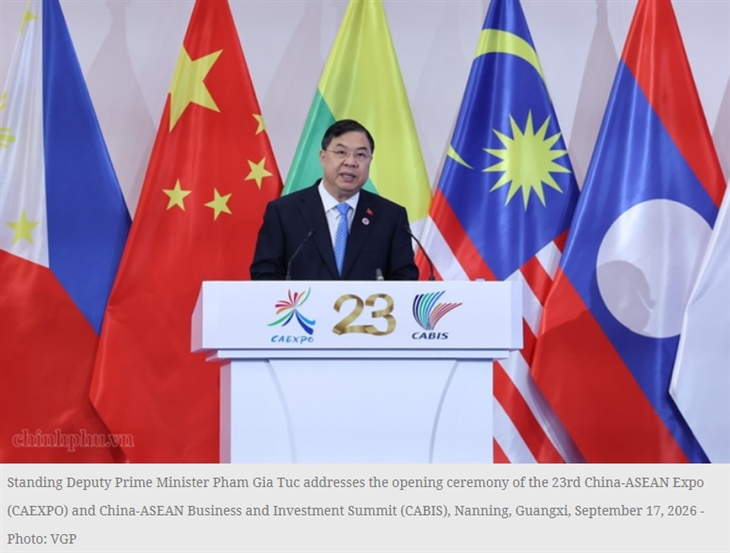
Viet Nam seeks to expand space for ASEAN-China cooperation ...
Viet Nam expects to make greater contributions to expanding the space for ASEAN-China cooperation for shared prosperity, underlined ...Top leader To Lam to attend 81st UNGA General Debate, ...
Viet Nam treasures friendly relations with Thailand: Prime ...

Viet Nam approves action program to implement ASEAN ...
The Vietnamese Government has approved an action program to implement the ASEAN Connectivity Strategic Plan in Viet Nam for 2026–2035 ...Industry and trade sector steps up strategic technology ...
Gov't approves National AI Strategy
Viet Nam continues to strengthen its strategic position in ...
