


What changes must Vietnamese food exporters make to their packaging when exporting to EU?
Thursday, November 19,2026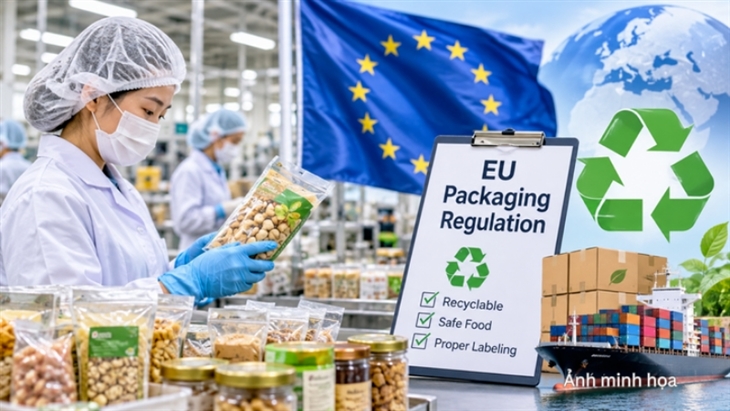
AsemconnectVietnam - New EU regulations on packaging and packaging waste impose requirements on Vietnamese food exporters, from material control and documentation completion to design for recycling.
Material and documentation review for each product code:
A bag of exported cashews might be made from multi-layered film to limit oxygen and moisture penetration. When businesses consider switching to a more recyclable structure, new bag must be re-tested for preservation capabilities, seal tightness and suitability for packaging line. Changing materials therefore entails a series of decisions regarding technical aspects, costs and product quality.
This scenario was presented at Vietnam International Food Industry Conference 2026, held in Ho Chi Minh City, within framework of Vietnam Foodexpo 2026. From requirements for food contact materials to design roadmaps for recycling, conference content showed that businesses need to review packaging right from material procurement and product development stages.
According to Dr. Ngo Xuan Nam, Deputy Director of SPS Vietnam Office, businesses need to consider three groups of requirements simultaneously. The first group is safety of food contact materials, including migration control and material traceability. Second group is environmental requirements according to Regulation (EU) 2025/40 on Packaging and Packaging Waste (PPWR). The third group relates to label information, including how to present environmental characteristics of packaging to consumers.
Accordingly, PPWR will be applied universally from August 12, 2026, to packaging placed on EU market, including packaging for imported goods. Requirements for immediate business review include limitations on PFAS (polypropylene-based Ascorbic Acid) in food-contact packaging, technical documentation and conformity declarations, according to roles of each party. Requirements for harmonized labeling, recyclability classification and recycled plastic content have separate timelines. Timing of implementation of some provisions depends on implementing documents.
Review needs to focus on each component of packaging. Oil-resistant paper and molded pulp packaging are material groups highlighted in discussion when considering PFAS risks. Regarding bisphenol A (BPA), businesses need to pay attention to can coatings, lids, printing inks and adhesives depending on packaging structure. Discussion also outlines a separate transitional deadline of January 20, 2028, for certain disposable food-contact items used for preserving fruits, vegetables and seafood within scope of regulations. This has direct implications for canning businesses when planning alternative coating trials and working with can and lid suppliers.
From a testing perspective, Dr. Ngo Xuan Nam noted that businesses need to confirm with testing laboratory about sample type, method and quantitative limits before submitting samples. Scope of testing may vary between paper, plastic and coated materials. For example, when evaluating an oil-resistant paper bag, businesses need to check if the laboratory's testing scope includes the type of paper and coating being used. Results should then be recorded along with information about material code and specifications of tested sample.
Mr. Nguyen Quoc Dung, Head of Chemical Engineering Department, Eurofins Vietnam, analyzed PPWR according to stages from design, material selection to reuse, labeling and traceability. In design stage, color, labels, adhesives, inks and coatings can all affect the identification, classification or quality of material obtained after recycling. When reviewing a plastic bottle, for example, businesses need to consider bottle body, cap, and label separation. For flexible films, assessment needs to take into account film layers and materials binding them together.
Based on above requirements, Vietnam SPS Office proposes that businesses create a catalog of packaging for each export product code, recording structure, number of layers, material type and intended use. This catalog serves as basis for collecting compliance declarations from suppliers, determining tests to be performed and reviewing content on labels. When suppliers change film, ink, adhesive or coating, changed information needs to be forwarded to food business for reassessment of relevant product code's documentation.
Assignment of responsibilities also needs to be clarified with importing partner. Depending on roles as stipulated by regulations and sales market, parties need to identify the unit responsible for preparing and maintaining documentation, party bearing testing costs and the party performing Extended Responsibility for Producers (EPR). Presentation by SPS Vietnam Office cited case of registration through the LUCID system in Germany to illustrate that businesses must determine their obligations according to the country where packaging is placed on market.
Designs for recycling must retain their protective function.
According to Mr. Bui Quang Thinh, Chairman of Committee on Science, Technology and Sustainable Packaging, Vietnam Packaging Association (VINPAS), design should start from characteristics of food and conditions of use. For dry goods, businesses need to determine sensitivity to oxygen, moisture and expected shelf life. Frozen goods packaging needs to have durability at low temperatures, puncture resistance and appropriate airtightness. For sterilized food in packaging, materials and seals must meet heat treatment requirements of the product.
In example of cashew nuts, VINPAS proposed a research plan to switch from PET, aluminum and PE laminated film to a structure mainly made of PE with a specialized barrier layer. Plan aims for compatibility with recycled PE while maintaining preservation functionality. To evaluate, businesses need to measure oxygen and moisture barrier capabilities, test seal tightness, run samples on machines and monitor quality of cashew nuts during storage. Results on finished packaging serve as basis for deciding whether or not to put solution into production.
For flexible packaging, a structure primarily made of PE or PP can reduce need to combine difficult-to-process plastics. Applicability also depends on stiffness, heat resistance, sealing performance and machine speed. VINPAS also notes that entire structure must be evaluated, including film, barrier layer, ink and adhesive. A change in barrier layer may necessitate adjustments to film thickness or sealing conditions to maintain product quality.
Technical guidelines such as CEFLEX and RecyClass are introduced by VINPAS for businesses to refer to when designing and evaluating recyclability. CEFLEX can support selection of structure for flexible packaging from design stage. RecyClass provides evaluation methods for each material type. Evaluation results from these tools can supplement technical evidence for the business's dossier. Determination of legal obligations and recycling approval under PPWR is carried out according to applicable EU criteria.
Another approach is to reduce packaging materials and space. Businesses can consider reducing film thickness, adjusting bag and box sizes, or optimizing pallet stacking. According to VINPAS, assessment needs to monitor both amount of packaging per kilogram of food and rate of product spoilage. If size or thickness is changed, businesses need to re-test impact resistance, airtightness and product quality after storage and transportation.
VINPAS proposes a 90-day roadmap for businesses to start with specific product codes. In the first 30 days, businesses create a list of export products, collect documentation and update customer requirements. From day 31 to day 60, businesses classify risks and select 2–3 priority product codes. Final stage is for sample testing, measurement, assessment of recyclability and comparison with projected costs. For businesses considering changing packaging, results for each product code serve as a basis for deciding whether to maintain the current structure, improve materials or invest in equipment.
Source: Vitic/ congthuong.vn
Proof of origin, conditions for utilizing FTA preferences
Transparency in origin to enhance value of seafood export
Certificate of origin: small and medium-sized enterprises hope for support
To leverage FTA preferences, businesses need to master rules of origin.
Removing obstacles to rules of origin helps Hai Phong businesses take advantage of FTAs
Wood export: transparency of raw materials to meet rules of origin
Promoting Vietnam-Cambodia trade connections
Self-certification of origin: proactively leveraging CPTPP preferences
China increases purchases, Vietnamese rice export welcome recovery signals
Export in 2027: Which product groups have prospects and what do businesses need to prepare?
EVFTA creates opportunities for Vietnamese goods to expand market share in EU
Agricultural, forestry and aquatic product export reached over 63 billion USD after 10 months
Seafood export exceed US$10.4 billion: What's driving force for end of this year?
UKVFTA creates momentum to raise standards for Vietnamese goods in UK market
Viet Nam seeks to expand space for ASEAN-China cooperation ...
Viet Nam expects to make greater contributions to expanding the space for ASEAN-China cooperation for shared prosperity, underlined ...Top leader To Lam to attend 81st UNGA General Debate, ...
Viet Nam treasures friendly relations with Thailand: Prime ...

Viet Nam approves action program to implement ASEAN ...
The Vietnamese Government has approved an action program to implement the ASEAN Connectivity Strategic Plan in Viet Nam for 2026–2035 ...Industry and trade sector steps up strategic technology ...
Gov't approves National AI Strategy
Viet Nam continues to strengthen its strategic position in ...
