


Removing obstacles to rules of origin helps Hai Phong businesses take advantage of FTAs
Wednesday, November 11,2026
AsemconnectVietnam - Faced with increasingly stringent requirements on origin of goods, Hai Phong has shifted focus of supporting businesses from removing procedural obstacles to improving capacity to enforce rules of origin.
C/O - the “passport” of exported goods
Report on socio-economic situation in October and the first 10 months of 2026 by General Statistics Office (Ministry of Finance) shows that GDP in the third quarter of 2026 increased by 9.95%, bringing growth for the first 9 months to 9.01%. The first 10 months of 2026 recorded historical milestones such as total import and export turnover exceeding 1,010 billion USD for the first time; registered FDI capital reached 54.85 billion USD, the highest since 2009; implemented FDI capital reached 24.08 billion USD, the highest in 5 years.
Contributing to this overall result, data from Customs Department of Region III shows that Hai Phong city's export turnover in the first 10 months is estimated at US$49.3 billion, an increase of 12.3% compared to the same period last year, reaching 94.9% of annual plan; import reached US$40.1 billion, an increase of 18.8%. The city's main export markets are South Korea, Japan and European Union (EU).
Sharing with reporters from Industry and Trade Newspaper about this export growth result, Mr. Nguyen Cong Han, Deputy Director of Department of Industry and Trade of Hai Phong city, said that network of Free Trade Agreements (FTAs), especially new generation FTAs, is opening up many opportunities for the city's export activities. Furthermore, the business community in the city now understands regulations on origin of goods, thereby effectively utilizing tariff preferences and ensuring transparency in exports. Mr. Nguyen Cong Han likened the Certificate of Origin (C/O) to a "trade passport," enabling Vietnamese goods to benefit from preferential tariffs under FTAs, while also serving trade management, trade defense and meeting increasingly stringent technical requirements of import markets.
Hai Phong currently has over 3,200 businesses directly involved in import and export activities and over 1,800 businesses producing goods for export. Given this scale, whether businesses meet rules of origin directly impacts production and business of entire city.
According to Mr. Nguyen Cong Han, many businesses, especially small and medium-sized enterprises or those newly involved in exporting, still face difficulties in determining origin, choosing appropriate C/O forms, preparing documentation and handling arising situations. Meanwhile, post-verification of origin by foreign regulatory agencies is becoming increasingly stringent, requiring businesses to improve their management capacity and compliance.
Currently, businesses are facing challenges that no longer primarily lie in accessing policies but rather in implementation capacity. Many businesses report difficulties in determining regional value content (RVC), applying specific product rules (PSR), proving origin of raw materials purchased from multiple suppliers and issues related to administrative procedures and logistics services.
These difficulties are even more apparent in industries heavily reliant on imported raw materials and components, such as electronics and textiles. Mr. Do Nam Hai, Deputy General Director of Hai Garment Joint Stock Company – a company whose products are largely exported to EU and the US – believes that FTAs help businesses expand their markets, maintain production and provide jobs for thousands of workers. However, according to him, tariff preferences are only a necessary condition; businesses must continue to innovate technology, standardize processes and meet standards of each market.
Failure to fully comply with rules of origin not only results in loss of tariff preferences but also risks rejection of Certificates of Origin (C/O) or post-audit risks. A lack of a systematic record-keeping system also makes it difficult for businesses to explain the origin of goods, affecting their reputation in international market.
To address these issues, Hai Phong City Department of Industry and Trade has recently organized numerous training programs on origin of goods and export development support for businesses. For example, at training conference on July 25th, speakers from Department of Industry and Trade presented five topics covering an overview of origin of goods and Certificates of Origin (C/O); the C/O issuance process; financial solutions to support import and export businesses; practical situations and common errors; and post-inspection and verification of origin.
Similarly, at conference on November 7th, training topics on origin were explored in greater depth: distinguishing between preferential and non-preferential rules of origin, selecting appropriate documents; guidance on rules of origin, documentation, and common errors for C/O Form B; practical exercises in determining the origin of specific products and reviewing case studies. Businesses had opportunity to directly discuss difficulties encountered in preparing documents, declaring information, and carrying out procedures for requesting Certificates of Origin (C/O).
Businesses' opinions were addressed immediately at conference by Department's leaders and specialized units. For issues beyond their authority, Hai Phong Department of Industry and Trade compiled and submitted proposals to the Ministry of Industry and Trade and other relevant ministries and agencies for consideration and resolution.
Procedural reform, creating room for growth
In parallel with training, Hai Phong is accelerating reform of C/O issuance procedures. From August 2025, the city will implement C/O issuance according to the "5-in-1" model at Public Administrative Service Center: receiving, appraising, approving, stamping and returning results at one point, helping to reduce processing time by about 70%. By mid-September 2026, the city will have issued approximately 150,000 C/Os for export goods, totaling about 7 billion USD.
These efforts have been recognized. According to 2025 FTA Implementation Index (FTA Index) published by Ministry of Industry and Trade, Hai Phong achieved 35.62/40 points, ranking first among 34 provinces and cities and being the only locality ranked "Very Good," while the national average score is 21.66. The city leads in two component indices: access to information and implementation of legal regulations under the FTA. Speaking at FTA Index 2025 announcement ceremony, Mr. Hoang Minh Cuong, Vice Chairman of Hai Phong People's Committee, said that Hai Phong considers FTA Index as a tool for governance and reform, not a pursuit of rankings.
Supporting businesses regarding origin of goods is also linked to the overall growth target. Speaking at the city's People's Council meeting, Mr. Nguyen Ngoc Tu, Director of Hai Phong Department of Finance, said that industry continues to be main driving force of growth, accounting for approximately 49.5% of GRDP. To achieve a growth target of 13% or more, the city is focusing on removing bottlenecks for businesses, including those related to markets and logistics.
In the coming period, Hai Phong Department of Industry and Trade will continue to improve quality of Certificate of Origin (C/O) issuance in a transparent, timely manner; promote digital transformation; maintain dialogue channels and organize regular thematic training sessions. The goal is to help businesses maximize the benefits from FTAs, reduce trade defense risks and expand export markets.
Source: Vitic/ congthuong.vn
Promoting Vietnam-Cambodia trade connections
Self-certification of origin: proactively leveraging CPTPP preferences
China increases purchases, Vietnamese rice export welcome recovery signals
Export in 2027: Which product groups have prospects and what do businesses need to prepare?
EVFTA creates opportunities for Vietnamese goods to expand market share in EU
Agricultural, forestry and aquatic product export reached over 63 billion USD after 10 months
Seafood export exceed US$10.4 billion: What's driving force for end of this year?
UKVFTA creates momentum to raise standards for Vietnamese goods in UK market
UKVFTA opens up, Vietnamese fruits and vegetables need to overcome technical barriers
RCEP expands export opportunities for Vietnamese goods to ASEAN
Exploiting FTAs, opening up more export opportunities for Nghe An
Ha Tinh: Export recover, import increase
Leveraging CEPA to expand export opportunities for Vietnamese fruits and vegetables to UAE
In the first 10 months of 2026, Vietnam's total goods import and export surpass 1,000 billion USD mark
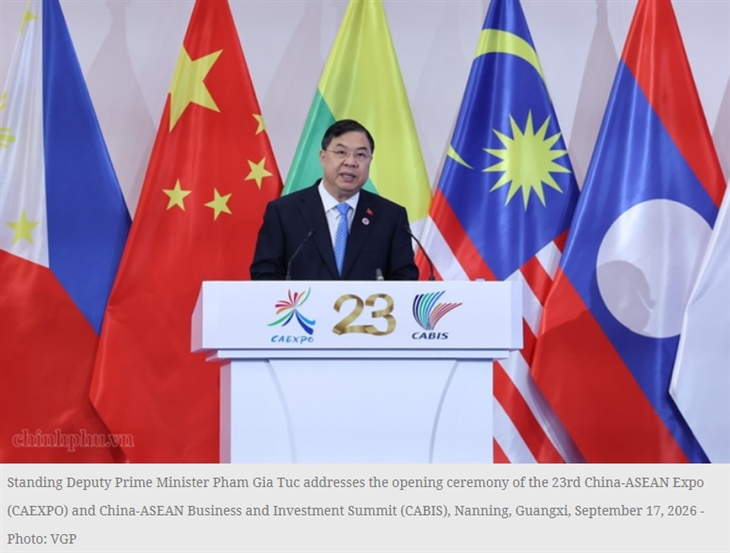
Viet Nam seeks to expand space for ASEAN-China cooperation ...
Viet Nam expects to make greater contributions to expanding the space for ASEAN-China cooperation for shared prosperity, underlined ...Top leader To Lam to attend 81st UNGA General Debate, ...
Viet Nam treasures friendly relations with Thailand: Prime ...
Viet Nam approves action program to implement ASEAN ...
The Vietnamese Government has approved an action program to implement the ASEAN Connectivity Strategic Plan in Viet Nam for 2026–2035 ...Industry and trade sector steps up strategic technology ...
Gov't approves National AI Strategy
Viet Nam continues to strengthen its strategic position in ...
