


Vietnam ranks 47th in UNIDO’s 2026 Quality Infrastructure Index
Tuesday, November 10,2026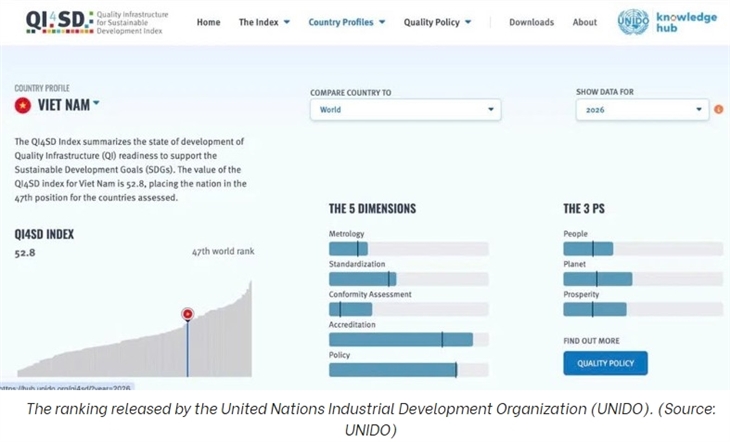
AsemconnectVietnam - The index assesses the development of a country’s quality infrastructure and its contribution to achieving the United Nations Sustainable Development Goals.
Vietnam scored 52.8 points and ranked 47th out of 170 countries and territories in the 2026 Quality Infrastructure for Sustainable Development (QI4SD) Index, released recently by the United Nations Industrial Development Organization (UNIDO).
First introduced in 2022, the QI4SD index assesses the development of a country’s quality infrastructure and its contribution to achieving the United Nations Sustainable Development Goals (SDGs). It is based on 37 indicators across five components: standardisation, metrology, accreditation, conformity assessment and quality policy.
Quality infrastructure does not refer to physical facilities such as roads, bridges, factories or data centres. Instead, it encompasses the institutions, standards, regulations, procedures and technical services that ensure products and services meet requirements for quality, safety and environmental protection. These systems enable countries to measure, test, certify and verify products and services against internationally recognised benchmarks.
Compared with the 2024 assessment, Vietnam improved its score by 1.6 points, from 51.2 to 52.8. Its ranking, however, slipped from 42nd to 47th, partly because the number of countries and territories assessed increased from 155 to 170.
Despite the lower ranking, UNIDO selected Vietnam as one of the countries demonstrating significant improvements in quality infrastructure during 2024–2026, alongside Colombia, Iran, Nigeria and Uzbekistan.
For Vietnam’s export-oriented industries, including textiles and garments, agriculture, food processing and manufacturing, stronger quality infrastructure is increasingly important. Greater adoption of international standards, improved measurement capabilities, traceability and conformity assessment can help businesses meet increasingly stringent market requirements.
As global trade places greater emphasis on sustainability, the ability to demonstrate compliance is becoming an important competitive factor. Developing an integrated quality infrastructure aligned with the practical needs of production could therefore improve product quality, expand market access and strengthen Vietnamese businesses’ participation in international supply chains.
Source: en.vneconomy.vn/vietnam-ranks-47th-in-unidos-2026-quality-infrastructure-index.htm
Viet Nam posts US$12.07 billion trade deficit in January-October period
RCEP expands export opportunities for Vietnamese goods in ASEAN
Viet Nam, Belarus step up business connectivity to expand trade cooperation
AgroViet 2026 to showcase sustainable agriculture technologies and products
Strategic turning point
Vietnam’s stock market capitalization reaches $386 billion
Vietnam’s GDP to surpass Indonesia this year: IMF
Standard Chartered forecasts Viet Nam GDP growth at 11% next year
Vietnam and ASEAN move to elevate position in global value chain
First 10 members of Viet Nam International Financial Center in HCMC announced
Vietnam, Singapore strengthen cooperation on corporate governance
Viet Nam, Poland agree to elevate bilateral ties to Strategic Partnership
Full Joint Statement on upgrading Viet Nam-Poland ties to Strategic Partnership
EuroCham launches "Give Back to Vietnam" initiative, linking business growth with social responsibility
