


Vietnam-EFTA FTA: Another 'highway' to bring Vietnamese goods into European market
Wednesday, October 28,2026
AsemconnectVietnam - On October 18th, Vietnam signed a free trade agreement with countries of European Free Trade Association (EFTA), concluding a 14-year journey with 21 rounds of negotiations.
14 years and 21 negotiation sessions
EFTA consists of four members: Switzerland, Norway, Iceland and Liechtenstein. The journey to negotiating a Free Trade Agreement (FTA) between Vietnam and the EFTA countries began in May 2010, when Vietnam and the EFTA bloc signed a Memorandum of Understanding to establish a Joint Study Group. From initial studies on feasibility of building a free trade agreement, two years later, in April 2012, the Government assigned Ministry of Industry and Trade to lead negotiations with four EFTA countries: Norway, Switzerland, Iceland and Liechtenstein. The first round of negotiations took place in Hanoi from May 22 to 25, 2012, opening a long and complex chapter on issues ranging from trade in goods and services, investment, rules of origin, intellectual property, to sustainable development and technical cooperation.
There were times when negotiation process was interrupted. Some issues required years to find common ground. On September 8, 2025, negotiations resumed in Geneva. From there, two sides entered five consecutive rounds of negotiations to address final aspects of a comprehensive, modern and high-standard agreement.
Culmination of this negotiation journey was EFTA Ministerial Meeting on July 2, 2026, in Iceland. At this meeting, Minister of Industry and Trade, leading Vietnamese negotiating delegation, discussed final issues to complete negotiations.
Fourteen years, 16 rounds of formal negotiations and 5 rounds of technical negotiations demonstrate Vietnam's perseverance in its approach to integration. It doesn't chase speed, nor does it compromise core interests to achieve its goals quickly, but rather persistently seeks balance to build a long-term and sustainable cooperation framework.
On October 18th, Vietnam is scheduled to sign a free trade agreement with the European Free Trade Association (EFTA) countries. This is a new generation, comprehensive free trade agreement with a high level of commitment.
According to the agreement, for industrial and seafood products, EFTA countries commit to continuing to completely eliminate import tariffs on products originating from Vietnam as soon as the agreement comes into effect. On Vietnam's side, most import tariffs on industrial and seafood products from EFTA will be reduced and eliminated within a maximum of 11 years. Vietnamese goods imported from this bloc mainly serve domestic production, including machinery and equipment, electrical and mechanical products, chemicals, seafood raw materials, and pharmaceuticals. This means that reducing import tariffs also simultaneously lowers input costs for manufacturing businesses.
For agricultural products, the parties apply a roadmap for opening up in accordance with trade interests and sensitivity levels of each country. Some key export products of EFTA, such as cheese, coffee, chocolate, baby food and nutritional supplements, will enjoy a 0% tariff rate when entering Vietnamese market over a maximum period of 16 years. At the same time, EFTA also grants Vietnam preferential treatment equivalent to that of recent FTAs signed by the bloc.
Scope of the agreement includes 14 main areas: trade in goods; rules of origin; trade facilitation; trade and services; trade remedies; SPS and TBT measures; investment; intellectual property rights; government procurement; competition; Trade and sustainable development; small and medium-sized enterprises; cooperation and capacity building; institutions and dispute resolution.
For businesses, the two most important areas to consider during preparation are rules of origin and sanitary and phytosanitary measures, as these are the practical conditions that determine whether goods are eligible for preferential tariffs.
Regarding rules of origin, the agreement stipulates a comprehensive system of rules of origin to ensure that goods eligible for preferential tariffs truly originate from participating parties. A notable point is mechanism for cumulation of origin between EFTA member countries and Vietnam and also allows for expanded cumulation for non-agricultural materials originating from ASEAN or EU countries if they have preferential trade agreements with EFTA. The agreement also clearly defines origin criteria for each product group, methods of origin certification and regulations on processing and manufacturing.
Regarding trade defense, the agreement reaffirms rights and obligations of the parties under WTO agreements on anti-dumping, anti-subsidy and safeguard measures. At the same time, the parties commit to enhancing transparency and consultation before applying safeguard measures, aiming to limit the use of anti-dumping measures between the parties. In addition, the agreement establishes a bilateral safeguard mechanism to address cases of increased imports causing significant damage to domestic production.
Expanding trade, investment and technology cooperation between Vietnam and EFTA.
Ahead of the signing ceremony of the Vietnam-EFTA Free Trade Agreement, Norwegian Ambassador to Vietnam Stein Iversen shared with the press that the agreement not only expands trade opportunities but also creates a stable, transparent and predictable legal framework for business operations, sending a message in support of free trade based on international rules, strengthening confidence and minimizing uncertainties in context of global trade being heavily impacted by geopolitical competition.
Among the sectors that will benefit from the agreement, Ambassador Stein Iversen believes that seafood is one of the most clearly beneficial. Improved access to Vietnamese market will significantly enhance competitiveness of Norwegian seafood, especially salmon. Along with trade cooperation, attracting high-quality investment and increasing technological content of economy are prominent areas of cooperation offered by Vietnam-EFTA Free Trade Agreement.
Meanwhile, Swiss Ambassador to Vietnam Thomas Gass also shared that the agreement establishes a modern framework for trade and investment cooperation, contributing to strengthening economic relations between EFTA and Vietnam. According to the Ambassador, the agreement aims to improve market access, reduce trade barriers, enhance legal certainty for businesses and promote sustainable and inclusive growth.
Ambassador Thomas Gass also noted that EFTA-Vietnam FTA is expected to boost trade, investment and technology transfer between Vietnam and EFTA countries. The agreement will also facilitate attracting investment in sectors such as pharmaceuticals, precision engineering, machinery, clean technology and high-quality food, while supporting Vietnam's continued deep integration into global supply chains.
Sharing her views with reporters from Industry and Trade Newspaper on significance of the agreement, Ms. Nguyen Hoang Thuy, Commercial Counselor of Vietnam, Vietnam Trade Office in Sweden, concurrently covering Denmark, Norway, Iceland and Latvia, stated that Vietnam-EFTA FTA goes beyond a tariff reduction agreement. It is a message affirming Vietnam's continued commitment to deep and broad international economic integration, market diversification, partner diversification and improving the quality of trade relations with developed economies.
According to Ms. Nguyen Hoang Thuy, with Vietnam-EFTA FTA, businesses should see not only opportunities to increase exports but also opportunities to upgrade themselves. EFTA market sets very high standards, but these standards are also consistent with Vietnam's new development orientation: increasing added value, improving the quality of growth and participating more deeply in sustainable supply chains.
Ms. Nguyen Hoang Thuy believes that with Vietnam-EFTA Free Trade Agreement, businesses need to remember three keywords: standardization, transparency and perseverance. Standardization should encompass everything from products to processes, documentation and contracts; transparency regarding origin, raw materials, standards, emissions, labor and social responsibility; and perseverance in building trust and long-term cooperative relationships, rather than expecting immediate results.
Source: Vitic/ congthuong.vn
Vietnamese tuna exports saw growth, challenges remained
Import-export of FDI sector: strong momentum from hi-tech industry
Vietnamese seafood welcomes new opportunities from Vietnam-EFTA FTA
VEFTA - further evidence affirming undeniable achievements of international economic integration
Opportunities from VIFTA: Vietnamese seafood export to Israel boost
Dairy imports and exports saw growth in 9 months of 2026
Vietnam records trade surplus for second consecutive period
Vietnam - Panama promote trade, investment and logistics cooperation
CPTPP: 'A connecting point' for Vietnamese goods to deepen into Latin American market
CPTPP opens up Malaysian market, creating more opportunities for Vietnamese Halal products
Imports of paper products increased in October
Fruit and vegetable trade in 9 months of 2026: growth drivers and seasonal fluctuations
Untangling CPTPP origin bottleneck: Textile and garment industry shifts supply sources
Lam Dong: Vegetable and fruit export increase by nearly 300%
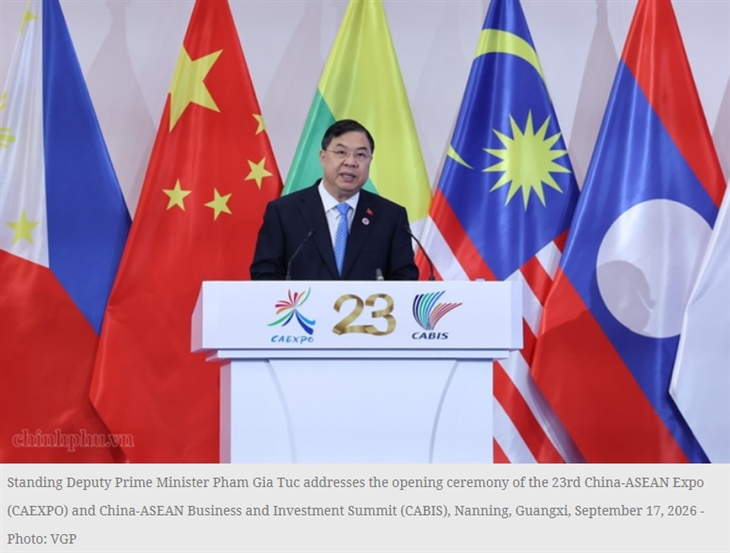
Viet Nam seeks to expand space for ASEAN-China cooperation ...
Viet Nam expects to make greater contributions to expanding the space for ASEAN-China cooperation for shared prosperity, underlined ...Top leader To Lam to attend 81st UNGA General Debate, ...
Viet Nam treasures friendly relations with Thailand: Prime ...
Viet Nam approves action program to implement ASEAN ...
The Vietnamese Government has approved an action program to implement the ASEAN Connectivity Strategic Plan in Viet Nam for 2026–2035 ...Industry and trade sector steps up strategic technology ...
Gov't approves National AI Strategy
Viet Nam continues to strengthen its strategic position in ...
