


VEFTA - further evidence affirming undeniable achievements of international economic integration
Wednesday, October 28,2026
AsemconnectVietnam - Resolution No.59-NQ/TW continues to emphasize need to leverage domestic resources and enhance effectiveness of integration. From results of negotiations and signing of VEFTA to wide-ranging FTA network, there are compelling grounds, evidence and arguments that international economic integration has created and is creating more room for development for Vietnam.
This is a new step in expanding external economic relations, but it also requires viewing integration based on data and results. In comparison with Resolution No. 59-NQ/TW dated January 24, 2025, of the Politburo on international integration in new situation (Resolution No. 59-NQ/TW), it is necessary to affirm the proven achievements, identify limitations, and refute erroneous interpretations of the goals and nature of international economic integration.
Undeniable achievements and practical values
Significance of VEFTA should be viewed from existing cooperation foundation and areas where both sides can complement each other. Currently, average annual trade turnover between Vietnam and EFTA member countries is approximately US$2 billion. Vietnam exports goods such as seafood, footwear, textiles, machinery, electronic equipment and components to these markets; While imports mainly consist of machinery, industrial equipment, chemicals, pharmaceuticals and raw materials for production, this structure shows that trade relations are not only geared towards consuming goods but also linked to the input needs of production.
According to General Statistics Office, in 2025, Vietnam's total import and export turnover of goods reached US$930.05 billion, an increase of 18.2% compared to previous year. Of this, export reached US$475.04 billion, an increase of 17%; imports reached US$455.01 billion, an increase of 19.4%; and trade balance showed a surplus of US$20.03 billion. These are verifiable results regarding the scale and development of the economy's goods trade.
However, these increases are not entirely due to FTAs. General Statistics Office also pointed out supporting factors, such as recovery of demand in many markets, domestic macroeconomic stability, supply chain shifts and improved digitalization processes in logistics and customs. FTAs facilitate market access and tariff preferences, but trade results are still affected by many other factors.
Export structure also presents both opportunities and challenges. In 2025, foreign-invested sector, including crude oil, is expected to achieve export turnover of US$367.09 billion, accounting for 77.3% of total turnover; domestic economic sector will achieve US$107.95 billion, accounting for 22.7% and decreasing by 6.1% compared to the previous year. Processed industrial goods group will reach US$421.47 billion, accounting for 88.7% of total export turnover. These figures demonstrate large scale of exports, while also highlighting need to enhance capacity of domestic enterprises and increase linkages between domestic businesses and FDI sector.
Vietnam-EU trade relations continue to record significant growth. In 2025, total import and export turnover between the two sides will exceed US$73.8 billion, with Vietnam exporting approximately US$56 billion to the EU market. This growth momentum is expected to be maintained in 2026: in the first eight months alone, export turnover reached US$44.26 billion, an increase of 19.8% compared to the same period.
The structure of goods exported to the EU still relies heavily on electronics, computers and components, textiles, and footwear. Alongside these product groups, agriculture, forestry, and fisheries are expanding their presence through higher value-added products such as coffee, cashews, frozen fruits and vegetables, and processed seafood. Access to distribution channels in Northern and Western Europe shows that the opportunity to enhance the position of Vietnamese goods lies not only in the scale of supply but also in the ability to meet market demands. Furthermore, tariff preferences under the EVFTA create a competitive advantage for Vietnamese businesses, especially at a time when ASEAN competitors do not yet have free trade agreements with EU and do not enjoy similar access conditions.
Vietnam-EU economic relations are also expanding beyond processing and consumption of goods. With its advantageous location and market connectivity, Vietnam has opportunity to participate more deeply in production and supply networks of European businesses in Asia. Along with green transition trend, developing production capacity that meets environmental standards can help Vietnam enhance its role in regional value chain, while increasing its attractiveness to investment capital from EU.
Another indicator shows potential for improving effectiveness of the agreement. According to Ministry of Industry and Trade, utilization rate of preferential certificates of origin under EVFTA will reach approximately 34.6% in 2025. This means that many businesses have not yet fully utilized tariff preferences offered by the agreement.
Thus, integration opens up more favorable conditions, but does not replace competitiveness. Businesses wanting to effectively exploit high-standard markets must invest in quality, traceability, rules of origin, environmental standards and supply chain management.
Resolution No.59-NQ/TW identifies integration as a strategic driving force for national development. Resolution emphasizes requirement to maximize domestic resources while effectively leveraging external resources. Enhancing effectiveness of international economic integration to build an independent, self-reliant and strong economy; promoting economic restructuring, innovating growth model and fostering digital transformation.
From the Resolution's orientation, it can be seen that effectiveness of integration is not only measured by number of FTAs, total import and export turnover or amount of investment attracted. These indicators need to be considered alongside quality of growth, capacity of Vietnamese enterprises, level of participation of domestic enterprises in value chain, ability to master technology and effectiveness of implementing commitments. As required: Deep and broad integration must contribute to strengthening foundation of domestic development.
Identifying and refuting misleading arguments about integration
Institute for Strategic and Policy Research in Industry and Trade has pointed out several types of misinterpretations regarding Vietnam's international economic integration. This includes view that integration means a change in development direction, or that FTAs only aim to facilitate foreign businesses exploiting the domestic market.
Given such perspectives, counter-arguments cannot simply be affirmations or denials, but must be based on evidence and persuasive reasoning. Arguments must be based on reliable data, legal grounds and rigorous analysis.
First, let's consider content. Trade agreements are a framework of commitments regarding economic rights and obligations between parties. Vietnam's development direction is reflected in guidelines, policies and official documents of the Party and State; in particular, Resolution No.59-NQ/TW emphasizes maintaining national interests, developing domestic strengths and effectively utilizing external resources. Therefore, inference that expanding economic cooperation means Vietnam is abandoning its development direction is unfounded.
Some argue that FTAs primarily benefit foreign businesses in Vietnam. However, these agreements establish commitments between parties, facilitating expansion of trade and investment according to agreed-upon rules. Extent to which these benefits translate into concrete results depends on competitiveness and ability of each industry and business to utilize preferential treatment.
With VEFTA, scope of commitments is not limited to goods trade but also includes services, investment, intellectual property, government procurement, competition, rules of origin, trade-related measures and sustainable development. This demonstrates that VEFTA is a multi-sectoral economic cooperation framework with commitments that go beyond simply opening market to imported goods.
What needs to be analyzed is ability of domestic businesses to leverage commitments, competitiveness of each industry, level of linkage with FDI businesses and effectiveness of support policies. When a Vietnamese business fails to take advantage of incentives, reasons may be related to rules of origin, production scale, quality standards or compliance costs. These issues need to be addressed by improving capacity and refining policies; it cannot be inferred that FTAs only benefit foreign partners.
Data from 2025 shows that FDI sector accounted for 77.3% of merchandise exports, while domestic economic sector accounted for 22.7%, with export value decreasing by 6.1% compared to previous year. This is a real challenge regarding export capacity of domestic businesses. However, from this data, appropriate conclusion should be to improve capacity of domestic businesses, develop supporting industries and improve linkages with the FDI sector; rather than denying all the results of integration.
Implementing Resolution No.59-NQ/TW with verifiable results
Resolution No.59-NQ/TW requires a shift from a participation-oriented mindset to an active contribution, building and shaping; while simultaneously enhancing effectiveness of international economic integration to serve building of an independent, self-reliant and strong economy. This requires Vietnam not only to expand its foreign relations but also to improve its capacity to implement commitments, perfect institutions, increase competitiveness and promote role of the people and businesses in integration process.
With VEFTA, next measure is not expectations at the signing ceremony, but results when the agreement is implemented: whether businesses can access the market; to what extent incentives are utilized; whether investment contributes to upgrading technology, skills and production capacity; and whether linkages with domestic businesses are improved. These questions need to be answered with data after implementation.
International economic integration is not a choice between closing down and opening up at all costs. It is a process of expanding cooperation based on national interests, while simultaneously strengthening domestic capabilities to seize opportunities and respond to competition. Achievements need to be acknowledged with reliable data; limitations must be pointed out with evidence; and misleading arguments need to be refuted with verifiable documents, data and arguments. This approach is also consistent with the spirit of Resolution No.59-NQ/TW: more proactive, deeper and more effective integration, closely linked to the country's self-reliance and sustainable development goals.
Source: Vitic/ congthuong.vn
Vietnamese tuna exports saw growth, challenges remained
Import-export of FDI sector: strong momentum from hi-tech industry
Opportunities from VIFTA: Vietnamese seafood export to Israel boost
Dairy imports and exports saw growth in 9 months of 2026
Vietnam records trade surplus for second consecutive period
Vietnam - Panama promote trade, investment and logistics cooperation
CPTPP: 'A connecting point' for Vietnamese goods to deepen into Latin American market
CPTPP opens up Malaysian market, creating more opportunities for Vietnamese Halal products
Imports of paper products increased in October
Fruit and vegetable trade in 9 months of 2026: growth drivers and seasonal fluctuations
Untangling CPTPP origin bottleneck: Textile and garment industry shifts supply sources
Lam Dong: Vegetable and fruit export increase by nearly 300%
Textile and garment export grow but concerns remain
Effectiveness of processed agricultural products seen from coffee industry
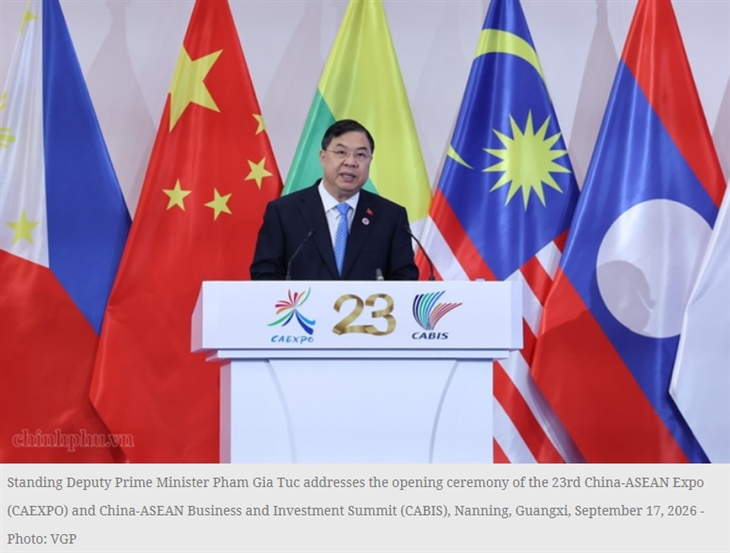
Viet Nam seeks to expand space for ASEAN-China cooperation ...
Viet Nam expects to make greater contributions to expanding the space for ASEAN-China cooperation for shared prosperity, underlined ...Top leader To Lam to attend 81st UNGA General Debate, ...
Viet Nam treasures friendly relations with Thailand: Prime ...
Viet Nam approves action program to implement ASEAN ...
The Vietnamese Government has approved an action program to implement the ASEAN Connectivity Strategic Plan in Viet Nam for 2026–2035 ...Industry and trade sector steps up strategic technology ...
Gov't approves National AI Strategy
Viet Nam continues to strengthen its strategic position in ...
