


Opportunities from VIFTA: Vietnamese seafood export to Israel boost
Wednesday, October 28,2026
AsemconnectVietnam - Thanks to tariff preferences from VIFTA and streamlined procedures, Vietnamese seafood exports to Israel are expected to recover strongly in 2026, opening up significant opportunities for businesses.
Diversifying export markets is becoming a trend that Vietnamese tuna businesses are interested in, with Israel being one of potential markets to expand trade opportunities and improve export efficiency. Seafood export turnover to this market increased by 30.7% in the first six months of 2026. Vietnam-Israel Free Trade Agreement (VIFTA) continues to open up more opportunities for businesses.
Seafood export to Israel maintain growth
According to Vietnam Association of Seafood Processing and Export (VASEP), in the first nine months of 2026, Vietnam's seafood export turnover is estimated to reach US$9.103 billion, an increase of 11.4% compared to the same period in 2025. Of this, tuna export reached US$716 million, an increase of only 3.5%, much lower than overall growth rate of entire industry. Previously, in 2025, tuna export turnover reached approximately US$924 million, a decrease of 7% compared to 2024.
In key export markets, Vietnamese tuna is being affected by increasingly stringent requirements regarding quality, traceability and environmental protection. Regulations in US and EU require businesses to strengthen supply chain control, improve compliance capacity and proactively adapt to market changes. Besides maintaining market share in traditional markets, businesses need to diversify export markets and expand trade relations to minimize risks and enhance competitiveness.
In an interview with Industry and Trade Newspaper, Ms. Le Hang, Deputy General Secretary of Vietnam Association of Seafood Processing and Export (VASEP), stated that Israel is a potential market for Vietnamese tuna. While export activities in some markets still face difficulties due to regulations on origin and protection of marine mammals, Israeli market has recorded positive growth results.
According to Ms. Le Hang, procedural requirements in Israel have certain advantages compared to some other markets. Along with that, import demand and market access opportunities are factors contributing to promotion of Vietnamese seafood exports to this Middle Eastern country.
Data shows that Israel continues to be a noteworthy market for Vietnamese seafood in the Middle East. According to VASEP, tuna exports to Israel are projected to decrease by 40% in 2025. However, exports have clearly recovered in 2026: in the first quarter of 2026, export value reached nearly US$10 million, a 33% increase compared to the same period. In the first six months of 2026, seafood exports to Israel reached approximately US$40 million, an increase of about 30.7%. Currently, Israel is Vietnam's largest tuna import market in the Middle East.
This result shows potential for growth in Israeli market for Vietnamese seafood. At the same time, it highlights need to maintain product quality, meet import regulations and build stable cooperative relationships with local partners.
VIFTA expands market access opportunities.
Besides import demand, VIFTA is one of important foundations helping Vietnamese seafood businesses improve their access to the Israeli market. This is the first free trade agreement Israel has signed with a Southeast Asian country. Under agreement, Israel will immediately eliminate 66.3% of tariff lines on Vietnamese goods upon entry into force, increasing to 92.7% by end of the period. Israel will also allocate tariff quotas with a 0% tariff rate for several Vietnamese products, including tuna.
According to Ms. Le Hang, opportunities from VIFTA contribute to expanding market access for Vietnamese seafood businesses. Implementation of the agreement helps businesses take advantage of tariff preferences, thereby increasing competitiveness of their products when exporting to Israel.
However, Israel is a market with high requirements for imported food. Specifically, imported goods must strictly comply with standards of importing country, many of which are specific. Israel simultaneously applies EU and US standards and conducts quite strict inspections of food products. On July 26, 2026, Israeli government also approved a proposal to ban import of goods produced wholly or partially by forced labor. This is a new regulation that exporting businesses need to be aware of. Therefore, taking advantage of agreement's benefits must be accompanied by ability to meet market regulations and organize export activities appropriately.
In fact, Vietnamese seafood already has a foothold in Israel. According to Vietnamese Trade Office in Israel, Vietnamese seafood accounts for approximately 12-13% of Israel's total seafood imports from markets around the world each year. Demand for frozen and processed seafood, especially canned seafood, creates opportunities for Vietnamese businesses to leverage their strengths in products such as tuna, pangasius and shrimp.
Besides tariff preferences, removal of technical requirements has also facilitated exports. Following lobbying efforts by Vietnamese Trade Office in Israel, on March 1, 2026, Israel sent a letter to Vietnamese authorities approving proposed scientific name for red snapper. Accordingly, scientific name is clearly stated on the export certificate for each shipment. This result creates more favorable conditions for exporting this product to Israel.
Ms. Le Hang noted that to effectively exploit opportunities in Israel, businesses need to proactively understand the needs of partners, select suitable products and ensure compliance with import regulations. Transparency in supply chain, enhanced traceability and quality control from raw materials to finished products are also crucial for maintaining orders.
In addition, businesses need to proactively build long-term relationships with importers, monitor market developments and be flexible in organizing transportation and storage of goods. Diversifying export markets also helps businesses spread risks and improve their ability to respond to changes in policies and demands in various markets.
Source: Vitic/ congthuong.vn
Vietnamese tuna exports saw growth, challenges remained
Import-export of FDI sector: strong momentum from hi-tech industry
Dairy imports and exports saw growth in 9 months of 2026
Vietnam records trade surplus for second consecutive period
Vietnam - Panama promote trade, investment and logistics cooperation
CPTPP: 'A connecting point' for Vietnamese goods to deepen into Latin American market
CPTPP opens up Malaysian market, creating more opportunities for Vietnamese Halal products
Imports of paper products increased in October
Fruit and vegetable trade in 9 months of 2026: growth drivers and seasonal fluctuations
Untangling CPTPP origin bottleneck: Textile and garment industry shifts supply sources
Lam Dong: Vegetable and fruit export increase by nearly 300%
Textile and garment export grow but concerns remain
Effectiveness of processed agricultural products seen from coffee industry
Vietnam’s exports of phones and components: breakthrough growth in new markets
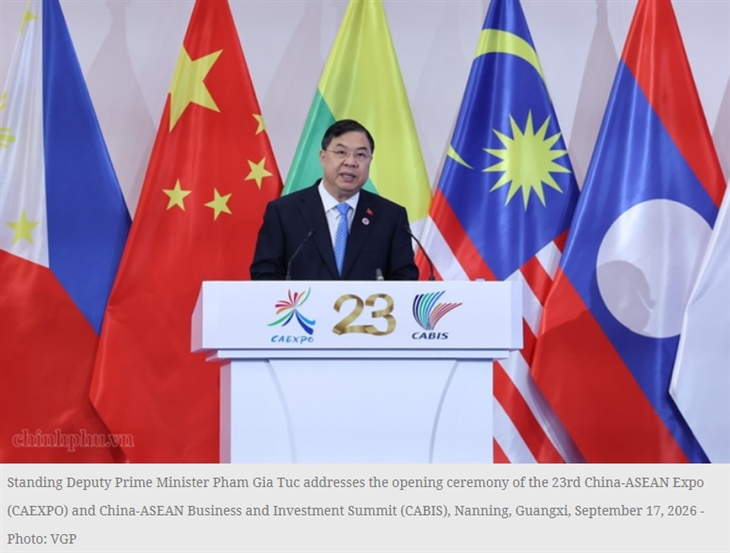
Viet Nam seeks to expand space for ASEAN-China cooperation ...
Viet Nam expects to make greater contributions to expanding the space for ASEAN-China cooperation for shared prosperity, underlined ...Top leader To Lam to attend 81st UNGA General Debate, ...
Viet Nam treasures friendly relations with Thailand: Prime ...
Viet Nam approves action program to implement ASEAN ...
The Vietnamese Government has approved an action program to implement the ASEAN Connectivity Strategic Plan in Viet Nam for 2026–2035 ...Industry and trade sector steps up strategic technology ...
Gov't approves National AI Strategy
Viet Nam continues to strengthen its strategic position in ...
