


CPTPP: 'A connecting point' for Vietnamese goods to deepen into Latin American market
Tuesday, October 27,2026
AsemconnectVietnam - Mexico is a crucial connecting point between North America and Latin American region. Leveraging CPTPP therefore needs to be transformed into a competitive advantage and long-term trade relationship.
A Gateway connecting North America and Latin America
Mexico holds a special position in regional trade network. Its economy is deeply integrated with the United States and Canada through US-Mexico-Canada Agreement, with over 80% of its exports destined for the US market. At the same time, Mexico is one of the largest economies in Latin America, with extensive economic and trade relations with the region.
According to Ms. Nguyen Thi Trang, Commercial Counselor, Vietnam Trade Office in Mexico, Mexico should not only be viewed as a consumer market of over 130 million people. For Vietnamese businesses, it can also be a connecting point between North America and Latin American market.
This characteristic creates two layers of opportunities: firstly, Mexico's domestic consumer demand; secondly, demand for raw materials, components, machinery, equipment and inputs serving production chains linked to North America.
In reality, current trade relationship between two countries shows significant potential. In 2025, Vietnam-Mexico trade turnover is projected to reach US$8.17 billion, an increase of 27%; of which Vietnam's export to Mexico will exceed US$7 billion, an increase of nearly 29%. By end of 2025, Mexico will be Vietnam's largest trading partner in Latin America and the third largest in the Americas, after the United States and Canada.
By August 2026, bilateral trade reached US$7.2 billion, an increase of nearly 40%; Vietnam's export to Mexico will reach nearly US$6.3 billion, also an increase of nearly 40%. Mexico will have become Vietnam's second largest trading partner in the Americas, after the United States.
Growth-oriented product groups focus on computers, electronics and components; telephones and components; machinery and equipment; footwear; textiles; transportation vehicles and parts.
However, according to Ms. Nguyen Thi Trang, opportunities lie not only in product groups with already high export volumes but also in many other sectors, such as: agricultural machinery, wood products, raw materials, consumer goods and many other product groups. “Trade Office brought 8 Mexican businesses to Vietnam to participate in Vietnam International Sourcing event series taking place in early September 2026. After networking and direct work, 4 out of 8 businesses reached trade agreements with Vietnamese suppliers”, representative of Vietnamese Trade Office in Mexico stated.
From tax incentives to genuine competitiveness
CPTPP provides Vietnamese goods with tariff advantages if they meet rules of origin. However, having a market and tax incentives does not automatically mean having orders.
Regarding this, Ms. Nguyen Thi Trang stated that in 2025, Mexico imported $664 billion, while Vietnam exported approximately $7 billion, equivalent to about 1%. This figure shows significant potential, but also raises questions about competitiveness and market share expansion of Vietnamese goods.
Vietnamese goods currently have a notable advantage: they can both leverage CPTPP and benefit from recent adjustments to Mexico's import tax policies, including increased protection for certain domestic industries and imposition of additional tariffs on some imports from Asian countries that do not have free trade agreements (FTAs) with Mexico.
However, tariffs are only part of the advantage. Through practical experience working with importers, Vietnamese Trade Office in Mexico has observed that, in addition to price, partners are initially interested in product specifications, quality, certifications, production capacity, minimum order quantities, delivery times, ability to maintain supply and especially ability to respond to and handle problems when they arise.
“Among Mexican businesses that Trade Office brought to participate in Vietnam International Sourcing 2026, there are some very large importers, not only importing for Mexico but also having distribution systems throughout the Central American region. When visiting Vietnamese factories, Vietnamese businesses were not prepared with English-speaking personnel. This is a very small detail, but it has greatly affected exchange process between the two sides,” said Ms. Nguyen Thi Trang.
She also noted that this shows that businesses may have FTAs, tax incentives and even buyers actively seeking them out, but still miss opportunities if they lack capacity to respond and pursue customers.
To fully leverage CPTPP, Vietnamese Trade Representative in Mexico recommends that businesses first correctly identify HS code, rules of origin, CPTPP tariffs, technical requirements and import conditions. They also need to know where Mexico is importing product from, at what price point and in what market segment.
Next, they should assess their own competitiveness: quality, specifications, minimum order quantity, supply capacity, delivery time, certifications and ability to maintain supply. Businesses must also determine whether they need importers, distributors, retail systems, or industrial customers, as each channel requires a different approach.
An indispensable requirement is risk management. Before a transaction, businesses need to check the HS code, origin, technical standards, product labeling, quarantine or food safety if applicable, and verify the partner. Once the transaction begins, risks shift to the contract, payment, documentation, logistics and customs clearance. As trade volume increases, businesses must also consider policy changes and trade defense measures.
In reality, once containers arrive at port or disputes arise, handling them becomes much more complex than identifying and preventing them from the outset. Therefore, better FTA is utilized, more business's compliance capacity must be enhanced.
In this process, trade mission can support businesses in monitoring and warning of changes in local policies, providing market information, finding and verifying partners, organizing trade promotion activities, connecting with relevant agencies, associations and consulting firms and coordinating support when incidents occur within its functional scope. More importantly, businesses need to change their perspective on CPTPP. It's not just a tool to help Vietnamese goods benefit from better tariff rates in Mexico. If Mexico is viewed as a connecting point between North America and Latin America, CPTPP can become a link in a strategy to expand market space.
That process begins with product research, identifying rules of origin and market requirements; then verifying competitiveness, bringing products to buyers, meeting directly with partners and monitoring after connection.
Source: Vitic/ congthuong.vn
Vietnamese tuna exports saw growth, challenges remained
Import-export of FDI sector: strong momentum from hi-tech industry
Dairy imports and exports saw growth in 9 months of 2026
Vietnam records trade surplus for second consecutive period
CPTPP opens up Malaysian market, creating more opportunities for Vietnamese Halal products
Imports of paper products increased in October
Fruit and vegetable trade in 9 months of 2026: growth drivers and seasonal fluctuations
Lam Dong: Vegetable and fruit export increase by nearly 300%
Textile and garment export grow but concerns remain
Effectiveness of processed agricultural products seen from coffee industry
Vietnam’s exports of phones and components: breakthrough growth in new markets
Manufacturing drove industrial growth in 9 months
Increasing localization rates is essential for sustainable growth
VASEP proposes tax relief to support Vietnamese seafood exporters
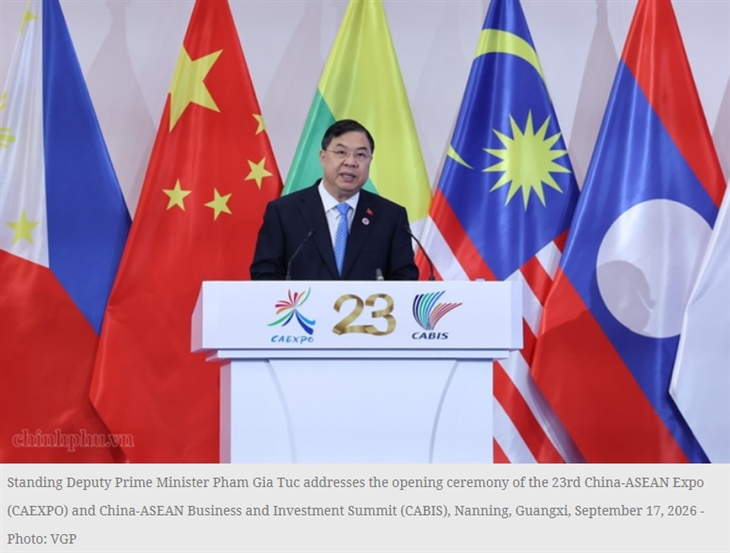
Viet Nam seeks to expand space for ASEAN-China cooperation ...
Viet Nam expects to make greater contributions to expanding the space for ASEAN-China cooperation for shared prosperity, underlined ...Top leader To Lam to attend 81st UNGA General Debate, ...
Viet Nam treasures friendly relations with Thailand: Prime ...
Viet Nam approves action program to implement ASEAN ...
The Vietnamese Government has approved an action program to implement the ASEAN Connectivity Strategic Plan in Viet Nam for 2026–2035 ...Industry and trade sector steps up strategic technology ...
Gov't approves National AI Strategy
Viet Nam continues to strengthen its strategic position in ...
