


Developing logistics services to create leverage for import and export by 2030
Thursday, October 15,2026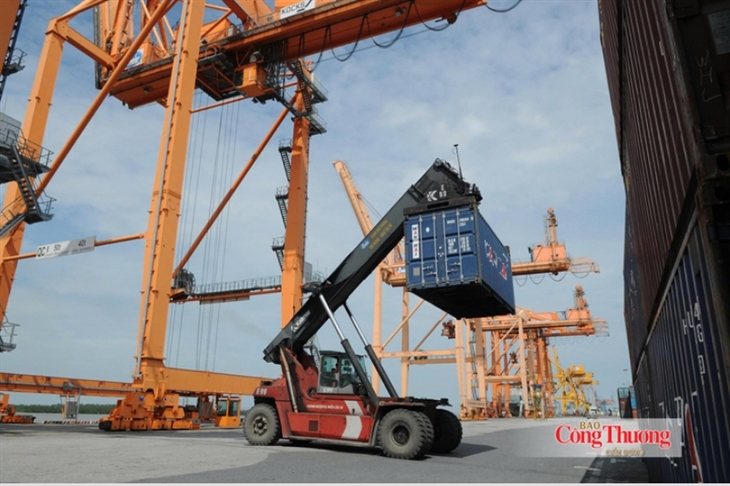
AsemconnectVietnam - Developing logistics services is one of important contents in draft strategy for import and export of goods by 2030, with a vision to 2045.
Logistics: A link that needs to be removed to enhance competitiveness of goods
According to data from General Statistics Office, Ministry of Finance, in the first nine months of 2026, Vietnam imported more than 34.3 billion USD worth of services, an increase of 15% compared to the same period. Of which, transportation services alone reached 16.4 billion USD, accounting for nearly 48% of total import value of services. Notably, cost of transportation and insurance services for imported goods amounted to nearly 14.4 billion USD.
According to Vietnam Logistics Report 2025, Vietnam's logistics costs are estimated to be equivalent to about 16-17% of GDP, higher than many countries in the region. This reality necessitates an urgent reorganization of logistics system towards greater efficiency, from transportation infrastructure, seaports and warehouses to management technology and service delivery capacity of businesses.
In this context, Vietnam Logistics Service Development Strategy for period 2025-2035, with a vision to 2050, aims to further reduce logistics costs while enhancing Vietnam's position in international rankings. Notably, Resolution No.20-NQ/TW dated July 28, 2026, of the 14th Central Committee of Communist Party of Vietnam on building and developing Vietnam into a strong maritime nation sets a target of reducing logistics costs to below 12% of GDP by 2030 and establishing 5-6 modern, internationally-standard logistics centers.
These goals demonstrate that logistics is being placed in direct relation to national competitiveness, development of marine economy and efficiency of import and export activities. To realize these goals, it is necessary not only to supplement infrastructure, but also to create a synchronized connection between transportation modes, production centers, distribution systems and consumer markets.
Mr. Tran Thanh Hai, Deputy Director of Import-Export Department - Ministry of Industry and Trade, emphasized that logistics is playing an increasingly important role in the economy, especially after supply chain disruptions during Covid-19 pandemic. Decision No.2229/QD-TTg issued by the Prime Minister is a significant milestone, creating a basis for ministries, sectors, localities, and businesses to jointly implement tasks to develop logistics.
Recently, Ministry of Industry and Trade has continuously organized working sessions with localities and businesses on the implementation of Decision No. 2229/QD-TTg. This activity shows that the requirement to put logistics development orientations into practice is being emphasized with participation of many entities in the economy.
During development of Draft Strategy for Import and Export of Goods until 2030, with a vision to 2045, Ministry of Industry and Trade also identified development of logistics services as one of its important components.
According to draft strategy announced at consultation workshop on Import and Export of Goods until 2030 organized by Ministry of Industry and Trade on October 9th, draft requires development of a national shipping fleet policy that meets transportation needs of key import and export goods, especially those with large volumes. The State needs to study medium and long-term credit mechanisms and appropriate support policies, while also finding solutions to create stable demand for domestic shipping enterprises.
This orientation aims to gradually improve transportation capacity of domestic fleet, reduce dependence on foreign enterprises and increase self-reliance of supply chain. Given high costs of transportation and insurance for imported goods, enhancing domestic service capacity is a necessary direction to improve the efficiency of trade operations.
Along with maritime transport, draft emphasizes strengthening connection between industrial infrastructure and trade and logistics infrastructure. Accordingly, industrial parks and production centers need to be developed synchronously with seaports, inland container depots (ICDs), warehouses, logistics centers, border gates and distribution networks. This connection aims to optimize logistics costs, shorten goods circulation time and improve efficiency of supply chain.
Another noteworthy point is formation of inter-regional industrial-logistics-trade corridors along coast, developing modern logistics centers linked to industrial parks, seaports, airports and international border gates. Simultaneously, green logistics, digital logistics and infrastructure serving e-commerce and cross-border trade are identified as development directions that need to be promoted.
Daft proposal suggests application of smart logistics, automated warehouse management technology, real-time tracking and retrieval of goods, optimization of transportation and distribution and construction of integrated logistics complexes.
Digital supply chain management systems are also proposed, utilizing big data, artificial intelligence and digital platforms in managing, coordinating and forecasting market demand. The goal is to improve efficiency of goods circulation, reduce logistics costs, and support businesses in being more proactive in organizing import and export activities.
Besides infrastructure and technology, the draft aims to develop logistics service businesses capable of providing integrated services, from transportation and smart warehousing to supply chain management. Large domestic logistics corporations are directed to support the construction or leasing of bonded warehouses in key markets, thereby promoting export to new markets.
To enhance capacity to support businesses, the draft also mentions development of consulting organizations on international trade law, logistics, quality standards, intellectual property, digital transformation and sustainable development. Participation of industry associations, research institutes, universities and private sector is encouraged through a socialized mechanism. At the same time, control of economic concentration in logistics sector needs to be promoted to ensure a healthy and equal competitive environment, creating conditions for Vietnamese businesses to participate more deeply in regional and global supply chains.
Promoting cross-border e-commerce
Another direction directly linked to logistics is promoting cross-border e-commerce. At recent Vietnam Cross-Border E-commerce Forum (VOIEF 2026) with theme "Impacts of Digital Transformation in Customs Sector," representatives from E-commerce Department of Ministry of Industry and Trade assessed that Vietnam still has enormous potential for development in this sector. In 2025, proportion of export via e-commerce will only reach 0.48% of the country's total export turnover; many sectors such as textiles, footwear, and personal care products have room for online growth ranging from 80-99%.
Ms. Trinh Thi Thu Hien, Deputy Director of Import-Export Department, noted that import-export turnover through e-commerce platforms currently only reaches about 4.4 billion USD out of a total of 930 billion USD in 2025. Goods exported through e-commerce are still concentrated in a few consumer goods sectors and have not yet expanded to processed industrial products and deeply processed agricultural products. Markets accessed are also mainly neighboring countries due to obstacles related to costs and procedures for long-distance transportation. Therefore, expanding online exports requires appropriate logistics solutions, digital infrastructure, goods data and safe and reliable electronic transaction services.
In this context, draft strategy proposes building solutions to enhance application of cross-border e-commerce based on synchronized development of digital infrastructure, logistics data platforms and goods traceability. Along with this, it suggests organizing promotional events, supporting businesses to improve their capacity to participate in cross-border e-commerce and building and operating national pavilions on major global e-commerce platforms to promote reputable products, OCOP products, typical rural industrial products and key Vietnamese goods.
Businesses, cooperatives and OCOP entities are also guided to receive support in improving product information and data and enhancing their capacity to utilize cross-border e-commerce platforms.
Source: Vitic/ congthuong.vn
Textile and garment sector sees growth in 2026
Mainstay of national economic development
Tay Ninh: Official export through border gates increase
New expressway creates momentum for accelerated logistics in the Mekong Delta
Manufacturing drove industrial growth in 9 months
Fruit and vegetable exports top $7.35 billion in 9M
33 new SPS notifications, many notable regulations for export
Trade surplus returns after 9 consecutive months of deficit
Northwest Coffee: Transforming to meet EUDR requirements and increase value
Increasing localization rates is essential for sustainable growth
Dairy imports and exports saw growth in 9 months of 2026
Finance Ministry outlines inflation scenarios for 2026 at 4.5% and 4.8%
Imports of computers and components reached nearly $189 billion in 9 months
Computers and components: key driver of Vietnam's export growth
Viet Nam seeks to expand space for ASEAN-China cooperation ...
Viet Nam expects to make greater contributions to expanding the space for ASEAN-China cooperation for shared prosperity, underlined ...Top leader To Lam to attend 81st UNGA General Debate, ...
Viet Nam treasures friendly relations with Thailand: Prime ...

Viet Nam approves action program to implement ASEAN ...
The Vietnamese Government has approved an action program to implement the ASEAN Connectivity Strategic Plan in Viet Nam for 2026–2035 ...Industry and trade sector steps up strategic technology ...
Gov't approves National AI Strategy
Viet Nam continues to strengthen its strategic position in ...
