


Tay Ninh: Official export through border gates increase
Thursday, October 15,2026
AsemconnectVietnam - With $813.5 million in export under trade contracts after 9 months, Tay Ninh is changing face of border trade. Agricultural products are next link that needs transformation.
Export under trade contracts through border gates increased nearly 3.8 times
With a long border adjacent to Cambodia, border trade has always been a pillar of Tay Ninh's export. In the first nine months of 2026, the province's total export turnover is estimated at $15.54 billion, an increase of 19%. Of which, Cambodia is the province's third largest export market and second largest import market. In the first eight months, export to this market reached US$964 million, an increase of 18.3%, while imports reached US$1.54 billion, an increase of 7.8%. The most outstanding highlight lies in structure of export channels.
In an interview with Industry and Trade Newspaper, Ms. Chau Thi Le, Deputy Director of Department of Industry and Trade of Tay Ninh province, said that in the first nine months of 2026, export under commercial contracts through the province's border gates reached US$813.5 million, an increase of 283.2%, or nearly 3.8 times compared to the same period last year. The main items included synthetic rubber, empty aluminum cans, paper, bicycle parts, garment raw materials and accessories, fabric, sewing thread, clothing, animal feed, fertilizers, cosmetics and consumer goods.
Meanwhile, value of trade and exchange by border residents reached VND 1,620.5 billion, equivalent to approximately US$62.3 million, an increase of 327.8%. Thus, although both channels have seen strong growth, scale of official export is now approximately 13 times larger than that of border resident exports, accounting for nearly 93% of total value of goods exported through these two channels. According to Department of Industry and Trade's assessment, official export are increasingly on rise.
However, a closer look at product structure reveals a clear disparity. Goods exported under commercial contracts are mainly industrial products, raw materials and consumer goods from large-scale enterprises. Meanwhile, vegetables, fruits and many general merchandise and household goods such as mattresses, notebooks and plastic cups are still primarily exported through border resident channel. In other words, agricultural products have not yet truly entered the "main" official trade channel. Characteristic of border resident channel is that transactions are small-scale and have few contractual obligations, making it highly sensitive to any changes in management policies on other side of border.
According to Ms. Chau Thi Le, Cambodia has strengthened control over weight of cargo vehicles and focused on developing domestic brands. These factors have somewhat affected progress of the province's exports.
For businesses with established systems, contracts and documentation, such changes can be adjusted to adapt. However, for small-scale agricultural traders and households accustomed to flexible exchange methods, this poses a direct risk to output, selling prices, and producers' income.
Long-term prospects with Cambodian market
Nevertheless, Ms. Chau Thi Le believes that Cambodia's demand for imported goods remains quite high, presenting an opportunity for Vietnamese goods to penetrate the market more deeply. Export structure for the first eight months partly demonstrates this. Textiles led with $373 million, an increase of 10.2%; iron and steel of all kinds reached $248 million, an increase of 24.6%; textile and footwear raw materials and accessories reached $61 million, an increase of 30%; Chemical export reached US$24 million, an increase of over 7.6 times. Majority were inputs for production, indicating that Tay Ninh's goods are gradually integrating into supply chain of neighboring Cambodia. However, iron and steel products decreased by 22.9%, signaling that competition in some product groups has become more intense.
Based on this reality, Department of Industry and Trade continues to advise businesses to increase import and export through commercial contracts to avoid risks. Simultaneously, the Department is implementing project to promote border trade development and exports to Cambodia for the period 2025-2027, as per Decision No.2162/QD-BCT dated July 25, 2025, of Ministry of Industry and Trade.
At local level, the People's Committee of Tay Ninh province has signed cooperation agreements with three bordering provinces of Cambodia: Svay Rieng, Prey Veng and Tboung Khmum. This provides a foundation for promptly resolving any issues arising at border gates.
In fourth quarter, the Provincial People's Committee assigned Department of Industry and Trade to prioritize development of modern agricultural wholesale markets in central urban areas, industrial zones and border gate areas, while also providing timely information on global market and changes in the trade policies of other countries. In production stage, the province is strengthening management of planting area codes, packaging facilities and traceability inspections. These are the missing links needed for agricultural products to enter trade market with stable volume and consistent quality.
Infrastructure connections are also being prepared for new phase. The DT.791 road connecting Xa Mat border gate with Tan Nam border gate is included in list of projects the province is focusing on implementing. Notably, Moc Bai - Trans-Asian industrial and urban corridor connecting road project, with a scale of 8-10 lanes, has a first phase approximately 33.1 km long, ending 4 km from Moc Bai international border gate. The project has a total estimated capital of VND 7,600 billion under public-private partnership model, and is expected to commence in the first quarter of 2027.
Once infrastructure is fully developed, wholesale markets are established, and raw material areas are standardized, Tay Ninh's agricultural products will be able to transition from small-scale shipments to long-term, stable commercial contracts.
Source: Vitic/ congthuong.vn
Textile and garment sector sees growth in 2026
Mainstay of national economic development
Developing logistics services to create leverage for import and export by 2030
New expressway creates momentum for accelerated logistics in the Mekong Delta
Manufacturing drove industrial growth in 9 months
Fruit and vegetable exports top $7.35 billion in 9M
33 new SPS notifications, many notable regulations for export
Trade surplus returns after 9 consecutive months of deficit
Northwest Coffee: Transforming to meet EUDR requirements and increase value
Increasing localization rates is essential for sustainable growth
Dairy imports and exports saw growth in 9 months of 2026
Finance Ministry outlines inflation scenarios for 2026 at 4.5% and 4.8%
Imports of computers and components reached nearly $189 billion in 9 months
Computers and components: key driver of Vietnam's export growth
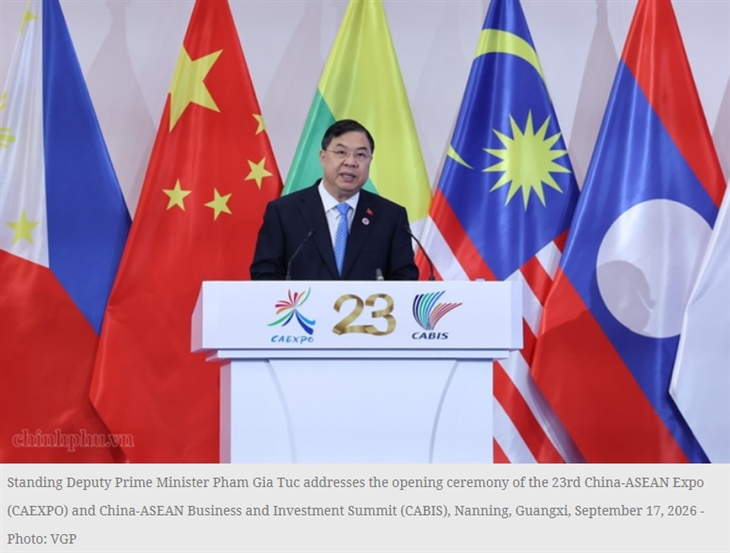
Viet Nam seeks to expand space for ASEAN-China cooperation ...
Viet Nam expects to make greater contributions to expanding the space for ASEAN-China cooperation for shared prosperity, underlined ...Top leader To Lam to attend 81st UNGA General Debate, ...
Viet Nam treasures friendly relations with Thailand: Prime ...

Viet Nam approves action program to implement ASEAN ...
The Vietnamese Government has approved an action program to implement the ASEAN Connectivity Strategic Plan in Viet Nam for 2026–2035 ...Industry and trade sector steps up strategic technology ...
Gov't approves National AI Strategy
Viet Nam continues to strengthen its strategic position in ...
