


New expressway creates momentum for accelerated logistics in the Mekong Delta
Thursday, October 15,2026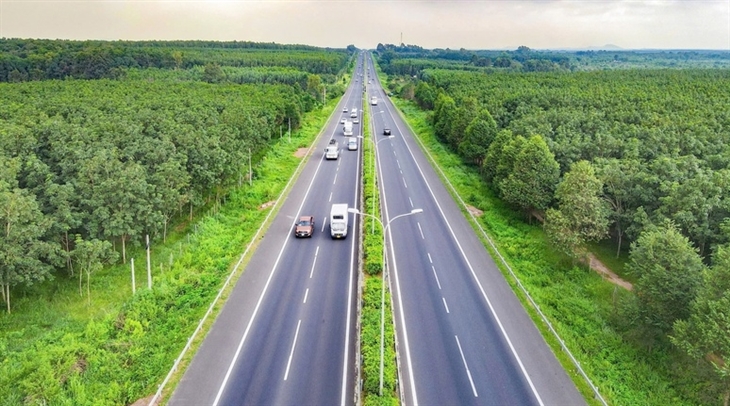
AsemconnectVietnam - New expressway provides businesses in the Mekong Delta with more options for accessing ports. Greater benefit lies in ability to reorganize routes and logistics chains.
Exporting a shipment of fruit from Mekong Delta involves many stages: obtaining a designated growing area according to market requirements, preliminary processing, packaging, cold storage or appropriate treatment, customs clearance and then loading onto a ship. Each stage takes time, but journey to the port is difficult to predict when vehicles travel through frequently congested roads of Ho Chi Minh City. Delayed deliveries may require rerouting; refrigerated containers also incur additional operating costs while waiting.
Therefore, Ben Luc - Long Thanh expressway, which opened its entire length on October 1st, not only adds nearly 58 km of road but also opens up more options for cargo trucks traveling between Mekong Delta and the Southeast region, helping businesses recalculate routes to industrial zones, seaports and transportation hubs. The route connects western area of Ho Chi Minh City to Dong Nai allows vehicles to avoid many inner-city routes on inter-regional journeys.
Shortening journey to seaport
Mr. Vu Tien Dung, Commercial Director of Hanh Nguyen Logistics JSC in Can Tho City, sees highway project from perspective of coordinating agricultural and aquatic product shipments. This company is handling all stages in logistics chain: from preservation and post-harvest processing to transportation and export procedure support.
For exported fruit, workflow can start from planting area code, then preliminary processing, packaging, warehousing and processing according to market requirements. When goods are ready, the trucks must arrive at the port on time for shipping company to receive the goods; a delay in one stage can increase cost of entire chain.
According to Mr. Dung, about 90% of the goods for corporate customers currently pass through Cat Lai port. From Can Tho to Ho Chi Minh City area, it usually takes about 2-2.5 hours; However, final section to port is difficult to predict due to congestion on Nguyen Van Linh, Phu My Bridge and Vo Chi Cong roads.
“Customers have already booked ships; if delivery is delayed, they have to rebook, which incurs very high costs”, Mr. Dung said. Refrigerated trucks also cannot simply turn off their engines and wait. When vehicles are stuck in traffic jams, businesses still have to bear operating costs. Therefore, Ben Luc - Long Thanh expressway gives businesses more options to consider. Shipments to Cai Mep - Thi Vai port can use the new route to avoid part of journey through busy urban areas. Although distance may be longer than going to Cat Lai, the more stable travel time can still help reduce overall costs.
New route does not mean a seamless journey to all hubs. Currently, expressway ends at National Highway 51; Tan Hiep interchange connecting to Bien Hoa - Vung Tau expressway will only be operational when connecting route is permitted to be put into use in near future. Therefore, businesses still have to factor in journey from warehouse to port, not just travel time on highway.
Mr. Nguyen Thanh Tam, a 14-tonne truck driver who frequently travels between Western and Eastern regions, said he experienced highway on days it opened. Previously, trucks traveling through Ho Chi Minh City to Dong Nai often encountered traffic jams at Nguyen Van Linh, Phu My Bridge or Vo Chi Cong. According to him, once connecting points are completed, the journey could be shortened by about 60-90 minutes.
Mr. Tam is still concerned about highway tolls and unfinished subsequent connections. For drivers who travel frequently, choosing a route also requires considering fuel consumption, waiting time and ability to turn around.
Mr. Nguyen Xuan Thuan, a driver who specializes in Tay Ninh - Vung Tau route, also noticed that journey is more convenient compared to going through urban areas of Ho Chi Minh City. Previously, having to travel through busy main roads made transportation time difficult to predict. For intercity routes, newly opened routes offer drivers more options to consider based on delivery points and actual traffic conditions.
For agricultural products from Mekong Delta to benefit, all logistics links must work together.
Mekong Delta is a source of agricultural and aquatic products, while Ho Chi Minh City and the Southeast region have industrial centers, service centers and seaports. Better road connections will open up opportunities for two-way traffic: vehicles from Mekong Delta carrying agricultural products can return with machinery, supplies or industrial goods if suitable sources are found.
For agricultural products, post-harvest quality depends on preservation, processing and time it takes to deliver goods to processing facilities or ports. Expressways do not replace planting area codes, packaging standards or quarantine requirements of importing countries. However, less fluctuating routes can help improve coordination, reduce waiting times and lower costs.
Mr. Vu Tien Dung stated that his company chose to locate in Phu Huu A concentrated industrial cluster, Chau Thanh commune (formerly Hau Giang province) because of its connectivity via road, waterway and regional transportation hubs. Here, the company provides a comprehensive logistics service chain, from dry storage, cold storage, freezing and irradiation to transportation, customs clearance and sea and air freight booking.
With the company's "one-stop shop, multiple services" model, goods don't have to go through multiple units for each stage. After harvesting, fruit can be processed, sorted, packaged, preserved and handled according to market requirements before being loaded into containers and transported to the port. More seamless logistics chain, the easier it is for businesses to coordinate cargo handling schedules and vehicle schedules.
This company's story shows that agricultural logistics requires not only warehouses and vehicles, but also suitable locations, integrated services and convenient transportation routes. New expressway is just one link in chain. For growers and export businesses to benefit, additional roads connecting raw material areas, cold storage, quarantine and irradiation services, customs procedures and port connections are needed.
Ben Luc - Long Thanh expressway hasn't solved all bottlenecks, but it has opened up more options and reduced the dependence of inter-regional routes on the inner city routes of Ho Chi Minh City. By improving connections and reorganizing vehicle schedules, warehouses and ports of arrival, logistics businesses in the Western region can deliver agricultural and aquatic products to domestic and international markets more promptly and at more controllable costs.
Source: Vitic/ congthuong.vn
Textile and garment sector sees growth in 2026
Mainstay of national economic development
Manufacturing drove industrial growth in 9 months
Fruit and vegetable exports top $7.35 billion in 9M
33 new SPS notifications, many notable regulations for export
Trade surplus returns after 9 consecutive months of deficit
Northwest Coffee: Transforming to meet EUDR requirements and increase value
Increasing localization rates is essential for sustainable growth
Dairy imports and exports saw growth in 9 months of 2026
Finance Ministry outlines inflation scenarios for 2026 at 4.5% and 4.8%
Imports of computers and components reached nearly $189 billion in 9 months
Computers and components: key driver of Vietnam's export growth
Trade balance with US maintained significant surplus
Import-export of FDI sector: strong momentum from hi-tech industry
