


Northwest Coffee: Transforming to meet EUDR requirements and increase value
Wednesday, October 14,2026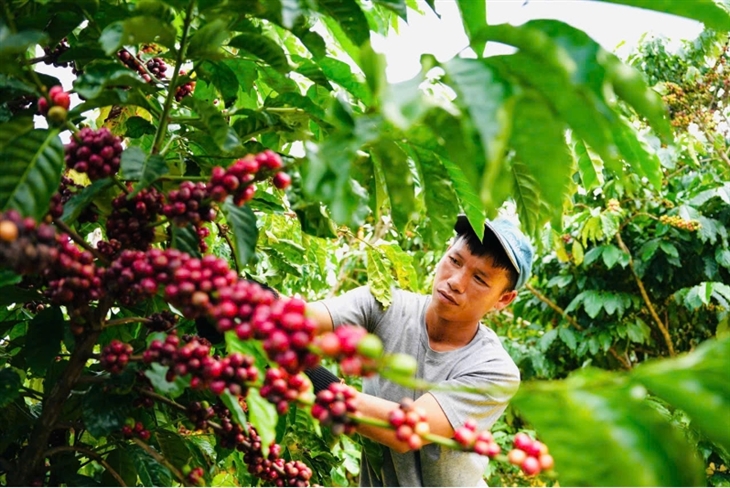
AsemconnectVietnam - Faced with EUDR requirements and impact of climate change, Northwest coffee region is transforming its farming methods, managing growing areas and improving product quality and value.
EUDR promotes changes in growing areas
EU is currently a major coffee consumer market for Vietnam, accounting for approximately 40% of total coffee export. With implementation of EU's Regulation on Deforestation (EUDR), requirements for coffee industry extend beyond just product itself, encompassing traceability, data on growing areas and link between production and forest protection.
In this context, Northwest region, particularly Son La, is emerging as a major Arabica coffee producing area in the country. According to Son La Department of Agriculture and Environment, the province's coffee growing area is nearly 40,000 hectares and continues to expand. In Dien Bien, area of newly planted coffee in 2026 alone reached over 10,000 hectares. Expanding coffee cultivation offers opportunities to improve income and livelihoods for farming households, including many ethnic minority households. However, pace of expansion also necessitates changes in production methods.
Speaking at online webinar "Promoting EUDR-compliant coffee production in Vietnam: Transitioning from traditional farming to sustainable production in the Northwest" held on afternoon of October 6th, Mr. Nguyen Manh Son from Institute of Agricultural Strategy, Policy and Environment stated that, unlike Central Highlands, which accounts for over 90% of Vietnam's coffee growing area and has relatively stable cultivation in many regions, majority of coffee growing areas in Northwest have only been established in recent years, especially since 2023, when export coffee prices increased sharply. While many coffee growing areas in Central Highlands have adopted intensive farming, scientific and technological methods, intercropping with shade trees and some areas have achieved sustainable certification, most coffee in Northwest is still cultivated using extensive, traditional methods and heavily dependent on rainwater.
Steep terrain means that this farming method not only limits productivity but also poses a risk of soil erosion and degradation. In Son La, several transformation models are emerging, ranging from intercropping fruit trees and shade trees, using modern irrigation systems, to sustainable farming practices. These include model of Bich Thao Coffee Cooperative and sprinkler irrigation model implemented by some coffee-growing households in Muong Chanh commune, supported by CARE organization.
Dr. Nguyen The Manh from CARE organization stated that the project "Green and Sustainable Adaptation for Ethnic Minority Communities in Son La Province" - Mekong Elevate and CARE - is supporting several smart agricultural models aimed at sustainable coffee development. Among these, irrigation systems are one of solutions that farmers can see the most clearly in context of coffee being increasingly affected by climate change. Water-saving irrigation models for Arabica coffee in Son La can help regulate flowering time, save labor and improve yield. When combined with undergrowth and organic fertilizer, the system also contributes to maintaining moisture, improving biodiversity and soil health. However, cost and water availability remain bottlenecks. In particular, in areas with limited water resources or very high altitudes, installing and operating irrigation systems is challenging.
Effectiveness on farm and expansion challenge
Reality at Mr. Ha Van Thao's household in Muong Chanh commune shows clear changes after applying irrigation system. Since 2024, the family has received support from CARE project for a system including drip irrigation and sprinkler irrigation. After one year, the family compared irrigated area with area without system and noticed a difference in yield. Based on these results, the family continued to expand system to the entire area.
From cooperative's perspective, Mr. Nguyen Xuan Thao, Director of Bich Thao Coffee Cooperative, believes that it is impossible to mechanically apply farming methods of Central Highlands to Son La. Arabica coffee in Son La has different characteristics from Robusta coffee in Central Highlands in terms of variety, geographical conditions, climate, soil, flowering time and pollination methods. Therefore, irrigation techniques and care procedures must also be suitable for characteristics of each region.
Since 2017, Bich Thao Coffee Cooperative has introduced new coffee varieties for replanting, focusing on climate change resilience and disease resistance. The cooperative also provides training on use of microbial preparations, irrigation, pruning, canopy shaping and shade tree planting. According to Mr. Thao, yields in some areas of cooperative are maintained at around 25-30 tonnes of fresh fruit per hectare; some new varieties such as A16 and TN7 can reach 40-45 tonnes of fresh fruit per hectare in intensively cultivated areas.
However, Mr. Thao emphasized that yield is not only goal. Quality must go hand in hand with yield to create higher value for product. This is a noteworthy issue as Son La coffee continues to expand. According to information from Bich Thao Coffee Cooperative, total coffee production in Son La could reach approximately 50,000 tonnes of exportable beans annually, but high-quality and specialty coffee currently still accounts for a very small percentage, less than 1%. "These figures show that challenge for coffee in Northwest Vietnam is not just about increasing acreage or yield, but also about improving quality and identifying the right production areas", Mr. Thao stated.
A major question arises: with approximately 40,000 hectares of coffee in Son La, majority of which is still extensive and self-produced by households, are the pioneering models suitable for replication? According to Mr. Nguyen The Manh, this is not an easy question to answer. Through his research on coffee in Son La, he found that there is currently no comprehensive study of the province's coffee growing regions, including data on temperature, ecological conditions, soil properties, soil type, agrochemistry and regional characteristics to determine areas truly suitable for Arabica coffee cultivation.
Mr. Nguyen The Manh also noted that not all areas of Son La have the same conditions and are equally suitable for producing high-quality Arabica coffee. Therefore, instead of just looking at potential for expanding the cultivated area, it is necessary to clearly identify areas with conditions suitable for coffee cultivation.
In long term, Mr. Nguyen The Manh believes that organizations, businesses and stakeholders need to build a complete and standardized dataset for Son La, including meteorological data, soil data and related factors. With a complete dataset, assessment and identification of suitable areas for coffee development will have a scientific and practical basis.
In context of EUDR and increasingly high demands of international market, Northwest coffee therefore needs not only to demonstrate where the product is grown, but also to gradually answer the question of how it is produced, whether it is suitable for the natural conditions, and what value it creates. This is also basis for Northwest coffee industry to shift from goal of increasing acreage to improving quality, efficiency and sustainability of production region.
Source: Vitic/ congthuong.vn
Textile and garment sector sees growth in 2026
Mainstay of national economic development
Manufacturing drove industrial growth in 9 months
Fruit and vegetable exports top $7.35 billion in 9M
Increasing localization rates is essential for sustainable growth
Dairy imports and exports saw growth in 9 months of 2026
Finance Ministry outlines inflation scenarios for 2026 at 4.5% and 4.8%
Imports of computers and components reached nearly $189 billion in 9 months
Computers and components: key driver of Vietnam's export growth
Trade balance with US maintained significant surplus
Import-export of FDI sector: strong momentum from hi-tech industry
Export drive growth, contributing to Vietnam's economic acceleration in 2026
Imports of phones and components: slight downward trend
Vietnam: FDI sector led in machinery, equipment, tools, and spare parts imports
