


Export drive growth, contributing to Vietnam's economic acceleration in 2026
Monday, October 12,2026
AsemconnectVietnam - Strong export growth, along with manufacturing and public investment, is creating a crucial driving force, propelling Vietnam's economy into the top growth group in the region in 2026.
Export become a prominent driving force
On October 6th, the World Bank (WB) raised its forecast for Vietnam's economic growth in 2026 by 1.1 percentage points, to 7.4% - the highest in East Asia and Pacific (EAP) region. This is not only a remarkable figure regarding growth rate, but also shows increasingly clear resilience of a highly open economy, in which export continue to play a particularly important role.
From a growth rate of 8.02% in 2025, Vietnam's economy is projected to accelerate to 8.3% in the first half of 2026. According to World Bank, manufacturing, export and public investment are the main drivers of this growth. Export are emerging as a crucial "spearhead," directly creating added value and stimulating production, investment and capital flows into the economy.
Figures from General Statistics Office of Ministry of Finance show export sector's resilience more clearly than ever. In the first nine months of 2026, merchandise export reached US$434.30 billion, a 24.5% increase compared to the same period last year. In the third quarter alone, export reached US$167.85 billion, a significant 30.4% increase year-on-year and a 17% increase compared to the second quarter.
Looking at scale of trade, picture is even more impressive. Total merchandise export and import in the first nine months reached US$888.02 billion, an increase of 30.4%. Export increased by 24.5%, while import increased by 36.7%. In September alone, export reached US$59.48 billion, a 39.1% increase compared to the same period last year.
These figures show that export are no longer simply output of production. In a highly open economy like Vietnam, export are directly impacting industrial production, investment demand, employment and capital flows. When export orders increase, factories expand production; when production expands, demand for machinery, raw materials, logistics and support services also increases.
Export structure also shows that the economy is continuing to shift towards industrialization. In the first nine months, processed industrial goods group reached US$392.79 billion, accounting for 90.4% of total export value. Agricultural and forestry products group reached US$30 billion; seafood reached US$9.10 billion and fuels and minerals accounted for only 0.6%.
This is a noteworthy point. Export growth is no longer primarily based on resources, but is increasingly linked to processing, manufacturing and technology products. 35 items achieved export turnover exceeding US$1 billion, with 7 items surpassing US$10 billion, demonstrating increasing concentration of export capacity.
World Bank also noted that in the first eight months of 2026, Vietnam's goods exports increased significantly, with electronics and machinery continuing to play a core role. In particular, Vietnam is integrating more deeply into the technology supply chain, with products related to artificial intelligence (AI) contributing significantly to export growth.
This can be seen as a crucial qualitative shift in dynamics of exports.
According to World Bank, in the 12 months ending April 2026, China, Indonesia, Malaysia, the Philippines, Thailand and Vietnam exported a total of approximately US$1.4 trillion worth of AI-related goods. For Vietnam, computers, servers and routers accounted for about 60% of AI-related exports, with a significant portion destined for end-user demand in the US. In other words, Vietnam is not standing outside global technology wave. On contrary, the economy is benefiting from shift and expansion of the technology supply chain. This is also why Vietnam has the largest upward revision of its 2026 export forecast in EAP region.
At Ministry of Industry and Trade's regular press conference for the third quarter of 2026, held on the afternoon of October 7th, Ms. Trinh Thi Thu Hien, Deputy Director of Import-Export Department, Ministry of Industry and Trade, stated that from the beginning of this year, Government Resolution 01 set a target of 15-16% export growth. Meanwhile, after nine months, total import and export turnover reached US$888.02 billion, a 30.4% increase compared to the same period last year. This is a bright spot for the economy.
Problem behind growth figures
But if we only look at the export growth rate to conclude that the economy has entered a sustainable growth cycle, it is perhaps too early.
The most concerning point lies in the export structure. In the first nine months of 2026, foreign-invested sector achieved US$350.41 billion, accounting for 80.7% of total export turnover and increasing by 29.4%. Meanwhile, domestic economic sector achieved US$83.89 billion, accounting for 19.3% and only increasing by 7.5%. Thus, majority of export growth still comes from FDI sector.
Another noteworthy indicator is that imports in the first nine months increased by 36.7%, significantly faster than exports. Imports reached US$453.72 billion, with production materials accounting for 94.1%. From a positive perspective, sharp increase in imports of machinery, equipment, raw materials and supplies reflects expanding production. Therefore, increase in imports is not necessarily a cause for concern. However, this figure also shows that level of domestic production self-sufficiency remains modest.
These figures raise an unavoidable question: how can exports truly become a driving force for improving quality of growth in Vietnamese businesses, instead of primarily reflecting production capacity of FDI sector? This question is even more significant in the context of Vietnam's deeper integration into the AI supply chain.
Global wave of AI investment is opening up enormous opportunities. But World Bank also warns that this simultaneously represents a new type of risk. Vietnam is one of the most open economies and heavily reliant on AI-driven value chains. If global growth driven by AI continues, Vietnam will be in a favorable position. However, if global economy slows down or AI demand reverses, impact on a highly open economy will be significant.
World Bank forecasts Vietnam's growth will slightly decline to 7.3% in 2027 and 2028. Export will remain a crucial pillar of Vietnam's growth. But this pillar needs to be strengthened by domestic enterprise capacity, technology, logistics, infrastructure, human resources, and deeper participation in value chains.
From perspective of Ministry of Industry and Trade, Ms. Trinh Thi Thu Hien stated that current import structure of electronics and semiconductor sector shows that a portion of import capital is directly serving expansion of production and export supply chains. This also raises a question for long-term trade policy. It's not just about controlling imports, but also about increasing the proportion of value added created domestically.
According to direction of Import-Export Department, along with immediate solutions regarding mechanisms, policies, markets and business support, enhancing capacity of Vietnamese businesses and increasing value of domestically produced products will be a long-term solution to improve trade balance.
Source: Vitic/ congthuong.vn
Imports of phones and components: slight downward trend
Vietnam: FDI sector led in machinery, equipment, tools, and spare parts imports
Agricultural, forestry and fishery export: Growth driven by fruits, vegetables and seafood
Import-export turnover surged over 30% year-on-year in 9 months
Regulations on criteria and conditions for establishing Free Trade Zones issued
Vietnam's black pepper imports surged in 9 months of 2026
Vietnam's chemical exports showed solid growth in September
Industrial production increased 12.3% in 9 months, highest since 2019
Seafood exports exceed US$9 billion in 9 months of 2026
Domestic market accelerates, cementing role as economic anchor
VASEP proposes tax relief to support Vietnamese seafood exporters
Trade surplus rebounds in September after nine months of deficit
Fertilizer export markets remain heavily concentrated in Asia
Import-export and trade balance of FDI sector versus domestic enterprises
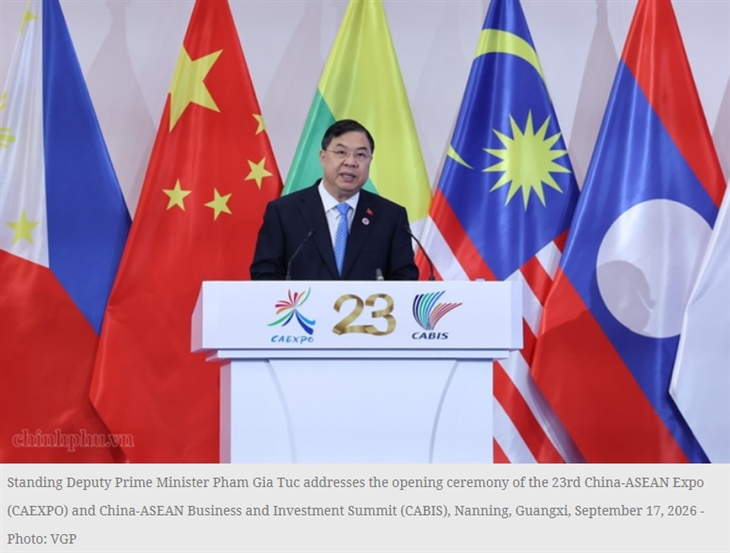
Viet Nam seeks to expand space for ASEAN-China cooperation ...
Viet Nam expects to make greater contributions to expanding the space for ASEAN-China cooperation for shared prosperity, underlined ...Top leader To Lam to attend 81st UNGA General Debate, ...
Viet Nam treasures friendly relations with Thailand: Prime ...

Viet Nam approves action program to implement ASEAN ...
The Vietnamese Government has approved an action program to implement the ASEAN Connectivity Strategic Plan in Viet Nam for 2026–2035 ...Industry and trade sector steps up strategic technology ...
Gov't approves National AI Strategy
Viet Nam continues to strengthen its strategic position in ...
