


Exporting to EU: Don't wait until it's too late
Tuesday, September 29,2026
AsemconnectVietnam - EU is tightening residue control and reviewing import tolerances. For Vietnamese enterprises, waiting for regulations to take effect before making changes may be too late.
This information was presented by experts at the online seminar on policies and regulations of European Union on the import of food and agricultural products of animal and plant origin, organized by the Vietnamese Embassy in Kingdom of Belgium/Vietnamese Delegation to EU in coordination with EU's Agrinfor Programme on the afternoon of September 24th.
MRL is no longer just a matter of one shipment
According to Mr. Tran Van Cong, Agricultural Counselor, Vietnamese Delegation to EU, EU is one of the largest markets for Vietnamese agricultural, forestry and aquatic products, importing approximately 35 billion USD annually. EVFTA agreement creates tariff advantages, but these preferential tariffs only help goods gain more market access. To maintain market share, enterprises must meet increasingly stringent technical requirements. Among these, pesticide residue limits (MRLs) are becoming a problem that cannot be solved with just one pre-export test.
Chris Downes, a policy and legal expert at AGRINFO/EU, said EU is discussing possibility of changing MRL regulations, including narrowing or eliminating import tolerances for certain pesticide active ingredients. If implemented, this change could directly impact industries that use active ingredients that EU does not allow but currently accept a certain level of residue in imported goods.
Currently, EU market has two separate regulatory systems for pesticides. One system determines which active ingredients are permitted for use in EU; other regulates MRLs for food. Therefore, an active ingredient not permitted for use in EU can still be used in a non-EU country if product meets EU's import tolerance level. However, EU is considering changing this approach for active ingredients identified as highly hazardous. Under proposal under discussion, MRL for some active ingredients could be reduced to 0.01 mg/kg or the lowest possible level.
Final scope has not yet been determined. European Commission focuses on group of highly hazardous active ingredients; some member states want to expand to include active ingredients that pose a risk to bees and groundwater. European Parliament is also discussing possibility of applying this to all active ingredients not permitted for use in EU.
According to Chris Downes, proposal is still under discussion among EU institutions. European Commission plans to conduct an impact assessment, while final regulation could be adopted in 2027. For Vietnam, it is necessary to promptly review active ingredients currently used in key export sectors, especially those potentially affected by new policy. The issue is not only identifying which active ingredients are at risk of having their MRLs changed, but also assessing the possibility of replacement, impact on pest control and ability to maintain production and exports if these active ingredients are no longer used.
According to AGRINFO experts, more than 90 active ingredients have their MRLs changed each year. Meanwhile, the typical transition period is about 6 months. For perennial crops or industries requiring time to change cultivation processes, this period is not always sufficient. Therefore, MRL issue is no longer simply about "whether the product exceeds the limit" at the time of export. Enterprises need to know which limits EU is preparing to change, for which active ingredients and when, in order to plan ahead.
A single misstep could lead buyers to seek alternative sources.
Along with reviewing MRLs, EU is strengthening import controls based on risk levels. According to Chris Downes, for products with serious risk, EU may conduct physical inspections of 5-50% of shipments. For higher-risk products, every shipment may have to be sampled and tested before export, require official certification and undergo further inspection at EU border. Some Vietnamese products are now subject to enhanced controls. Durian falls under the category of products subject to controls related to pesticide residue; okra, dragon fruit and chili peppers are in the category with even higher levels of control.
With enhanced controls, testing costs increase, customs clearance times are extended and product quality is at risk. But greater impact may lie in relationship with buyers. Dragon fruit is an example cited by experts. While EU increased imports and Vietnam has a large supply, Vietnam's dragon fruit exports only increased by about 20%. At the same time, EU importers began seeking supplies from Ecuador, Mexico and Thailand.
This shows that competition in EU market is not just about price or tariffs. When a supply source consistently faces control issues, buyers may proactively seek alternatives. And once a supply chain has formed with a new supplier, restoring market after control measures are lifted is not always easy. Therefore, requirement for export industries is not just to effectively control a single shipment, but to control risks of entire industry.
Based on this reality, experts recommend that export industries regularly monitor Rapid Alert System for Food and Feed (RASFF), update changes in MRLs, share information within the industry and coordinate with regulatory agencies as soon as signs of risk appear. Residue control should also be implemented at production stage instead of waiting until goods are ready for export to conduct inspections. More importantly, Vietnam can still provide information and feedback on proposed policy changes from EU. For active ingredients that are crucial to key export products, it is necessary to clearly indicate level of dependence, substitutability and impact on production if that active ingredient is no longer accepted.
Another change that enterprises need to prepare for is Electronic Non-Customs System for imported agricultural products (ELAN). According to announcement, the system is expected to be fully completed and implemented from January 17, 2028, aiming to digitize process of issuing, managing and verifying non-customs documents in real time. Transition to an electronic system is expected to reduce paper usage, shorten processing time and potentially reduce costs for enterprises. For Vietnam, process of digitizing data and standardizing documents needs to be accelerated to be compatible with new system.
According to experts, in context of continuously updated EU regulations, monitoring policies cannot only be done when businesses are preparing to export goods. Controlling from production stage, promptly updating changes in MRLs and standardizing data and records will be crucial factors in maintaining market access.
Source: Vitic/ congthuong.vn
MRL is no longer just a matter of one shipment
According to Mr. Tran Van Cong, Agricultural Counselor, Vietnamese Delegation to EU, EU is one of the largest markets for Vietnamese agricultural, forestry and aquatic products, importing approximately 35 billion USD annually. EVFTA agreement creates tariff advantages, but these preferential tariffs only help goods gain more market access. To maintain market share, enterprises must meet increasingly stringent technical requirements. Among these, pesticide residue limits (MRLs) are becoming a problem that cannot be solved with just one pre-export test.
Chris Downes, a policy and legal expert at AGRINFO/EU, said EU is discussing possibility of changing MRL regulations, including narrowing or eliminating import tolerances for certain pesticide active ingredients. If implemented, this change could directly impact industries that use active ingredients that EU does not allow but currently accept a certain level of residue in imported goods.
Currently, EU market has two separate regulatory systems for pesticides. One system determines which active ingredients are permitted for use in EU; other regulates MRLs for food. Therefore, an active ingredient not permitted for use in EU can still be used in a non-EU country if product meets EU's import tolerance level. However, EU is considering changing this approach for active ingredients identified as highly hazardous. Under proposal under discussion, MRL for some active ingredients could be reduced to 0.01 mg/kg or the lowest possible level.
Final scope has not yet been determined. European Commission focuses on group of highly hazardous active ingredients; some member states want to expand to include active ingredients that pose a risk to bees and groundwater. European Parliament is also discussing possibility of applying this to all active ingredients not permitted for use in EU.
According to Chris Downes, proposal is still under discussion among EU institutions. European Commission plans to conduct an impact assessment, while final regulation could be adopted in 2027. For Vietnam, it is necessary to promptly review active ingredients currently used in key export sectors, especially those potentially affected by new policy. The issue is not only identifying which active ingredients are at risk of having their MRLs changed, but also assessing the possibility of replacement, impact on pest control and ability to maintain production and exports if these active ingredients are no longer used.
According to AGRINFO experts, more than 90 active ingredients have their MRLs changed each year. Meanwhile, the typical transition period is about 6 months. For perennial crops or industries requiring time to change cultivation processes, this period is not always sufficient. Therefore, MRL issue is no longer simply about "whether the product exceeds the limit" at the time of export. Enterprises need to know which limits EU is preparing to change, for which active ingredients and when, in order to plan ahead.
A single misstep could lead buyers to seek alternative sources.
Along with reviewing MRLs, EU is strengthening import controls based on risk levels. According to Chris Downes, for products with serious risk, EU may conduct physical inspections of 5-50% of shipments. For higher-risk products, every shipment may have to be sampled and tested before export, require official certification and undergo further inspection at EU border. Some Vietnamese products are now subject to enhanced controls. Durian falls under the category of products subject to controls related to pesticide residue; okra, dragon fruit and chili peppers are in the category with even higher levels of control.
With enhanced controls, testing costs increase, customs clearance times are extended and product quality is at risk. But greater impact may lie in relationship with buyers. Dragon fruit is an example cited by experts. While EU increased imports and Vietnam has a large supply, Vietnam's dragon fruit exports only increased by about 20%. At the same time, EU importers began seeking supplies from Ecuador, Mexico and Thailand.
This shows that competition in EU market is not just about price or tariffs. When a supply source consistently faces control issues, buyers may proactively seek alternatives. And once a supply chain has formed with a new supplier, restoring market after control measures are lifted is not always easy. Therefore, requirement for export industries is not just to effectively control a single shipment, but to control risks of entire industry.
Based on this reality, experts recommend that export industries regularly monitor Rapid Alert System for Food and Feed (RASFF), update changes in MRLs, share information within the industry and coordinate with regulatory agencies as soon as signs of risk appear. Residue control should also be implemented at production stage instead of waiting until goods are ready for export to conduct inspections. More importantly, Vietnam can still provide information and feedback on proposed policy changes from EU. For active ingredients that are crucial to key export products, it is necessary to clearly indicate level of dependence, substitutability and impact on production if that active ingredient is no longer accepted.
Another change that enterprises need to prepare for is Electronic Non-Customs System for imported agricultural products (ELAN). According to announcement, the system is expected to be fully completed and implemented from January 17, 2028, aiming to digitize process of issuing, managing and verifying non-customs documents in real time. Transition to an electronic system is expected to reduce paper usage, shorten processing time and potentially reduce costs for enterprises. For Vietnam, process of digitizing data and standardizing documents needs to be accelerated to be compatible with new system.
According to experts, in context of continuously updated EU regulations, monitoring policies cannot only be done when businesses are preparing to export goods. Controlling from production stage, promptly updating changes in MRLs and standardizing data and records will be crucial factors in maintaining market access.
Source: Vitic/ congthuong.vn
Halal – a 'gateway' for Vietnamese goods to expand into Malaysian market
Draft proposal for signing Vietnam–EFTA free trade agreement completed
Vietnam tilapia exports surge 43 percent in first eight months as Brazil drives growth
China - largest supplier of fruits and vegetables to Vietnam in August
Iron and steel exports maintain growth momentum in 8 months of 2026
Digital technology industry saw growth
HCM City’s industrial parks attract $5.57bln in investment in 9M
Automotive parts imports saw impressive growth
Over 10 million tonnes of iron and steel imported in 8 months of 2026
Machinery exports saw growth in 8 months of 2026
Seafood exports face significant pressure from US market in 4th quarter
Vietnam's fruit and vegetable exports saw strong growth in key markets
CBU automobile market: Chinese vehicles expanded market share
Paper exports saw growth in 9 months of 2026
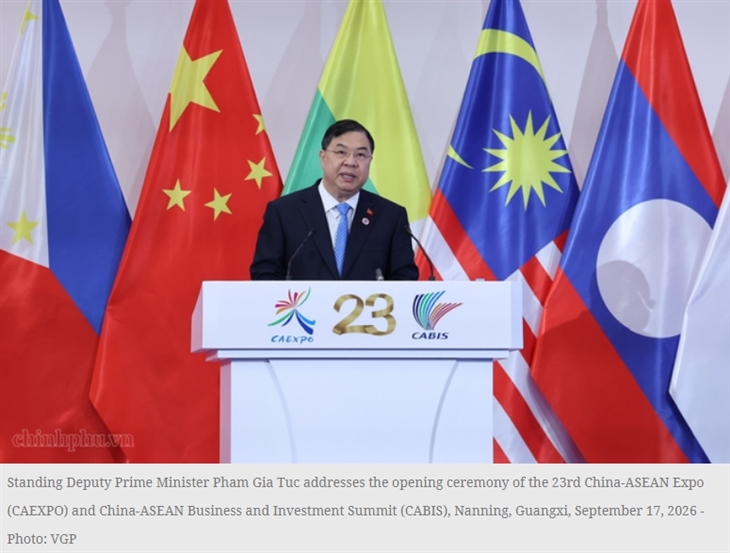
Viet Nam seeks to expand space for ASEAN-China cooperation ...
Viet Nam expects to make greater contributions to expanding the space for ASEAN-China cooperation for shared prosperity, underlined ...Top leader To Lam to attend 81st UNGA General Debate, ...
Viet Nam treasures friendly relations with Thailand: Prime ...

Viet Nam approves action program to implement ASEAN ...
The Vietnamese Government has approved an action program to implement the ASEAN Connectivity Strategic Plan in Viet Nam for 2026–2035 ...Industry and trade sector steps up strategic technology ...
Gov't approves National AI Strategy
Viet Nam continues to strengthen its strategic position in ...
