


Removing 'bottleneck' of capital and foreign language skills for export enterprises
Wednesday, September 16,2026
AsemconnectVietnam - Expanding export market brings many opportunities for small enterprises. To participate effectively, sellers must simultaneously solve problems of foreign language skills, capital and trust with partners.
Technology opens the 'door'
According to report on socio-economic situation in August and the first eight months of 2026, published by General Statistics Office, Ministry of Finance on September 3rd, merchandise export in August reached US$54.79 billion, an increase of 26% compared to the same period last year. Cumulative export for the first eight months reached US$374.84 billion, an increase of 22.4%.
Foreign-invested sector, including crude oil, exported US$300.37 billion, an increase of 26.9% and accounting for 80.1% of total export. Domestic economic sector achieved US$74.47 billion, an increase of 7.4% and accounting for 19.9%. Processed industrial goods group reached US$337.99 billion, equivalent to 90.2% of the country's total export value.
General Statistics Office predicts that results of the first eight months provide a basis for possibility of exceeding 15-16% target set in Resolution No.01/2026/NQ-CP in merchandise export turnover in 2026.
At seminar "Capital Diversion and Foreign Language Skills in Exporting" held on September 9th, Mr. Nguyen Tuan Viet - CEO of VIETGO, a trade promotion and export connection expert, stated that exports play a crucial role in the economy. For businesses, ability to sell goods to global market determines their ability to expand their market reach.
He assessed that Vietnam currently has many favorable conditions for enterprises to participate more deeply in export activities. Large enterprises and foreign investment create an environment for domestic businesses, especially small and medium-sized enterprises, to learn, participate in production and gradually improve their competitiveness.
Despite wide-open market opportunities, according to expert, many newcomers to export still fear two issues: foreign language skills and capital. Many believe that fluency in English is necessary for international trade or that a large amount of capital is required to fulfill orders. Workshop focused on directly addressing these two obstacles.
Regarding foreign language skills, Mr. Viet argued that English proficiency is not only determining factor. He himself had to hire interpreters in his early years of exporting, but now, with development of translation technology, sellers can communicate with customers in their native language, thus reducing many communication difficulties.
Sellers need to consider which language customers can understand, rather than assuming that all international partners are proficient in English. "Language isn't core issue; problem lies in quality of your thinking," Mr. Nguyen Tuan Viet emphasized, adding that while translation tools can handle language aspect, professional knowledge and sales skills still determine quality of transaction. Sellers must understand product, know how to pitch it, clearly communicate requirements and handle any arising situations with customers.
Regarding capital, Mr. Viet mentioned ways to reduce amount of equity required for orders through professional knowledge, relationships with suppliers and ability to negotiate payment terms. Newcomers still need initial funding for learning, purchasing customer data, conducting surveys, sourcing products and taking product photos.
Managing cash flow
At workshop, many enterprises shared methods they had applied in handling capital during export process. According to Ms. Huynh Thi Ngoc Hanh, Director of Miss Cara Co., Ltd., capital problem is linked to negotiating payment terms. For example, with a shipment of dragon fruit worth approximately $12,000 exported to the US by air, she persuaded customer to pay full amount before goods arrived at the airport. For subsequent orders, she continued to negotiate for customer to pay a deposit of about 40-50%. In some cases, this percentage was raised to 70% to ensure sufficient funds to pay the factory. Ms. Hanh said she had previously handled grapefruit orders worth over $30,000 using this method.
In garment industry, she once handled an order worth nearly 3 billion VND, with customer paying a 50% deposit. This money was used to partially pay for fabric and purchase accessories. After production was completed, she continued to negotiate for customer to pay remaining amount before the container was loaded.
"ability to negotiate payment terms depends heavily on reputation, pricing and how enterprises handles issues. If goods are defective, enterprises must react quickly and ensure customer rights are protected to maintain trust in subsequent orders", Ms. Hanh said.
Regarding foreign languages, Ms. Hanh stated that her English is limited. When working with foreign clients, she mainly communicates via WhatsApp, using Google Translate and ChatGPT for texts requiring more precise wording. Many clients also use their native languages, so both parties communicate directly through translation tools.
Mr. Tran Binh Minh - CEO of Binh Minh Café Co., Ltd. also frequently uses Google Translate to work with clients who speak Arabic and other Middle Eastern languages. According to Mr. Minh, this method of communication may be slower, but seller can closely follow content client wants to convey, minimizing risk of information being shortened during the translation process.
For orders under 500 million VND, focus will be on detailed discussions about quality and delivery schedule, with continuous sending of product images and videos to build trust. Only then enterprises negotiate upfront payment percentage. If the customer does not agree to pay in full, the deposit percentage can be adjusted down to 80%, 70%, or 50%. Larger orders of approximately 2-3 containers are processed in installments, with deposit for entire order used to fulfill the first container. Once the customer pays for the delivered goods, enterprises continues to use that cash flow to finance subsequent containers.
Mr. Ha Quang Vu - CEO of Ha Quang Import-Export Co., Ltd. - chooses to break down the cost structure in the selling price, negotiate payment terms with factories and utilize the time allowed for delayed freight payments to logistics companies to reduce equity capital. According to him, enterprises can negotiate with factories to delay payment for 7-10 days after goods leave the factory. This timeframe allows businesses to obtain documentation, collect payments from customers and then pay supplier.
Another option is to invite customers to Vietnam to directly supervise quality and packaging process. After inspecting goods, customers can pay immediately. Enterprises can also divide a large order into multiple deliveries to rotate cash flow between shipments.
Mr. Vu also mentioned option of acting as an export broker, whereby enterprises focus on finding customers, connecting transactions and earning commissions on orders instead of directly investing capital to complete entire transaction.
Source: Vitic/ congthuong.vn
According to report on socio-economic situation in August and the first eight months of 2026, published by General Statistics Office, Ministry of Finance on September 3rd, merchandise export in August reached US$54.79 billion, an increase of 26% compared to the same period last year. Cumulative export for the first eight months reached US$374.84 billion, an increase of 22.4%.
Foreign-invested sector, including crude oil, exported US$300.37 billion, an increase of 26.9% and accounting for 80.1% of total export. Domestic economic sector achieved US$74.47 billion, an increase of 7.4% and accounting for 19.9%. Processed industrial goods group reached US$337.99 billion, equivalent to 90.2% of the country's total export value.
General Statistics Office predicts that results of the first eight months provide a basis for possibility of exceeding 15-16% target set in Resolution No.01/2026/NQ-CP in merchandise export turnover in 2026.
At seminar "Capital Diversion and Foreign Language Skills in Exporting" held on September 9th, Mr. Nguyen Tuan Viet - CEO of VIETGO, a trade promotion and export connection expert, stated that exports play a crucial role in the economy. For businesses, ability to sell goods to global market determines their ability to expand their market reach.
He assessed that Vietnam currently has many favorable conditions for enterprises to participate more deeply in export activities. Large enterprises and foreign investment create an environment for domestic businesses, especially small and medium-sized enterprises, to learn, participate in production and gradually improve their competitiveness.
Despite wide-open market opportunities, according to expert, many newcomers to export still fear two issues: foreign language skills and capital. Many believe that fluency in English is necessary for international trade or that a large amount of capital is required to fulfill orders. Workshop focused on directly addressing these two obstacles.
Regarding foreign language skills, Mr. Viet argued that English proficiency is not only determining factor. He himself had to hire interpreters in his early years of exporting, but now, with development of translation technology, sellers can communicate with customers in their native language, thus reducing many communication difficulties.
Sellers need to consider which language customers can understand, rather than assuming that all international partners are proficient in English. "Language isn't core issue; problem lies in quality of your thinking," Mr. Nguyen Tuan Viet emphasized, adding that while translation tools can handle language aspect, professional knowledge and sales skills still determine quality of transaction. Sellers must understand product, know how to pitch it, clearly communicate requirements and handle any arising situations with customers.
Regarding capital, Mr. Viet mentioned ways to reduce amount of equity required for orders through professional knowledge, relationships with suppliers and ability to negotiate payment terms. Newcomers still need initial funding for learning, purchasing customer data, conducting surveys, sourcing products and taking product photos.
Managing cash flow
At workshop, many enterprises shared methods they had applied in handling capital during export process. According to Ms. Huynh Thi Ngoc Hanh, Director of Miss Cara Co., Ltd., capital problem is linked to negotiating payment terms. For example, with a shipment of dragon fruit worth approximately $12,000 exported to the US by air, she persuaded customer to pay full amount before goods arrived at the airport. For subsequent orders, she continued to negotiate for customer to pay a deposit of about 40-50%. In some cases, this percentage was raised to 70% to ensure sufficient funds to pay the factory. Ms. Hanh said she had previously handled grapefruit orders worth over $30,000 using this method.
In garment industry, she once handled an order worth nearly 3 billion VND, with customer paying a 50% deposit. This money was used to partially pay for fabric and purchase accessories. After production was completed, she continued to negotiate for customer to pay remaining amount before the container was loaded.
"ability to negotiate payment terms depends heavily on reputation, pricing and how enterprises handles issues. If goods are defective, enterprises must react quickly and ensure customer rights are protected to maintain trust in subsequent orders", Ms. Hanh said.
Regarding foreign languages, Ms. Hanh stated that her English is limited. When working with foreign clients, she mainly communicates via WhatsApp, using Google Translate and ChatGPT for texts requiring more precise wording. Many clients also use their native languages, so both parties communicate directly through translation tools.
Mr. Tran Binh Minh - CEO of Binh Minh Café Co., Ltd. also frequently uses Google Translate to work with clients who speak Arabic and other Middle Eastern languages. According to Mr. Minh, this method of communication may be slower, but seller can closely follow content client wants to convey, minimizing risk of information being shortened during the translation process.
For orders under 500 million VND, focus will be on detailed discussions about quality and delivery schedule, with continuous sending of product images and videos to build trust. Only then enterprises negotiate upfront payment percentage. If the customer does not agree to pay in full, the deposit percentage can be adjusted down to 80%, 70%, or 50%. Larger orders of approximately 2-3 containers are processed in installments, with deposit for entire order used to fulfill the first container. Once the customer pays for the delivered goods, enterprises continues to use that cash flow to finance subsequent containers.
Mr. Ha Quang Vu - CEO of Ha Quang Import-Export Co., Ltd. - chooses to break down the cost structure in the selling price, negotiate payment terms with factories and utilize the time allowed for delayed freight payments to logistics companies to reduce equity capital. According to him, enterprises can negotiate with factories to delay payment for 7-10 days after goods leave the factory. This timeframe allows businesses to obtain documentation, collect payments from customers and then pay supplier.
Another option is to invite customers to Vietnam to directly supervise quality and packaging process. After inspecting goods, customers can pay immediately. Enterprises can also divide a large order into multiple deliveries to rotate cash flow between shipments.
Mr. Vu also mentioned option of acting as an export broker, whereby enterprises focus on finding customers, connecting transactions and earning commissions on orders instead of directly investing capital to complete entire transaction.
Source: Vitic/ congthuong.vn
FDI into Vietnam surged in 8 months of 2026
Textile and garment material imports: promising sign for year-end orders
What should Vietnamese enterprises be aware of when UK establishes regulations to combat deforestation?
World rice prices are rising, so why isn't Vietnamese rice benefiting?
New regulations on foreign trade management issued
From growth to sustainability: New challenge for Vietnam’s fish meal
Textiles and garments contribute to Vietnam's rise to group of export powerhouses
From US$1 trillion milestone to new opportunities for Vietnam's logistics
Total import and export turnover in the first 8 months reached US$770.14 billion
Leather and footwear exports reached US$19.54 billion in 8 months of 2026
Vietnam’s seafood exports increased in 8 months of 2026
Fruit and vegetable import market structure: China and US remained dominant
Imports of computers and electronic components increased in 8 months
Expor to EU: Packaging becomes a new challenge
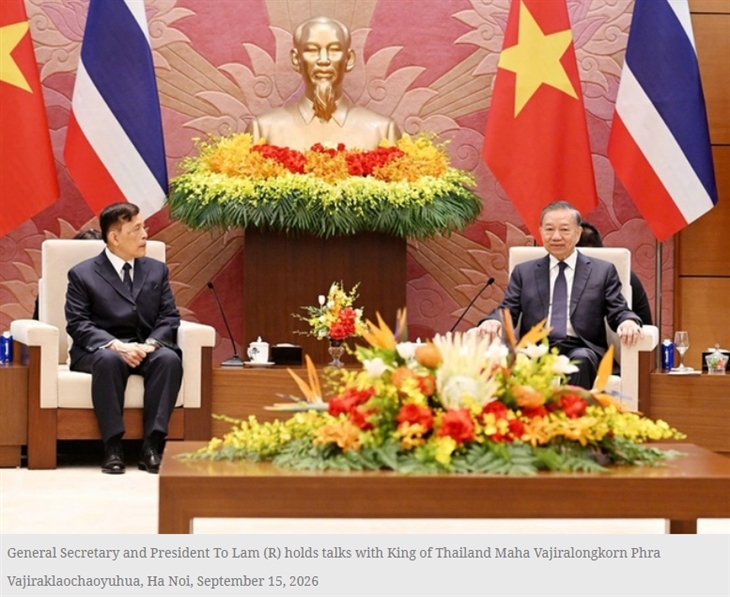
Top leader To Lam holds talks with Thai King
General Secretary and President To Lam held talks with King of Thailand Maha Vajiralongkorn Phra Vajiraklaochaoyuhua in Ha Noi on ...Prime Minister meets WTO Director-General on 18th BRICS ...
King of Thailand embarks on State visit to Viet Nam
Prime Minister Le Minh Hung to attend 18th BRICS Summit in ...
Viet Nam approves action program to implement ASEAN ...
The Vietnamese Government has approved an action program to implement the ASEAN Connectivity Strategic Plan in Viet Nam for 2026–2035 ...Industry and trade sector steps up strategic technology ...
Gov't approves National AI Strategy
Viet Nam continues to strengthen its strategic position in ...
