


Action plan on building Viet Nam into strong maritime nation by 2030 approved
Thursday, August 13,2026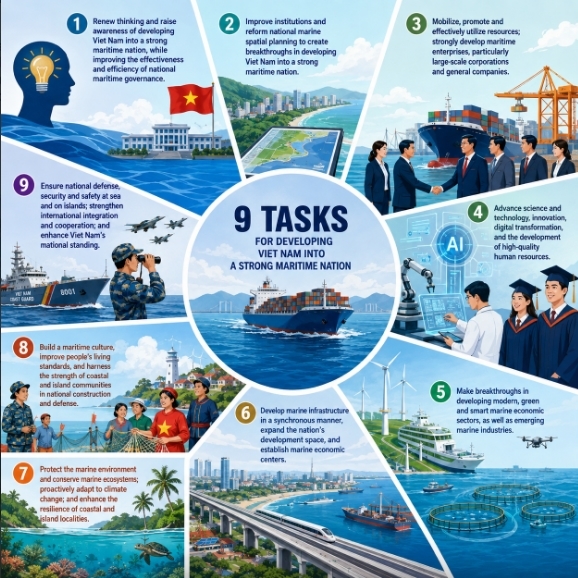
AsemconnectVietnam - The Government issued Resolution No. 218/NQ-CP on August 7, 2026, outlining an action plan to implement Resolution No. 20-NQ/TW of the Party Central Committee on building and developing Viet Nam into a strong maritime nation.
The Party Central Committee's Resolution No. 20-NQ/TW on building and developing Viet Nam into a strong maritime nation focuses on three major shifts in maritime development thinking including (1) from maritime resource exploitation to modern ocean governance; (2) from coastal economic development to building ocean governance and (3) from sector-based management to integrated, united national ocean governance.
Resolution 20 centers on ten pillars namely modern marine economy, modern ocean governance, maritime logistics, marine science and technology, marine environmental protection, defence and security, maritime law enforcement, international integration and cooperation, strong maritime enterprises, and prosperous coastal and island communities./.
The action plan aims to translate the Party's orientations into specific tasks for ministries, ministerial-level agencies and local authorities, with clear responsibilities, implementation timelines and evaluation criteria.
Under the plan, the Government has requested ministries, ministerial-level agencies and People's Committees of centrally-governed provinces and cities to proactively formulate plans and resolutely, synchronously and effectively carry out nine key tasks.
These include renewing thinking and raising awareness of building a strong maritime nation; improving institutions and national marine spatial planning; mobilizing and effectively using resources and developing large maritime enterprises; promoting science, technology, innovation, digital transformation and high-quality human resources; and making breakthroughs in modern, green, smart and emerging marine industries.
The plan reiterates Viet Nam's determination to achieve major goals through, including synchronous development of maritime infrastructure and the formation of marine economic centers; protection of the marine environment and conservation of marine ecosystems; proactive adaptation to climate change; improvement of the resilience of coastal and island localities; development of maritime culture and living standards; and assurance of national defense, security and safety at sea and on islands, alongside stronger international integration and cooperation.
The Government aims to increase the contribution of coastal localities to the national economy and establish a modern, green and smart marine economic ecosystem.
Ministries and relevant agencies are tasked with reviewing sectoral strategies and development plans, prioritizing smart and low-emission production and services that use resources and energy efficiently.
The Government will promote nearshore marine economic activities within 12 nautical miles, while developing the oil and gas industry, offshore technical services and sustainable exploitation of marine resources.
Special mechanisms will be considered for deep-water and offshore projects and offshore energy projects.
Viet Nam will also develop green and smart seaports, its merchant fleet, shipbuilding industries, and maritime logistics, while strengthening connectivity between seaports and road, rail, inland waterway and air transport networks.
The Government will review the Master Plan for Viet Nam's Seaport System for the 2021–2030 period, with a vision to 2050, and implement a national program for the maritime and marine engineering industries.
Restructuring fisheries toward sustainability
In the fisheries sector, the action plan stresses the need for restructuring production by reducing nearshore fishing, promoting responsible offshore fishing and developing industrial-scale and high-tech marine aquaculture.
Investment will be stepped up in fisheries infrastructure, breeding, preservation, processing and insurance, together with support policies for fishermen.
The Government will continue taking strong and coordinated measures to combat illegal, unreported and unregulated (IUU) fishing and remove the European Commission's "yellow card" warning.
Fisheries management, catch monitoring, traceability and law enforcement at sea will be strengthened.
At the same time, Viet Nam will promote aquaculture technologies, smart cages, digital systems, automation, artificial intelligence and renewable energy in fisheries production.
Developing marine tourism and emerging industries
The action plan also seeks to develop internationally competitive marine tourism and services, including large-scale tourism hubs and clusters, green tourism, cruise tourism, ecotourism, community-based tourism, the night-time economy and marine festivals.
Viet Nam will formulate policies to foster emerging marine industries, including high-tech marine aquaculture, marine pharmaceuticals, marine biotechnology, seawater desalination, wave energy, hydrogen, green ammonia and subsea cable infrastructure.
Through these measures, the Government aims to unlock the potential of the sea and coastal areas, expand the nation's development space, strengthen the competitiveness of the marine economy and ensure sustainable use of marine resources while firmly safeguarding national sovereignty, defense and security at sea and on islands./.
Source: en.baochinhphu.vn/action-plan-on-building-viet-nam-into-strong-maritime-nation-by-2030-issued-111260810111929667.htm
Resolution 20 centers on ten pillars namely modern marine economy, modern ocean governance, maritime logistics, marine science and technology, marine environmental protection, defence and security, maritime law enforcement, international integration and cooperation, strong maritime enterprises, and prosperous coastal and island communities./.
The action plan aims to translate the Party's orientations into specific tasks for ministries, ministerial-level agencies and local authorities, with clear responsibilities, implementation timelines and evaluation criteria.
Under the plan, the Government has requested ministries, ministerial-level agencies and People's Committees of centrally-governed provinces and cities to proactively formulate plans and resolutely, synchronously and effectively carry out nine key tasks.
These include renewing thinking and raising awareness of building a strong maritime nation; improving institutions and national marine spatial planning; mobilizing and effectively using resources and developing large maritime enterprises; promoting science, technology, innovation, digital transformation and high-quality human resources; and making breakthroughs in modern, green, smart and emerging marine industries.
The plan reiterates Viet Nam's determination to achieve major goals through, including synchronous development of maritime infrastructure and the formation of marine economic centers; protection of the marine environment and conservation of marine ecosystems; proactive adaptation to climate change; improvement of the resilience of coastal and island localities; development of maritime culture and living standards; and assurance of national defense, security and safety at sea and on islands, alongside stronger international integration and cooperation.
The Government aims to increase the contribution of coastal localities to the national economy and establish a modern, green and smart marine economic ecosystem.
Ministries and relevant agencies are tasked with reviewing sectoral strategies and development plans, prioritizing smart and low-emission production and services that use resources and energy efficiently.
The Government will promote nearshore marine economic activities within 12 nautical miles, while developing the oil and gas industry, offshore technical services and sustainable exploitation of marine resources.
Special mechanisms will be considered for deep-water and offshore projects and offshore energy projects.
Viet Nam will also develop green and smart seaports, its merchant fleet, shipbuilding industries, and maritime logistics, while strengthening connectivity between seaports and road, rail, inland waterway and air transport networks.
The Government will review the Master Plan for Viet Nam's Seaport System for the 2021–2030 period, with a vision to 2050, and implement a national program for the maritime and marine engineering industries.
Restructuring fisheries toward sustainability
In the fisheries sector, the action plan stresses the need for restructuring production by reducing nearshore fishing, promoting responsible offshore fishing and developing industrial-scale and high-tech marine aquaculture.
Investment will be stepped up in fisheries infrastructure, breeding, preservation, processing and insurance, together with support policies for fishermen.
The Government will continue taking strong and coordinated measures to combat illegal, unreported and unregulated (IUU) fishing and remove the European Commission's "yellow card" warning.
Fisheries management, catch monitoring, traceability and law enforcement at sea will be strengthened.
At the same time, Viet Nam will promote aquaculture technologies, smart cages, digital systems, automation, artificial intelligence and renewable energy in fisheries production.
Developing marine tourism and emerging industries
The action plan also seeks to develop internationally competitive marine tourism and services, including large-scale tourism hubs and clusters, green tourism, cruise tourism, ecotourism, community-based tourism, the night-time economy and marine festivals.
Viet Nam will formulate policies to foster emerging marine industries, including high-tech marine aquaculture, marine pharmaceuticals, marine biotechnology, seawater desalination, wave energy, hydrogen, green ammonia and subsea cable infrastructure.
Through these measures, the Government aims to unlock the potential of the sea and coastal areas, expand the nation's development space, strengthen the competitiveness of the marine economy and ensure sustainable use of marine resources while firmly safeguarding national sovereignty, defense and security at sea and on islands./.
Source: en.baochinhphu.vn/action-plan-on-building-viet-nam-into-strong-maritime-nation-by-2030-issued-111260810111929667.htm
Viet Nam approves International Financial Center development plan through 2035
Project on Ecosystem of supporting enterprises in leveraging FTAs in a period of 2026-2030 with a vision to 2035
Inter-sectoral legal support program for small and medium-sized enterprises and business household in a period of 2026-2030
General plan task of Can Tho City until 2050 with a vision to 2075
International market expansion program in a period of 2026-2030
Public debt borrowing and repayment plan for 2026
Plan on implementation of high-tech law
Plan of Hai Duong province for a period of 2021 - 2030, vision to 2050
Plan of Hau Giang province in a period of 2021 - 2030, vision to 2050
Sustainable forestry development program in a period of 2021 - 2025
National strategy on climate change to 2050
Plan on implementing national strategy for clean water supply and rural sanitation to 2030, vision to 2045
Supporting industry development program in Da Nang city in a period of 2022-2025
Action plan on implementing Nghe An province's tourism development strategy to 2030, vision to 2035
Ministry of Industry and Trade issues action plan to ...
The Ministry of Industry and Trade (MoIT) has issued an action plan to implement the “GoGlobal Program for 2026-2030,” outlining key ...National Assembly Chairman: Foreign affairs must become a ...
Place preserving memories of President Ho Chi Minh in ...
Vietnamese leaders pay tribute to President Ho Chi Minh on ...
Viet Nam approves International Financial Center ...
The Viet Nam International Financial Center (IFC) is expected to rank among the top 75 financial centers worldwide, top 25 financial ...Project on Ecosystem of supporting enterprises in ...
Inter-sectoral legal support program for small and ...
General plan task of Can Tho City until 2050 with a vision ...
