


Resolution No.10 is significant evolution in Viet Nam’s investment strategy: HSBC
Thursday, August 6,2026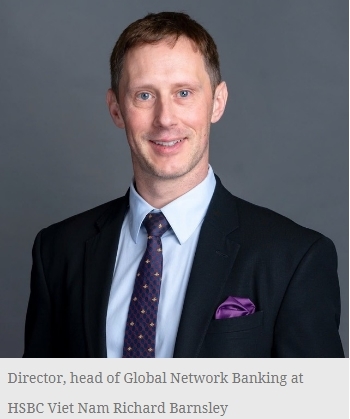
AsemconnectVietnam - Resolution No.10 is a significant evolution in Viet Nam’s investment strategy. The objective is no longer simply to attract capital, but to attract capability, told Director, head of Global Network Banking at HSBC Viet Nam Richard Barnsley.
According to the HSBC specialist, competitive labor costs, political stability, an expanding network of free trade agreements and an increasingly open investment environment have made Viet Nam one of the world's most attractive destinations for foreign direct investment (FDI).
The foreign-invested sector accounts for around three-quarters of Viet Nam's export value. In the first half of 2026 alone, newly registered FDI reached approximately US$17.39 billion, an increase of almost 87.2 percent compared with the same period a year earlier.
FDI has been central to Viet Nam's remarkable economic transformation, creating jobs, expanding exports and raising living standards, he noted.
Yet Viet Nam's leadership also recognizes that the original FDI-for-export model has limits. The next stage of development requires more than attracting investment, it requires capturing greater value from it.
That ambition is clearly reflected in Politburo Resolution 10-NQ/TW, issued on June 8, 2026. The Resolution sets out a new vision for FDI in the era of what many describe as Doi Moi 2.0.
Success will increasingly be measured by whether foreign investment brings technology, develops local talent, establishes research and development capability, and integrates Vietnamese enterprises more deeply into global value chains.
The Resolution sets out ambitious but measurable objectives. Between 2025 and 2030, Viet Nam aims to attract US$200–300 billion in newly registered FDI while disbursing US$150–200 billion, with approximately three-quarters of investment originating from developed economies.
It also seeks to integrate 10,000 Vietnamese enterprises into FDI supply chains and attract at least three of the world's leading technology companies to establish regional headquarters or R&D centers in Viet Nam.
Barnsley highlighted that in many respects, Resolution 10 represents a shift from incentives to institutions.
That shift is especially relevant at a time of geopolitical uncertainty, evolving global trade patterns and the rapid acceleration of artificial intelligence. Companies restructuring global supply chains are seeking resilient, predictable and innovation-driven investment destinations. Strong institutions have become one of the most valuable competitive advantages a country can offer.
Resolution 10 places institutional reform ahead of incentives, promotes performance-based support that rewards actual R&D activity and technology transfer rather than simply registered capital, and emphasizes supplier capability development through training, quality systems and management improvement.
These are precisely the capabilities that enable Vietnamese companies to meet the demanding standards of multinational corporations and become long-term participants in global value chains, told HSBC specialist./.
Source: en.baochinhphu.vn/resolution-no10-is-significant-evolution-in-viet-nams-investment-strategy-hsbc-111260805105328217.htm
The foreign-invested sector accounts for around three-quarters of Viet Nam's export value. In the first half of 2026 alone, newly registered FDI reached approximately US$17.39 billion, an increase of almost 87.2 percent compared with the same period a year earlier.
FDI has been central to Viet Nam's remarkable economic transformation, creating jobs, expanding exports and raising living standards, he noted.
Yet Viet Nam's leadership also recognizes that the original FDI-for-export model has limits. The next stage of development requires more than attracting investment, it requires capturing greater value from it.
That ambition is clearly reflected in Politburo Resolution 10-NQ/TW, issued on June 8, 2026. The Resolution sets out a new vision for FDI in the era of what many describe as Doi Moi 2.0.
Success will increasingly be measured by whether foreign investment brings technology, develops local talent, establishes research and development capability, and integrates Vietnamese enterprises more deeply into global value chains.
The Resolution sets out ambitious but measurable objectives. Between 2025 and 2030, Viet Nam aims to attract US$200–300 billion in newly registered FDI while disbursing US$150–200 billion, with approximately three-quarters of investment originating from developed economies.
It also seeks to integrate 10,000 Vietnamese enterprises into FDI supply chains and attract at least three of the world's leading technology companies to establish regional headquarters or R&D centers in Viet Nam.
Barnsley highlighted that in many respects, Resolution 10 represents a shift from incentives to institutions.
That shift is especially relevant at a time of geopolitical uncertainty, evolving global trade patterns and the rapid acceleration of artificial intelligence. Companies restructuring global supply chains are seeking resilient, predictable and innovation-driven investment destinations. Strong institutions have become one of the most valuable competitive advantages a country can offer.
Resolution 10 places institutional reform ahead of incentives, promotes performance-based support that rewards actual R&D activity and technology transfer rather than simply registered capital, and emphasizes supplier capability development through training, quality systems and management improvement.
These are precisely the capabilities that enable Vietnamese companies to meet the demanding standards of multinational corporations and become long-term participants in global value chains, told HSBC specialist./.
Source: en.baochinhphu.vn/resolution-no10-is-significant-evolution-in-viet-nams-investment-strategy-hsbc-111260805105328217.htm
Vietnam and Laos strengthen cooperation in trade, industry and energy
Top leader hosts Ambassadors, Chargés d’Affaires of ASEAN Member States
FDI inflows surpass US$38 billion in Jan-July period
Vietnam highlighted as a rising investment destination at ASEAN Conference 2026
Gov’t chief receives incoming IMF Resident Representative
Deputy Prime Minister Ho Quoc Dung hosts President of Southeast Asia Semiconductor Association
Vietnam, Panama seek to deepen trade, logistics cooperation
Deputy Minister Nguyen Hoang Long holds talks with Lithuanian Foreign Minister
Prime Minister Le Minh Hung receives New Zealand Ambassador: Vietnam an important regional partner
Deputy Prime Minister Ho Quoc Dung hosts President of Southeast Asia Semiconductor Association
Deputy PM meets WTO Deputy Director-General, Co-Chair of WEF Board of Trustees in Geneva
Vietnam Trade Office boosts coffee exports at Expo Cafe Chile 2026
Vietnam, Laos strengthen cooperation on inspection, domestic market management
Foreign Minister meets EC Vice President in Manila
Ministry of Industry and Trade issues action plan to ...
The Ministry of Industry and Trade (MoIT) has issued an action plan to implement the “GoGlobal Program for 2026-2030,” outlining key ...National Assembly Chairman: Foreign affairs must become a ...
Place preserving memories of President Ho Chi Minh in ...
Vietnamese leaders pay tribute to President Ho Chi Minh on ...
Viet Nam approves International Financial Center ...
The Viet Nam International Financial Center (IFC) is expected to rank among the top 75 financial centers worldwide, top 25 financial ...Project on Ecosystem of supporting enterprises in ...
Inter-sectoral legal support program for small and ...
General plan task of Can Tho City until 2050 with a vision ...
