


Vietnam highlighted as a rising investment destination at ASEAN Conference 2026
Monday, August 3,2026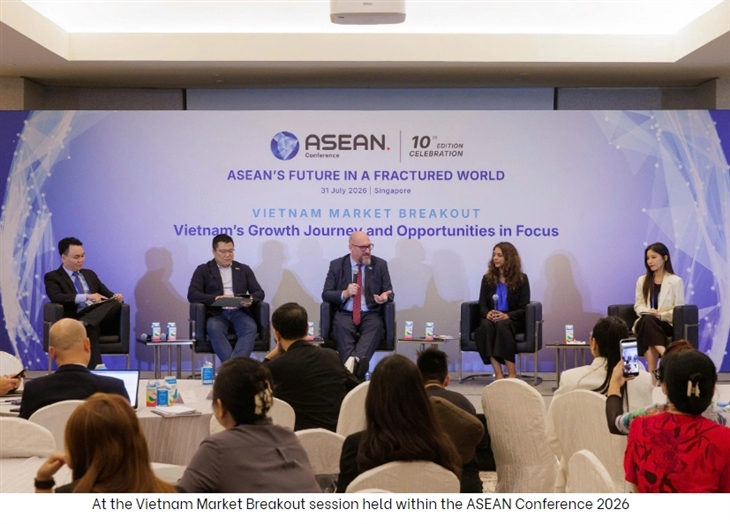
AsemconnectVietnam - As ASEAN seeks to strengthen its role amid a more fragmented global economy, Vietnam was placed in the spotlight at the ASEAN Conference 2026, with business leaders pointing to the country's transition toward higher-value investment, major infrastructure development, and financial market reforms as key drivers of its next growth phase.
Held under the theme "ASEAN's Future in a Fractured World," the conference marked the 10th edition of the annual event organized by the Singapore Business Federation (SBF). More than 1,000 business leaders, policymakers, and government officials from over 20 countries and economies attended discussions on geopolitical shifts, artificial intelligence, supply chain resilience, and the green economy. Vietnam was one of four dedicated country breakout sessions, alongside Indonesia, Malaysia, and Thailand, offering investors market-specific insights into business opportunities across the region.
Opening the conference, Mr. Mark Lee, Chairman of the Singapore Business Federation, said ASEAN has reached an important milestone as it celebrates a decade of regional dialogue through the conference, while facing a global environment increasingly shaped by geopolitical tensions, supply chain realignments, technological disruption, and the energy transition.
"This year's conference theme, ASEAN's Future in a Fractured World, reflects the realities of a complex global environment in which we now operate," Mr. Lee said, adding that closer collaboration among governments, businesses, and institutions would be essential to strengthen regional connectivity and unlock new opportunities.
With a population of more than 680 million, ASEAN has a potential to become the world's fourth-largest economy by 2030, he said, noting that the regional bloc is advancing initiatives such as the Digital Economy Framework Agreement (DEFA) while strengthening business partnerships and regional integration. Vietnam's inclusion as one of four dedicated country tracks reflected growing international interest in the country's investment outlook and economic transformation.
ASEAN becoming a new center of global growth
Delivering the conference keynote, Mr. Frederick Chin, Head of Group Wholesale Banking and Markets at UOB, said the world is undergoing a structural reordering rather than a temporary period of disruption.
He pointed to geopolitical tensions, the rapid rise of artificial intelligence, shifting global manufacturing, and evolving capital markets as forces reshaping international investment flows.
"ASEAN is no longer reacting to the future. We are shaping it," Mr. Chin said.
According to Mr. Chin, businesses are increasingly making investment decisions based not only on efficiency, but also on resilience, reliability, and trust.
He noted that foreign direct investment (FDI) into ASEAN has more than doubled over the past decade, rising from $115 billion to $244 billion, while the region now accounts for 15 per cent of global FDI inflows.
ASEAN exports are projected to increase by nearly 90 per cent by 2031, more than three times the pace of global trade growth, as companies continue diversifying production and supply chains.
"In a fragmented world, capital flows follow trust. And trust is increasingly shifting toward ASEAN," Mr. Chin said.
He described ASEAN as moving beyond its traditional role as "the world's middle ground" to become "the strategic center of gravity for global growth."
Looking ahead, Mr. Chin said AI infrastructure, digital connectivity, and cross-border investment will increasingly define the region's competitiveness. He argued that leadership in the coming decade will depend on three key factors: talent, capital, and trust. "Trust will be ASEAN's most valuable currency," he said.
Vietnam enters a new stage of development
Against that regional backdrop, UOB devoted its Vietnam market session to examining the country's next phase of economic development.
Speaking at the session, Mr. Victor Ngo, CEO of UOB Vietnam, said Vietnam is undergoing a pivotal transition as it works toward becoming a high-income economy by 2045 while maintaining annual growth of around 10 per cent through the remainder of the decade.
He noted that the country's economy expanded 8.18 per cent in the first half of the year, while disbursed FDI reached $13 billion, the highest first-half level in five years.
According to Mr. Ngo, Vietnam's traditional manufacturing industries, including electronics, textiles, and processing, will remain an important foundation for growth, but the country must increasingly attract higher-value investment.
"What I call FDI 1.0 - electronics, textiles and processing - remains vital," Mr. Ngo said. "But traditional drivers alone will not push growth from 8 to 10 per cent. That gap must be filled by FDI 2.0."
He described FDI 2.0 as the next stage of investment focused on semiconductors, artificial intelligence, innovation, advanced manufacturing, and the green transition, emphasizing technology transfer and deeper integration into domestic supply chains.
Infrastructure and capital to drive future growth
To support that transition, Mr. Ngo said Vietnam will require approximately $245 billion in infrastructure investment through 2030. The investment will span three major areas: transport infrastructure, energy systems, and digital and institutional development.
On transport, Vietnam is expanding airports, expressways, railways, and deep-water ports to strengthen national and regional connectivity.
On energy, implementation of Power Development Plan VIII is expected to require around $135 billion to expand electricity generation and transmission capacity needed to support industrial development.
Mr. Ngo also pointed to regulatory reforms designed to support emerging industries, saying Vietnam has moved from planning major initiatives to implementing them. "If you were at this conference a year ago, many of these initiatives were still on paper," he said. "Today, Vietnam is actively moving from policy planning into concrete, on-the-ground project execution."
Beyond infrastructure, Mr. Ngo identified three priorities for attracting long-term investment: developing more bankable infrastructure projects, expanding Vietnam's capital markets, and improving logistics efficiency.
He also highlighted the newly launched Vietnam International Financial Centers (VIFC) in Ho Chi Minh City and Da Nang as an important platform for attracting cross-border capital and supporting the country's transition toward higher-value investment.
Dong Nai showcases local investment opportunities
Vietnam's transformation was also illustrated through a presentation by Mr. Vu Ngoc Long, Director of Dong Nai city's Department of Industry and Trade, who outlined the southern city's long-term development strategy centered on its Long Thanh International Airport.
Mr. Long said Dong Nai aims to develop an integrated aviation ecosystem that combines airports, logistics, aerospace industries, financial services, commercial development, and smart urban planning.
The province is also prioritizing investment in semiconductors, artificial intelligence, biotechnology, clean energy, digital technology, and advanced manufacturing while strengthening partnerships with Singaporean and ASEAN investors.
Rather than attracting individual projects, Dong Nai aims to develop complete industrial ecosystems capable of generating higher value-added production, technology transfer, and stronger regional supply chain linkages, he said.
On the sidelines of the conference, UOB also arranged a meeting on July 31 between Dong Nai city leaders, executives from Sovico Group, and major regional investors, including Sembcorp, Changi Airport Group, and Surbana Jurong. During the session, Dong Nai officials presented the city's development strategy and discussed opportunities for foreign investment, with particular emphasis on the Long Thanh International Airport development project and its surrounding ecosystem.
Concluding his presentation, Mr. Ngo reaffirmed UOB’s commitment to supporting the country's next stage of development.
Since 2020, the bank's FDI Advisory Unit has supported more than 400 companies investing in Vietnam, facilitating approximately SGD9 billion in investment and contributing to more than 60,000 jobs. It is also expanding partnerships with local authorities while developing UOB Plaza Ho Chi Minh City as its new flagship headquarters in Vietnam.
Source: en.vneconomy.vn/vietnam-highlighted-as-a-rising-investment-destination-at-asean-conference-2026.htm
Deputy Prime Minister Ho Quoc Dung hosts President of Southeast Asia Semiconductor Association
Vietnam, Panama seek to deepen trade, logistics cooperation
Deputy Minister Nguyen Hoang Long holds talks with Lithuanian Foreign Minister
Prime Minister Le Minh Hung receives New Zealand Ambassador: Vietnam an important regional partner
Deputy Prime Minister Ho Quoc Dung hosts President of Southeast Asia Semiconductor Association
Deputy PM meets WTO Deputy Director-General, Co-Chair of WEF Board of Trustees in Geneva
Vietnam Trade Office boosts coffee exports at Expo Cafe Chile 2026
Vietnam, Laos strengthen cooperation on inspection, domestic market management
Foreign Minister meets EC Vice President in Manila
Viet Nam co-chairs ASEAN–New Zealand Ministerial Meeting
Foreign Minister meets U.S. Secretary of State Marco Rubio in Manila
Viet Nam proposes priorities to deepen ASEAN-U.S. strategic partnership
Vietnam, RoK step up cooperation in free economic zones and investment promotion
Viet Nam, Greece urged to improve legal framework for bilateral cooperation
Ministry of Industry and Trade issues action plan to ...
The Ministry of Industry and Trade (MoIT) has issued an action plan to implement the “GoGlobal Program for 2026-2030,” outlining key ...National Assembly Chairman: Foreign affairs must become a ...
Place preserving memories of President Ho Chi Minh in ...
Vietnamese leaders pay tribute to President Ho Chi Minh on ...
Plan on boosting export of Hanoi City in a period of ...
To organize synchronized and effective implementation of key tasks and solutions of the Politburo's Resolutions, the ...Inter-sectoral legal support program for small and ...
General plan task of Can Tho City until 2050 with a vision ...
