


Vietnam remains a solid economic performer
Tuesday, July 21,2026
AsemconnectVietnam - Three major international institutions all see Vietnam staying among Asia’s fastest-growing economies despite rising external risks.
The global economy has entered another period of heightened uncertainty. Geopolitical conflicts continue to disrupt energy markets, protectionist trade policies are reshaping global supply chains, and inflation remains stubbornly above target in many economies. Yet amid these challenges, Vietnam stands out as a rare bright spot.
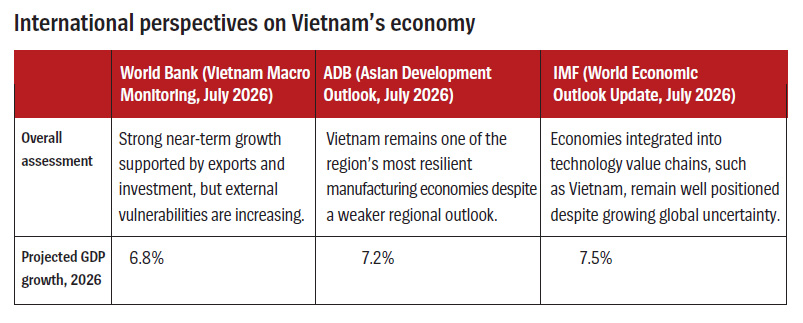
The latest assessments from the World Bank, the International Monetary Fund (IMF), and the Asian Development Bank (ADB) all point in the same direction: Vietnam remains one of the strongest-performing economies in Asia. Though each emphasize different aspects of the country’s outlook, they broadly agree that robust manufacturing, resilient exports, rising private investment, and sustained FDI continue to underpin growth.
The consensus, however, comes with an important caveat. The next phase of Vietnam’s development will depend less on benefiting from global manufacturing shifts and increasingly on strengthening domestic competitiveness, improving productivity, and reducing vulnerabilities to an increasingly volatile external environment.
Growth drivers remain intact
The World Bank’s latest Vietnam Macro Monitoring report describes an economy that entered 2026 with considerable momentum.
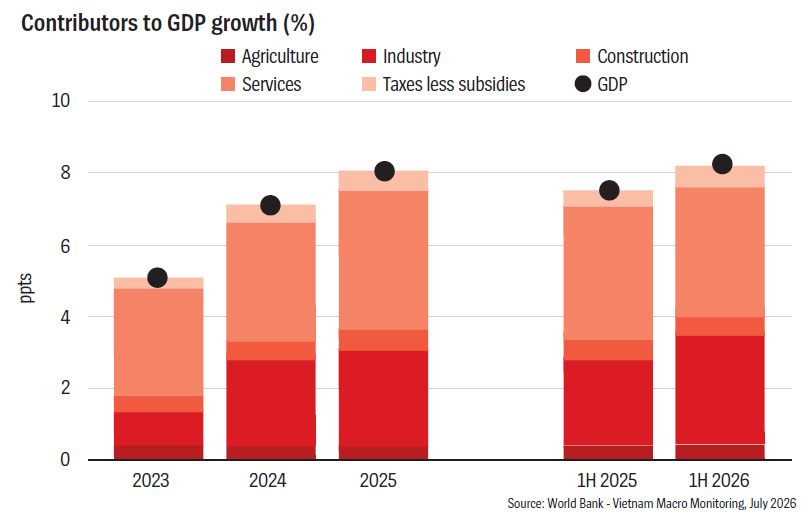
Real GDP expanded by 8.2 per cent year-on-year in the first half, up from 7.6 per cent in the same period of 2025. Manufacturing remained the principal engine of growth, supported by goods exports that increased 21 per cent, particularly in high-tech manufacturing and electronics. Investment also strengthened significantly, led by the private sector and followed by FDI, highlighting continued confidence among domestic and international investors.
The World Bank also noted that credit growth has remained sufficiently strong to support investment across logistics, digital infrastructure, manufacturing, and real estate, while newly-registered FDI commitments suggest that Vietnam continues to strengthen its position as a regional production hub.
The ADB reached a similar conclusion despite taking a more cautious view of the regional economy. Its July 2026 Asian Development Outlook revised down growth forecasts for developing Asia to 4.9 per cent from the 5.1 per cent projected only three months prior. Southeast Asia’s outlook was likewise lowered amid weaker external demand, prolonged energy market disruptions, and higher production costs stemming from conflict in the Middle East.
Yet Vietnam remains among the region’s standout performers. The ADB identified Vietnam as one of only a handful of Asian economies where manufacturing activity continues to expand comfortably, with Purchasing Managers’ Index (PMI) readings remaining above the 50-point threshold. Strong new export orders and resilient production suggest that global demand for Vietnamese manufactured goods, particularly electronics and machinery, continues to offset broader regional weakness.
The IMF likewise sees Vietnam benefiting from two structural trends reshaping the global economy. Its latest World Economic Outlook argued that while conflict in the Middle East has created a significant supply shock through higher energy prices, the rapid expansion of AI is simultaneously generating a powerful technology-driven investment cycle. Economies deeply integrated into global technology supply chains are expected to benefit disproportionately from this new wave of investment.
Together, these assessments reinforce a broader narrative that has emerged over the past decade. Vietnam is no longer viewed simply as a low-cost manufacturing destination but increasingly as a strategic production base within global technology supply chains.
Complex external risks
While confidence in Vietnam’s medium-term prospects remains high, international institutions are also becoming more vocal about the vulnerabilities accompanying this rapid expansion. Perhaps the most immediate concern is Vietnam’s increasing dependence on imported inputs.
According to the World Bank, imports of electronics, machinery, and intermediate goods are now growing even faster than exports. As manufacturers expand production capacity and public investment accelerates, demand for imported capital equipment has risen sharply, pushing the trade balance into deficit despite exceptionally-strong export growth.
This reflected Vietnam’s deep integration into regional manufacturing networks but also illustrates an important structural challenge. Much of Vietnam’s export success still relies on imported components rather than domestically-produced intermediate goods. As a result, stronger exports do not automatically translate into proportionately higher domestic value added.
The World Bank also highlighted mounting trade policy uncertainty. Investigations by the US into manufacturing overcapacity, forced-labor concerns, and intellectual property protection could complicate Vietnam’s export outlook, particularly given the country’s increasing importance in global supply chains. While no immediate disruption has occurred, the changing policy landscape introduces additional uncertainty for export-oriented manufacturers.
The ADB echoes these concerns, warning that global trade fragmentation, rising freight costs, and persistent geopolitical tensions are likely to weigh on export performance throughout developing Asia. Though electronics demand linked to AI continues to provide support, supply chains remain vulnerable to renewed disruptions, particularly if geopolitical conflicts intensify further.
Inflation presents another area requiring careful management. Vietnam’s headline inflation eased to 4.7 per cent in June following the introduction of lower-priced E10 and E5 blended gasoline, reducing transport costs. Nevertheless, inflation remains above the government’s 4.5 per cent target, while elevated core inflation continues to constrain household purchasing power.
The ADB similarly observed that inflationary pressures across Asia have broadened beyond energy prices. Rising transportation costs, logistics disruptions, and higher fertilizer prices are feeding into food prices and broader consumer inflation, leaving central banks across the region balancing growth objectives against price stability.
The IMF noted that although energy prices have eased from their April peaks, risks remain tilted to the downside. It warned that renewed geopolitical tensions could reignite commodity price volatility, while tighter global financial conditions, accelerating trade fragmentation, and a correction in technology-driven expectations could weigh on global growth.
For Vietnam, whose economy remains highly open and export-oriented, these external developments could quickly transmit through trade, investment, and financial channels.
Next stage of growth
Beyond the near-term outlook, financial institutions suggest that Vietnam’s longer-term challenge is changing. For decades, rapid growth has been driven largely by labor-intensive manufacturing, export expansion, and foreign investment. Those drivers remain important, but they may no longer be sufficient on their own.
The World Bank argued that Vietnam must improve its ability to convert foreign investment into productivity gains. That means strengthening technology transfer, expanding domestic supplier networks, and increasing local value creation rather than relying predominantly on imported intermediate goods. Recent policy initiatives have similarly emphasized the need to deepen links between multinational manufacturers and domestic enterprises.
The ADB likewise suggested that Vietnam’s future competitiveness will increasingly depend on its ability to capture opportunities arising from the global technology cycle while managing inflation and maintaining macro-economic stability. The continued expansion of AI, digital manufacturing, and advanced electronics presents significant opportunities for economies capable of moving higher up the value chain.
The IMF extended this argument further, calling for structural reforms that improve energy security, strengthen AI readiness, rebuild fiscal buffers, and enhance international cooperation amid a more fragmented global economy. Countries that combine macro-economic stability with technological capability are expected to benefit most from the next phase of global growth.
Overall, Vietnam’s growth story remains compelling, but sustaining its momentum will become increasingly challenging. Strong exports, resilient manufacturing, and robust investment continue to support the economy, yet future success will depend less on favorable demographics or shifting global supply chains and more on raising productivity, fostering innovation, strengthening domestic enterprises, and moving up global value chains.
Source: Vneconomy
Source: Vneconomy
Positive factors backed strong FDI growth in first half of 2026
Industrial production and manufacturing sector showed impressive growth
Vietnam domestic coffee prices held steady on July 20
Vietnam's domestic rice market on July 20: Export rice material prices rose
Four pillars set to drive Vietnam’s crypto asset market forward
Vietnam maintains its top position in ASEAN's wood sector
Increased output drives automotive industry growth
Vietnam spent over $1.2 billion on importing wheat in first half of 2026
New regulations facilitate customs brokerage services
Vietnam pepper prices held steady on July 20
HCMC proposes monthly support of up to $2,300 for businesses hiring experts
Vietnam coffee prices posted fourth straight weekly gain on July 19, 2026
Vietnam pepper prices remained steady in the weekend session on July 19, 2026
High-tech industries drive Ninh Binh’s trade value to over $32.4 bln
