


Impressive growth in fruit and vegetable exports in the first 5 months of 2026
Thursday, June 11,2026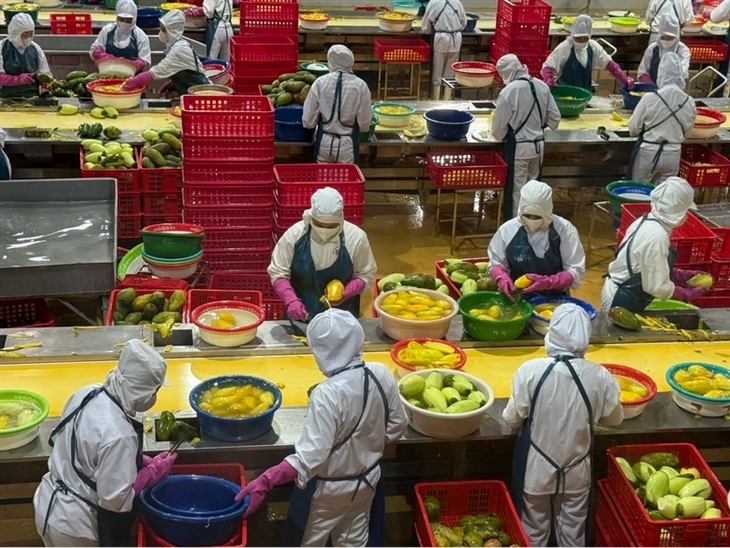
AsemconnectVietnam - Fruit and vegetable export continued to maintain impressive growth in the first 5 months of 2026 with a turnover of nearly 2.7 billion USD, an increase of 16% compared to the same period.
Exports flourish, many key products increase sharply
Fruit and vegetable industry continues to record positive signals in export activities. According to preliminary calculations by Vietnam Fruit and Vegetable Association based on data from Customs Department, fruit and vegetable export in May 2026 reached US$614.8 million, a 15% increase compared to the previous month and equivalent to the same period in 2025.
In the first five months of 2026, fruit and vegetable export reached US$2.67 billion, a 16% increase compared to the same period last year. Meanwhile, import reached nearly US$1.3 billion, a 31% increase, helping the industry maintain a trade surplus of over US$1.37 billion.
Vietnamese fruits and vegetables are mainly exported to Chinese market, accounting for 50% of total export value. The next two largest markets are the United States and South Korea, with market shares of 8.7% and 5.4% respectively. Durian is a "bright spot" in export activities, achieving high growth rates thanks to advantage of off-season durian and expansion of designated growing areas for official export to China. Besides that, traditional products such as dragon fruit, bananas, mangoes and coconuts maintain stable exports. In particular, coconuts have been identified as a strategic product for the future.
Notably, export structure is shifting positively towards high value-added products. Proportion of processed fruits and vegetables has increased to 35.82%, significantly higher than the 29.33% in the same period last year. This trend contributes to increasing export value and reducing dependence on seasonality of fresh fruit.
Especially, signing of Protocol on official export of pomelo and lemon between Vietnam and China in April 2026 opens up significant room for export growth in coming period. Besides Chinese market, successful export of Vietnam's first batch of fresh pomelos to Australia demonstrates increasing capacity of Vietnamese businesses to meet international standards.
Deep processing and technology are key to reaching the $10 billion mark.
Despite maintaining positive growth momentum, fruit and vegetable industry still faces numerous challenges regarding raw material sources, diseases and increasingly stringent requirements from importing markets. Reality in many banana-growing regions for export shows increasing pressure from diseases and soil degradation. Businesses must not only ensure production volume but also meet requirements for traceability, consistent quality and sustainable production.
According to expert, in context of increasingly fierce competition, advantage no longer lies in scale of cultivated area but in ability to manage growing region, control diseases and apply technology throughout entire production chain.
Many businesses have invested in automated irrigation systems, nutrient monitoring sensors, post-harvest preservation technologies and bio-farming solutions to improve product quality, reduce costs and meet green standards of international market.
In addition, deep processing is becoming a key growth driver for the industry. By 2025, exports of processed fruits and vegetables are expected to exceed $2 billion for the first time, an increase of over 42% compared to previous year. Products such as concentrated fruit juices, frozen fruits and dried fruits are increasingly accounting for a large proportion of the export structure.
Many businesses have boldly invested in large-scale processing plants right in the raw material areas. As a result, proportion of products processed has increased, contributing to higher added value and reducing consumption pressure during the peak harvest season.
In an interview with Industry and Trade Newspaper, Mr. Dang Phuc Nguyen, General Secretary of Vietnam Fruit and Vegetable Association, stated that the industry's development potential is still very large, with over 70% of exported fruits and vegetables currently still in fresh form. Expanding deep processing capacity will help the industry increase product value, diversify markets and reduce risks from trade fluctuations.
According to Import-Export Department (Ministry of Industry and Trade), from May onwards, many key fruits such as durian, lychee, mango and coconut enter their main harvest season. The abundant supply from raw material areas is expected to continue to strongly boost exports in the second and third quarters.
According to experts, to realize export target of 10 billion USD, fruit and vegetable industry needs to continue expanding area of certified raw materials, promote issuance of planting area codes, increase rate of deep processing, develop cold logistics and proactively meet the green and sustainable standards of the international market.
With current growth momentum, along with continuous expansion of official export markets and increase in proportion of processed products, fruit and vegetable industry has many opportunities to break through and move closer to the goal of becoming a 10 billion USD agricultural export industry in the coming years.
Source: Vitic/ congthuong.vn
Fruit and vegetable industry continues to record positive signals in export activities. According to preliminary calculations by Vietnam Fruit and Vegetable Association based on data from Customs Department, fruit and vegetable export in May 2026 reached US$614.8 million, a 15% increase compared to the previous month and equivalent to the same period in 2025.
In the first five months of 2026, fruit and vegetable export reached US$2.67 billion, a 16% increase compared to the same period last year. Meanwhile, import reached nearly US$1.3 billion, a 31% increase, helping the industry maintain a trade surplus of over US$1.37 billion.
Vietnamese fruits and vegetables are mainly exported to Chinese market, accounting for 50% of total export value. The next two largest markets are the United States and South Korea, with market shares of 8.7% and 5.4% respectively. Durian is a "bright spot" in export activities, achieving high growth rates thanks to advantage of off-season durian and expansion of designated growing areas for official export to China. Besides that, traditional products such as dragon fruit, bananas, mangoes and coconuts maintain stable exports. In particular, coconuts have been identified as a strategic product for the future.
Notably, export structure is shifting positively towards high value-added products. Proportion of processed fruits and vegetables has increased to 35.82%, significantly higher than the 29.33% in the same period last year. This trend contributes to increasing export value and reducing dependence on seasonality of fresh fruit.
Especially, signing of Protocol on official export of pomelo and lemon between Vietnam and China in April 2026 opens up significant room for export growth in coming period. Besides Chinese market, successful export of Vietnam's first batch of fresh pomelos to Australia demonstrates increasing capacity of Vietnamese businesses to meet international standards.
Deep processing and technology are key to reaching the $10 billion mark.
Despite maintaining positive growth momentum, fruit and vegetable industry still faces numerous challenges regarding raw material sources, diseases and increasingly stringent requirements from importing markets. Reality in many banana-growing regions for export shows increasing pressure from diseases and soil degradation. Businesses must not only ensure production volume but also meet requirements for traceability, consistent quality and sustainable production.
According to expert, in context of increasingly fierce competition, advantage no longer lies in scale of cultivated area but in ability to manage growing region, control diseases and apply technology throughout entire production chain.
Many businesses have invested in automated irrigation systems, nutrient monitoring sensors, post-harvest preservation technologies and bio-farming solutions to improve product quality, reduce costs and meet green standards of international market.
In addition, deep processing is becoming a key growth driver for the industry. By 2025, exports of processed fruits and vegetables are expected to exceed $2 billion for the first time, an increase of over 42% compared to previous year. Products such as concentrated fruit juices, frozen fruits and dried fruits are increasingly accounting for a large proportion of the export structure.
Many businesses have boldly invested in large-scale processing plants right in the raw material areas. As a result, proportion of products processed has increased, contributing to higher added value and reducing consumption pressure during the peak harvest season.
In an interview with Industry and Trade Newspaper, Mr. Dang Phuc Nguyen, General Secretary of Vietnam Fruit and Vegetable Association, stated that the industry's development potential is still very large, with over 70% of exported fruits and vegetables currently still in fresh form. Expanding deep processing capacity will help the industry increase product value, diversify markets and reduce risks from trade fluctuations.
According to Import-Export Department (Ministry of Industry and Trade), from May onwards, many key fruits such as durian, lychee, mango and coconut enter their main harvest season. The abundant supply from raw material areas is expected to continue to strongly boost exports in the second and third quarters.
According to experts, to realize export target of 10 billion USD, fruit and vegetable industry needs to continue expanding area of certified raw materials, promote issuance of planting area codes, increase rate of deep processing, develop cold logistics and proactively meet the green and sustainable standards of the international market.
With current growth momentum, along with continuous expansion of official export markets and increase in proportion of processed products, fruit and vegetable industry has many opportunities to break through and move closer to the goal of becoming a 10 billion USD agricultural export industry in the coming years.
Source: Vitic/ congthuong.vn
Vietnam's trade balance in May and first five months of 2026
Forecast for rice export price recovery amidst supply pressure
Vietnam commodities market on June 11: Gold plunged, coffee and rubber declined, pepper bucked the trend
Regulations on procedures for issuing and managing APEC Business Travel Cards issued
New phase of supporting industry development carried out
Vietnam steel imports edge down in Jan-Apr despite higher prices
Vietnam's petroleum market in May 2026
Vietnam - ASEAN 'join hands' to develop smart logistics
Ministry of Industry and Trade requires enterprises to ensure uninterrupted supply of biofuel gasoline nationwide
Vietnamese food products gain prominence at RoK's leading food fair
Reference exchange rate rises slightly on June 10
New impetus for Vietnam-ASEAN trade to break through
Vietnam commodity markets on June 10, 2026: Gold holds near record highs
Information on biofuel quality control provided


Public debt borrowing and repayment plan for 2026
Ensuring resources: Mobilizing sufficient and timely borrowed capital at reasonable costs and acceptable risks to meet expenditure needs ...Plan on implementation of high-tech law
Inter-sectoral legal support program for small and ...

Tourism destinations refresh offerings to welcome New ...
Across the Mekong Delta, many tourist sites have been busy upgrading their offerings. At the Con Son tourism site in Can Tho city, members ...Annual New Year festival shines in Da Nang
Phu Quoc emerging as a favourite global destination
Vietnam Airlines adds 270 flights to during 2026 New Year ...
