


Vietnam–Russia Economic Forum highlights internal strength in new context
Thursday, April 9,2026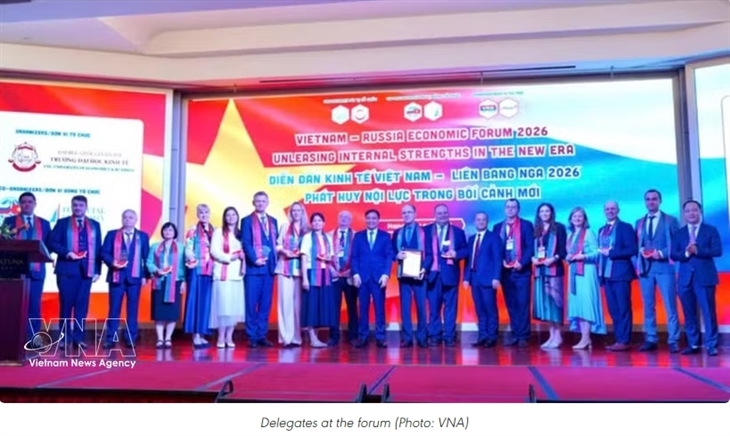
AsemconnectVietnam - The Vietnam–Russia Economic Forum 2026 (VREF 2026), themed “Unleashing internal strength in the new era,” took place in Hanoi on April 8 in a hybrid format, bringing together scholars, policymakers, experts and business representatives to discuss economic development and strengthen bilateral cooperation in the evolving global landscape.
The Vietnam–Russia Economic Forum 2026 (VREF 2026), themed “Unleashing internal strength in the new era,” took place in Hanoi on April 8 in a hybrid format.
The event was jointly organised by the University of Economics and Business under the Vietnam National University, Hanoi (VNU), the Financial University under the Government of the Russian Federation, and the Vietnam–Russia Friendship Association. It brought together scholars, policymakers, experts and business representatives to discuss economic development and strengthen bilateral cooperation in the evolving global landscape.
Addressing the forum, Assoc. Prof. and Dr. Dao Thanh Truong, Vice President of VNU, stressed that enhancing internal strength has become a strategic requirement for countries and organisations amid global uncertainties. In today’s context, internal strength extends beyond available resources to include innovation capacity, human resource quality, adaptability and participation in global cooperation networks.
He noted that universities play a central role in the knowledge ecosystem through education, research, technology transfer and policy consultation, while stronger collaboration between universities, businesses, state agencies and international partners is essential to maximise internal resources and expand development opportunities.
Experts at the forum highlighted that the world is witnessing disruptions and restructuring of global supply chains, fluctuations in energy, financial and food markets, and increasing geopolitical risks, alongside rapid advances in digital transformation, green transition and artificial intelligence. In this context, international cooperation needs to move beyond general commitments toward structured partnerships with concrete projects capable of generating measurable value.
Participants discussed several key areas of cooperation, including economic governance, finance and payments, science and technology, energy transition, logistics connectivity and human resource development. Proposals included promoting bilateral payments in national currencies (VND and RUB), strengthening research and innovation collaboration in fields such as artificial intelligence and digital technology, and expanding renewable energy cooperation.
Logistics connectivity and infrastructure development were also identified as critical factors for enhancing bilateral trade, with experts suggesting the development of multimodal transport corridors and greater digitalisation of trade procedures to reduce costs and transaction time.
The forum also emphasised the importance of high-quality human resources, particularly in STEM and digital skills, with recommendations to expand joint training programmes, mutual recognition of qualifications and academic exchanges between the two countries.
The discussions are expected to contribute to strengthening Vietnam–Russia cooperation and fostering sustainable economic partnerships in the coming period./.
Source: en.vietnamplus.vn/vietnamrussia-economic-forum-highlights-internal-strength-in-new-context-post340715.vnp
The event was jointly organised by the University of Economics and Business under the Vietnam National University, Hanoi (VNU), the Financial University under the Government of the Russian Federation, and the Vietnam–Russia Friendship Association. It brought together scholars, policymakers, experts and business representatives to discuss economic development and strengthen bilateral cooperation in the evolving global landscape.
Addressing the forum, Assoc. Prof. and Dr. Dao Thanh Truong, Vice President of VNU, stressed that enhancing internal strength has become a strategic requirement for countries and organisations amid global uncertainties. In today’s context, internal strength extends beyond available resources to include innovation capacity, human resource quality, adaptability and participation in global cooperation networks.
He noted that universities play a central role in the knowledge ecosystem through education, research, technology transfer and policy consultation, while stronger collaboration between universities, businesses, state agencies and international partners is essential to maximise internal resources and expand development opportunities.
Experts at the forum highlighted that the world is witnessing disruptions and restructuring of global supply chains, fluctuations in energy, financial and food markets, and increasing geopolitical risks, alongside rapid advances in digital transformation, green transition and artificial intelligence. In this context, international cooperation needs to move beyond general commitments toward structured partnerships with concrete projects capable of generating measurable value.
Participants discussed several key areas of cooperation, including economic governance, finance and payments, science and technology, energy transition, logistics connectivity and human resource development. Proposals included promoting bilateral payments in national currencies (VND and RUB), strengthening research and innovation collaboration in fields such as artificial intelligence and digital technology, and expanding renewable energy cooperation.
Logistics connectivity and infrastructure development were also identified as critical factors for enhancing bilateral trade, with experts suggesting the development of multimodal transport corridors and greater digitalisation of trade procedures to reduce costs and transaction time.
The forum also emphasised the importance of high-quality human resources, particularly in STEM and digital skills, with recommendations to expand joint training programmes, mutual recognition of qualifications and academic exchanges between the two countries.
The discussions are expected to contribute to strengthening Vietnam–Russia cooperation and fostering sustainable economic partnerships in the coming period./.
Source: en.vietnamplus.vn/vietnamrussia-economic-forum-highlights-internal-strength-in-new-context-post340715.vnp
Top RoK business leaders to visit Vietnam to explore investment opportunities
Vietnam, Laos step up investment cooperation to advance East–West Economic Corridor connectivity
Vietnam, India look to boost business connectivity through Vietnam Expo 2026
Can Tho looks to attract greater investment from RoK
Malaysia appreciates Vietnam’s competitive edge in investment attraction
Italian scholar praises Vietnam’s energy security strategy
Russia eyes expanded technological footprint in Asia through Vietnam’s nuclear project
Deputy PM’s visit to US sparks strong interest in Vietnam int’l financial centre
US firms eye expanding fintech investment in Vietnam
Vietnam pledges partnership to develop resilient, green supply chains: Party leader
ASEAN opens new export momentum for Vietnam
PM attends Vietnam – Russian Federation Business Forum in Moscow
Vietnamese mission in Geneva discusses new developments in US tariff policy
Vietnam, Russia expand room for, elevate trade cooperation
Public debt borrowing and repayment plan for 2026
Ensuring resources: Mobilizing sufficient and timely borrowed capital at reasonable costs and acceptable risks to meet expenditure needs ...Plan on implementation of high-tech law
Inter-sectoral legal support program for small and ...
Tourism destinations refresh offerings to welcome New ...
Across the Mekong Delta, many tourist sites have been busy upgrading their offerings. At the Con Son tourism site in Can Tho city, members ...Annual New Year festival shines in Da Nang
Phu Quoc emerging as a favourite global destination
Vietnam Airlines adds 270 flights to during 2026 New Year ...
