


Ho Chi Minh City targets high-quality FDI inflows
Tuesday, March 3,2026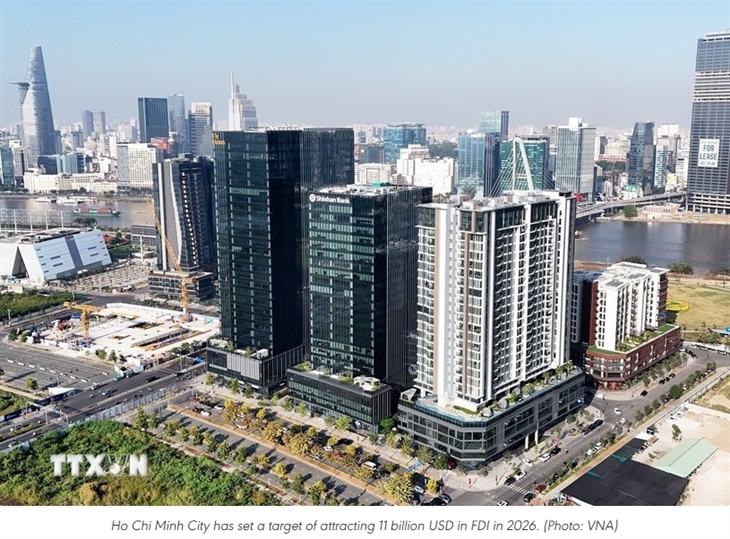
AsemconnectVietnam - The goal of 11 billion USD in FDI this year comes amid rising registered capital and the emergence of billion-USD projects that are injecting fresh momentum into the investment landscape.
Ho Chi Minh City has set a target of attracting 11 billion USD in foreign direct investment (FDI) in 2026, prioritising high technology, logistics, and financial – commercial centre projects.
The goal comes amid rising registered capital and the emergence of billion-USD projects that are injecting fresh momentum into the investment landscape.
Rising capital flows into data infrastructure
Hoang Vu Thanh, Acting Director of the municipal Department of Finance, said total FDI inflows in the first two months of 2026, including newly registered projects, capital adjustments, and capital contributions or share purchases, reached nearly 979.6 million USD, up 28.4% year-on-year.
The city granted investment registration certificates to 286 new projects, with total registered capital exceeding 242.8 million USD. Meanwhile, 59 existing projects raised their capital, recording a net increase of 480.6 million USD. In addition, 305 transactions involving foreign investors contributing capital, purchasing shares, or acquiring stakes in domestic enterprises were recorded, with total registered capital of approximately 256.2 million USD.
This structure indicates that capital inflows are driven not only by new projects but also by the expansion of existing operations, reflecting sustained investor confidence. Additional capital is particularly significant as it is typically associated with operationally effective projects that demonstrate long-term prospects.
A notable highlight is the sharp rise in investment in data infrastructure. In February 2026, UAE-based technology group G42, in partnership with a consortium of Vietnamese investors, signed a long-term framework agreement to develop a large-scale data centre system in Vietnam, with planned investment totalling up to 2 billion USD.
In addition, a US investor is advancing a similar data centre project with an estimated investment of around 2 billion USD.
Nguyen Van Duoc, Chairman of the municipal People’s Committee, noted that these investors have pledged to disburse approximately 60% of total capital, equivalent to 1.2 billion USD, by the second quarter of 2026.
The early and substantial disbursement commitment underscores investors’ readiness and determination to implement their projects, providing a concrete basis for the city to realise its full-year FDI target.
Ho Chi Minh City currently leads the country in cumulative valid FDI capital, with 142.9 billion USD across 20,756 active projects. This scale not only reflects the attractiveness of its investment environment but also affirms its role as a key economic and financial hub within regional production and service networks.
Selective investment attraction
This year, Ho Chi Minh City is targeting selective FDI attraction, focusing on high technology, digital transformation, logistics, and financial – commercial centres which are characterised by high added value, technological spillovers, and global supply chain connectivity. The Vietnam International Financial Centre in the city and the Cai Mep Ha Free Trade Zone are viewed as pivotal projects in this strategy.
At the same time, the southern metropolis is accelerating the expansion of its Hi-Tech Park, developing smart and eco-industrial parks and export processing zones, preparing clean land sources, and ensuring stable digital and energy infrastructure. These measures are designed to anticipate shifts in global production and supply chain restructuring amid evolving geopolitical and trade dynamics.
Institutional reform is central to achieving the 11 billion USD target. In 2026, the city plans to eliminate or simplify 100% of unnecessary, overlapping, or unclear investment and business conditions, and abolish all business conditions for sectors not subject to conditional investment under the Law on Investment.
Notably, it aims to reduce administrative procedure processing times and compliance costs by 50%. Procedures will be restructured based on digital data, eliminating the requirement for individuals and businesses to resubmit documents that have already been digitised, while avoiding the issuance of impractical new regulations or standards. Effective implementation of the Government’s Resolution 66/2025/NQ-CP on data-based administrative reform is considered a critical lever to improve investor experience.
The city also targets a 15% increase in newly licensed projects, construction permits given, and land-use right certificates granted compared to 2025. A dedicated task force will continue to review and remove obstacles for stalled projects and land areas, expediting progress on projects with hindrances cleared in 2025 and resolving outstanding issues.
A new feature of the 2026 investment promotion strategy is the planned establishment of specialised working groups to engage directly with major global technology corporations and strategic investors. This tailored approach will enable the city to proactively propose competitive and internationally benchmarked incentives to attract large-scale, high-tech projects./.
Source: en.vietnamplus.vn/ho-chi-minh-city-targets-high-quality-fdi-inflows-post338487.vnp
The goal comes amid rising registered capital and the emergence of billion-USD projects that are injecting fresh momentum into the investment landscape.
Rising capital flows into data infrastructure
Hoang Vu Thanh, Acting Director of the municipal Department of Finance, said total FDI inflows in the first two months of 2026, including newly registered projects, capital adjustments, and capital contributions or share purchases, reached nearly 979.6 million USD, up 28.4% year-on-year.
The city granted investment registration certificates to 286 new projects, with total registered capital exceeding 242.8 million USD. Meanwhile, 59 existing projects raised their capital, recording a net increase of 480.6 million USD. In addition, 305 transactions involving foreign investors contributing capital, purchasing shares, or acquiring stakes in domestic enterprises were recorded, with total registered capital of approximately 256.2 million USD.
This structure indicates that capital inflows are driven not only by new projects but also by the expansion of existing operations, reflecting sustained investor confidence. Additional capital is particularly significant as it is typically associated with operationally effective projects that demonstrate long-term prospects.
A notable highlight is the sharp rise in investment in data infrastructure. In February 2026, UAE-based technology group G42, in partnership with a consortium of Vietnamese investors, signed a long-term framework agreement to develop a large-scale data centre system in Vietnam, with planned investment totalling up to 2 billion USD.
In addition, a US investor is advancing a similar data centre project with an estimated investment of around 2 billion USD.
Nguyen Van Duoc, Chairman of the municipal People’s Committee, noted that these investors have pledged to disburse approximately 60% of total capital, equivalent to 1.2 billion USD, by the second quarter of 2026.
The early and substantial disbursement commitment underscores investors’ readiness and determination to implement their projects, providing a concrete basis for the city to realise its full-year FDI target.
Ho Chi Minh City currently leads the country in cumulative valid FDI capital, with 142.9 billion USD across 20,756 active projects. This scale not only reflects the attractiveness of its investment environment but also affirms its role as a key economic and financial hub within regional production and service networks.
Selective investment attraction
This year, Ho Chi Minh City is targeting selective FDI attraction, focusing on high technology, digital transformation, logistics, and financial – commercial centres which are characterised by high added value, technological spillovers, and global supply chain connectivity. The Vietnam International Financial Centre in the city and the Cai Mep Ha Free Trade Zone are viewed as pivotal projects in this strategy.
At the same time, the southern metropolis is accelerating the expansion of its Hi-Tech Park, developing smart and eco-industrial parks and export processing zones, preparing clean land sources, and ensuring stable digital and energy infrastructure. These measures are designed to anticipate shifts in global production and supply chain restructuring amid evolving geopolitical and trade dynamics.
Institutional reform is central to achieving the 11 billion USD target. In 2026, the city plans to eliminate or simplify 100% of unnecessary, overlapping, or unclear investment and business conditions, and abolish all business conditions for sectors not subject to conditional investment under the Law on Investment.
Notably, it aims to reduce administrative procedure processing times and compliance costs by 50%. Procedures will be restructured based on digital data, eliminating the requirement for individuals and businesses to resubmit documents that have already been digitised, while avoiding the issuance of impractical new regulations or standards. Effective implementation of the Government’s Resolution 66/2025/NQ-CP on data-based administrative reform is considered a critical lever to improve investor experience.
The city also targets a 15% increase in newly licensed projects, construction permits given, and land-use right certificates granted compared to 2025. A dedicated task force will continue to review and remove obstacles for stalled projects and land areas, expediting progress on projects with hindrances cleared in 2025 and resolving outstanding issues.
A new feature of the 2026 investment promotion strategy is the planned establishment of specialised working groups to engage directly with major global technology corporations and strategic investors. This tailored approach will enable the city to proactively propose competitive and internationally benchmarked incentives to attract large-scale, high-tech projects./.
Source: en.vietnamplus.vn/ho-chi-minh-city-targets-high-quality-fdi-inflows-post338487.vnp
Vietnamese firms strengthen foothold globally, better policies needed
Negotiations accelerated to conclude Vietnam – EFTA free trade deal
Ca Mau steps up efforts to help with removing IUU fishing yellow card
Da Nang seeks practical investment cooperation with Dubai partners
Vietnam among France’s five most promising export markets: Bpifrance
Agriculture sector on path to 74 billion USD in export revenue
Vietnamese airlines seal multi-billion-dollar deals in US to expand and modernise fleets
Vietnam, US step up dialogue to facilitate trade ties
Vietnam eyes deeper economic partnership with France in key future industries
Bac Ninh remains top destination for Korean investors in Vietnam
Hanoi aims to attract 4.5 billion USD in FDI in 2026
JICA hails milestones in Vietnam partnership amid green, digital push
Spring Fair 2026 expands Vietnam–Australia trade cooperation space
Vietnam looks to shape quality cocoa brand on global map
Plan of Hai Duong province for a period of 2021 - 2030, ...
Organize space reasonably and harmoniously, focusing on connecting Hai Duong in common development space, actively contributing to the ...Plan of Hau Giang province in a period of 2021 - 2030, ...
Sustainable forestry development program in a period of ...
Tourism destinations refresh offerings to welcome New ...
Across the Mekong Delta, many tourist sites have been busy upgrading their offerings. At the Con Son tourism site in Can Tho city, members ...Annual New Year festival shines in Da Nang
Phu Quoc emerging as a favourite global destination
Vietnam Airlines adds 270 flights to during 2026 New Year ...
