


2026: Vietnam expected to export 7.73 million tonnes of rice
Thursday, February 26,2026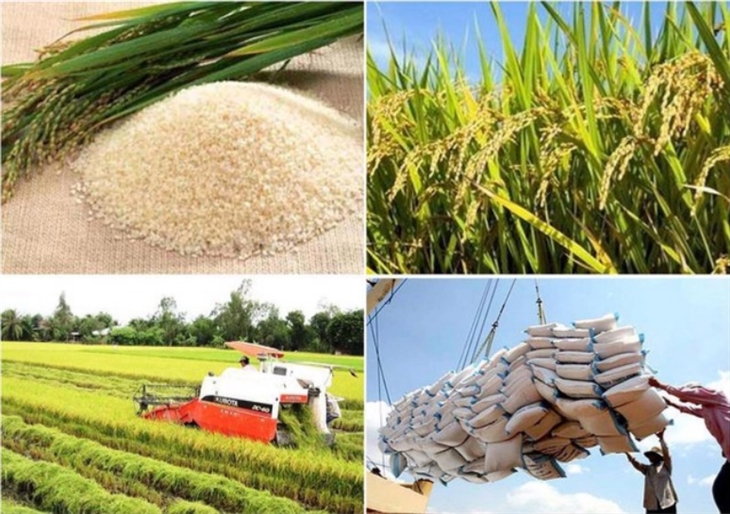
AsemconnectVietnam - Ministry of Agriculture and Environment forecasts that in 2026, Vietnam will produce more than 43.5 million tonnes of paddy rice, of which about 7.73 million tonnes will be for export.
Rice production in 2026 is expected to be stable, with a slight increase in output.
According to the plan, area of rice cultivation nationwide in 2026 is estimated to reach 7.09 million hectares, a decrease of about 36,100 hectares compared to the previous year. However, thanks to an increase in average yield to 61.4 quintals/hectare, total rice production for the year is still estimated at 43.552 million tonnes, an increase of about 12,000 tonnes compared to 2025.
Specifically, 2025-2026 winter-spring crop will achieve a production of about 20.335 million tonnes; 2026 summer-autumn crop will reach nearly 11 million tonnes; 2026 autumn-winter crop is expected to yield approximately 4.176 million tonnes; 2026 main crop is expected to yield approximately 8.117 million tonnes. While some crops show a trend of decreasing planted area, improved yields have contributed to maintaining stability of total production.
Mekong Delta continues to be a key rice-producing region, playing a decisive role in the supply of commercial rice for export.
Balanced supply and demand, rice exports are concentrated in the Mekong Delta.
Ministry of Agriculture and Environment reports that in 2026, rice-producing area in the Mekong Delta and part of Tay Ninh province is estimated at 3.84 million hectares, with a production of approximately 24.34 million tonnes of rice.
After deducting domestic consumption needs for approximately 28 million people in Mekong Delta and Ho Chi Minh City, along with rice used for seeds, animal feed, etc., total amount of rice consumed domestically is estimated at approximately 8.90 million tonnes. The remaining 15.46 million tonnes of paddy rice, equivalent to 7.73 million tonnes of milled rice for export, will continue to be heavily skewed towards high-quality and fragrant rice, with an estimated production of approximately 5.798 million tonnes, accounting for 75%. Glutinous rice will account for about 773,000 tonnes (10%), and the remainder will be rice for processing, accounting for about 15%.
Regarding export progress, the first six months of 2026 are expected to see exports of approximately 4.014 million tonnes of rice, mainly concentrated in January, March, and April. The last six months are estimated to reach approximately 3.716 million tonnes, peaking in July, August and September, coinciding with the major harvest season.
Boosting export while ensuring food security
To effectively manage rice exports, Ministry of Agriculture and Environment proposes focusing on boosting exports during months with high harvest yields, ensuring maintenance of minimum circulating reserves as required.
The Ministry also emphasizes a need for strict inventory reporting, gradually developing digital tools for monitoring and early warning of rice supply and demand risks, serving flexible export management while ensuring domestic food security. When necessary, businesses must be ready to supply domestic market according to stabilization directives.
In addition, solutions such as strengthening trade promotion, diversifying markets and product segments, promoting digital transformation in management, and developing scenarios for managing rice import and export operations are also being considered.
Ministry of Agriculture and Environment proposed that Ministry of Industry and Trade coordinate with localities to standardize rice procurement activities, strengthen supply chain linkage between traders, processing facilities and export businesses through clear and transparent contracts.
Businesses need to publicly announce procurement points, list prices according to type, quality and season; strengthen inspections and strictly handle fraudulent acts, price manipulation, and speculation, ensuring a balance of interests between farmers and businesses.
Ministry of Agriculture and Environment also provided input on amending Decree 107/2018/ND-CP on rice export business and building a mechanism for managing rice imports, protecting domestic production and rice value chain in context of increasing international competition.
According to data from the Customs Department (Ministry of Finance), Vietnam's rice exports in 2025 are projected to reach 8.06 million tonnes, valued at US$4.1 billion, a decrease of 10.8% in volume and 27.6% in value compared to 2024. This is also the lowest export volume and value in the past three years, although still significantly higher than the period before 2022. However, with this result, Vietnam still surpasses Thailand, rising to second place globally in rice exports, after India.
Source: Vitic/ congthuong.vn
According to the plan, area of rice cultivation nationwide in 2026 is estimated to reach 7.09 million hectares, a decrease of about 36,100 hectares compared to the previous year. However, thanks to an increase in average yield to 61.4 quintals/hectare, total rice production for the year is still estimated at 43.552 million tonnes, an increase of about 12,000 tonnes compared to 2025.
Specifically, 2025-2026 winter-spring crop will achieve a production of about 20.335 million tonnes; 2026 summer-autumn crop will reach nearly 11 million tonnes; 2026 autumn-winter crop is expected to yield approximately 4.176 million tonnes; 2026 main crop is expected to yield approximately 8.117 million tonnes. While some crops show a trend of decreasing planted area, improved yields have contributed to maintaining stability of total production.
Mekong Delta continues to be a key rice-producing region, playing a decisive role in the supply of commercial rice for export.
Balanced supply and demand, rice exports are concentrated in the Mekong Delta.
Ministry of Agriculture and Environment reports that in 2026, rice-producing area in the Mekong Delta and part of Tay Ninh province is estimated at 3.84 million hectares, with a production of approximately 24.34 million tonnes of rice.
After deducting domestic consumption needs for approximately 28 million people in Mekong Delta and Ho Chi Minh City, along with rice used for seeds, animal feed, etc., total amount of rice consumed domestically is estimated at approximately 8.90 million tonnes. The remaining 15.46 million tonnes of paddy rice, equivalent to 7.73 million tonnes of milled rice for export, will continue to be heavily skewed towards high-quality and fragrant rice, with an estimated production of approximately 5.798 million tonnes, accounting for 75%. Glutinous rice will account for about 773,000 tonnes (10%), and the remainder will be rice for processing, accounting for about 15%.
Regarding export progress, the first six months of 2026 are expected to see exports of approximately 4.014 million tonnes of rice, mainly concentrated in January, March, and April. The last six months are estimated to reach approximately 3.716 million tonnes, peaking in July, August and September, coinciding with the major harvest season.
Boosting export while ensuring food security
To effectively manage rice exports, Ministry of Agriculture and Environment proposes focusing on boosting exports during months with high harvest yields, ensuring maintenance of minimum circulating reserves as required.
The Ministry also emphasizes a need for strict inventory reporting, gradually developing digital tools for monitoring and early warning of rice supply and demand risks, serving flexible export management while ensuring domestic food security. When necessary, businesses must be ready to supply domestic market according to stabilization directives.
In addition, solutions such as strengthening trade promotion, diversifying markets and product segments, promoting digital transformation in management, and developing scenarios for managing rice import and export operations are also being considered.
Ministry of Agriculture and Environment proposed that Ministry of Industry and Trade coordinate with localities to standardize rice procurement activities, strengthen supply chain linkage between traders, processing facilities and export businesses through clear and transparent contracts.
Businesses need to publicly announce procurement points, list prices according to type, quality and season; strengthen inspections and strictly handle fraudulent acts, price manipulation, and speculation, ensuring a balance of interests between farmers and businesses.
Ministry of Agriculture and Environment also provided input on amending Decree 107/2018/ND-CP on rice export business and building a mechanism for managing rice imports, protecting domestic production and rice value chain in context of increasing international competition.
According to data from the Customs Department (Ministry of Finance), Vietnam's rice exports in 2025 are projected to reach 8.06 million tonnes, valued at US$4.1 billion, a decrease of 10.8% in volume and 27.6% in value compared to 2024. This is also the lowest export volume and value in the past three years, although still significantly higher than the period before 2022. However, with this result, Vietnam still surpasses Thailand, rising to second place globally in rice exports, after India.
Source: Vitic/ congthuong.vn
Exports to South Korea reached over US$2.6 billion in January of 2026
Main items exported to UK in January of 2026
Corn import markets in January of 2026
Pangasius exports in 2025 and prospects for 2026
Positive signs for Vietnam’s coffee exports in 2026
Vietnam seafood market – February 2026
Vietnam's shrimp exports reached US$4.6 billion in 2025
Soybean imports increased sharply in January of 2026
Wheat imports increased by nearly 127% in January of 2026
Vietnam Steel Market Report – February 2026
Fertilizer exports showed strong growth in January of 2026
Vietnam Rice Market Report – February 2026
Exports to the Netherlands grew in January of 2026
Exports to Indonesia showed growth in January of 2026

Plan of Hai Duong province for a period of 2021 - 2030, ...
Organize space reasonably and harmoniously, focusing on connecting Hai Duong in common development space, actively contributing to the ...Plan of Hau Giang province in a period of 2021 - 2030, ...
Sustainable forestry development program in a period of ...

Tourism destinations refresh offerings to welcome New ...
Across the Mekong Delta, many tourist sites have been busy upgrading their offerings. At the Con Son tourism site in Can Tho city, members ...Annual New Year festival shines in Da Nang
Phu Quoc emerging as a favourite global destination
Vietnam Airlines adds 270 flights to during 2026 New Year ...
